
Water parameters
Overview
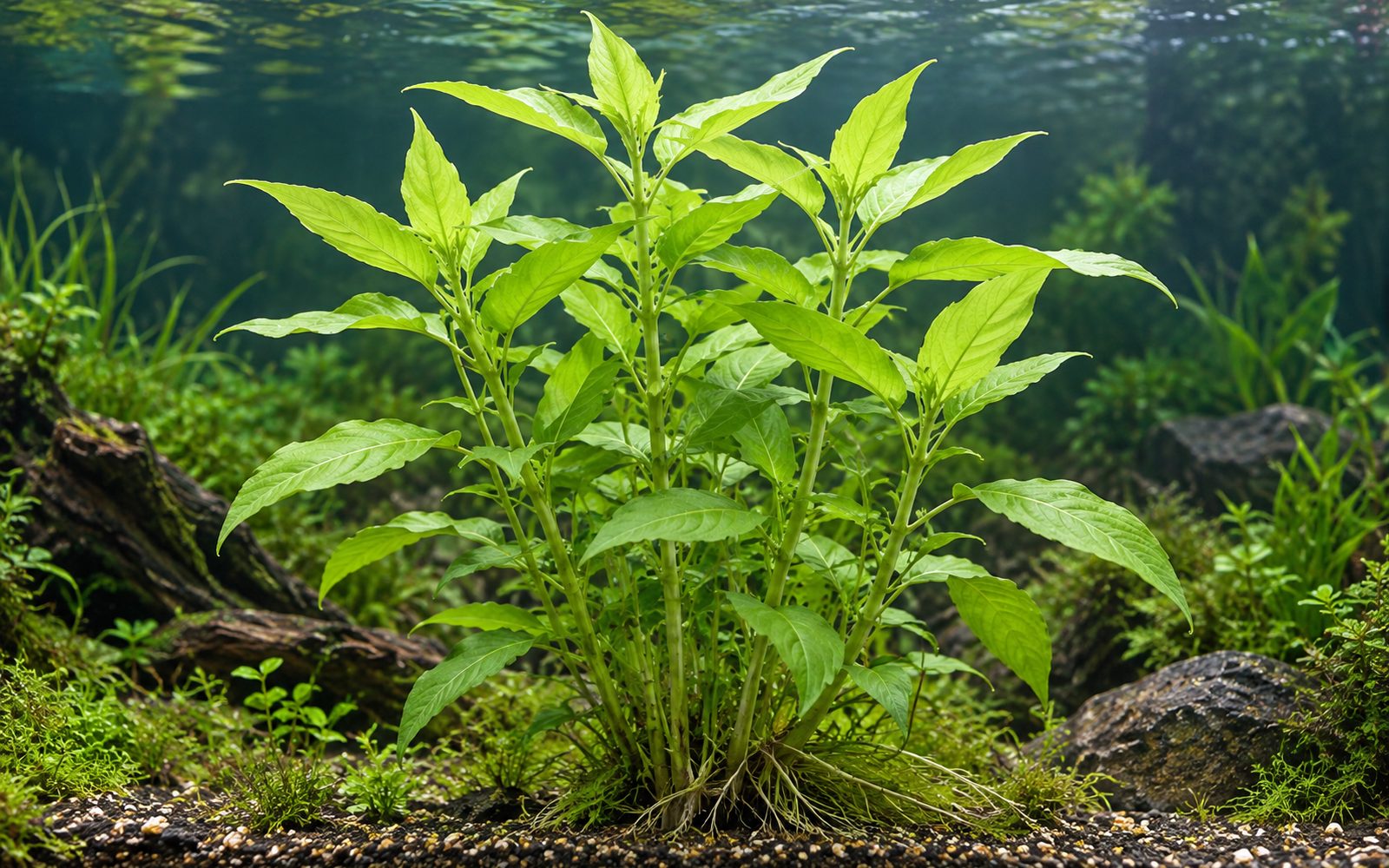
Gymnocoronis spilanthoides is a marsh plant of the daisy family native to South America. Large, light green, lance-shaped leaves are arranged in opposite pairs on its thick, hollow stems. It is one of the fastest-growing plants in the aquarium: under the right conditions it grows several centimeters a week and competes strongly with algae by quickly using up excess nutrients in the water. When it reaches the water surface, it can grow above the water and produce white, ball-shaped flowers. Because of its size, it is suitable for aquariums of at least 100 liters.
Do not release it into the wild: It is banned as an invasive in countries such as Australia and New Zealand. Trimmings must not be dumped into natural waters; they should go in the trash.
Planting and Placement
- Stems are planted one by one with 5 cm between them, 4–5 cm deep.
- It is placed in the background or in a corner, in an area that is easy to trim.
Care and Fertilization
- Light: Medium.
- CO₂: Not required.
- Fertilizer: Its nutrient demand is high; regular liquid fertilizer and root tabs are recommended.
- Trimming: May be needed weekly; stems that reach the surface are cut and replanted, and the surplus is removed.
Propagation
Common Problems
Hobbyist notes
Things you won't find in books, learned by trial and error. The most helpful ones are on top.
Change history and contributors
- Page created · October 16, 2026