
Water parameters
Overview
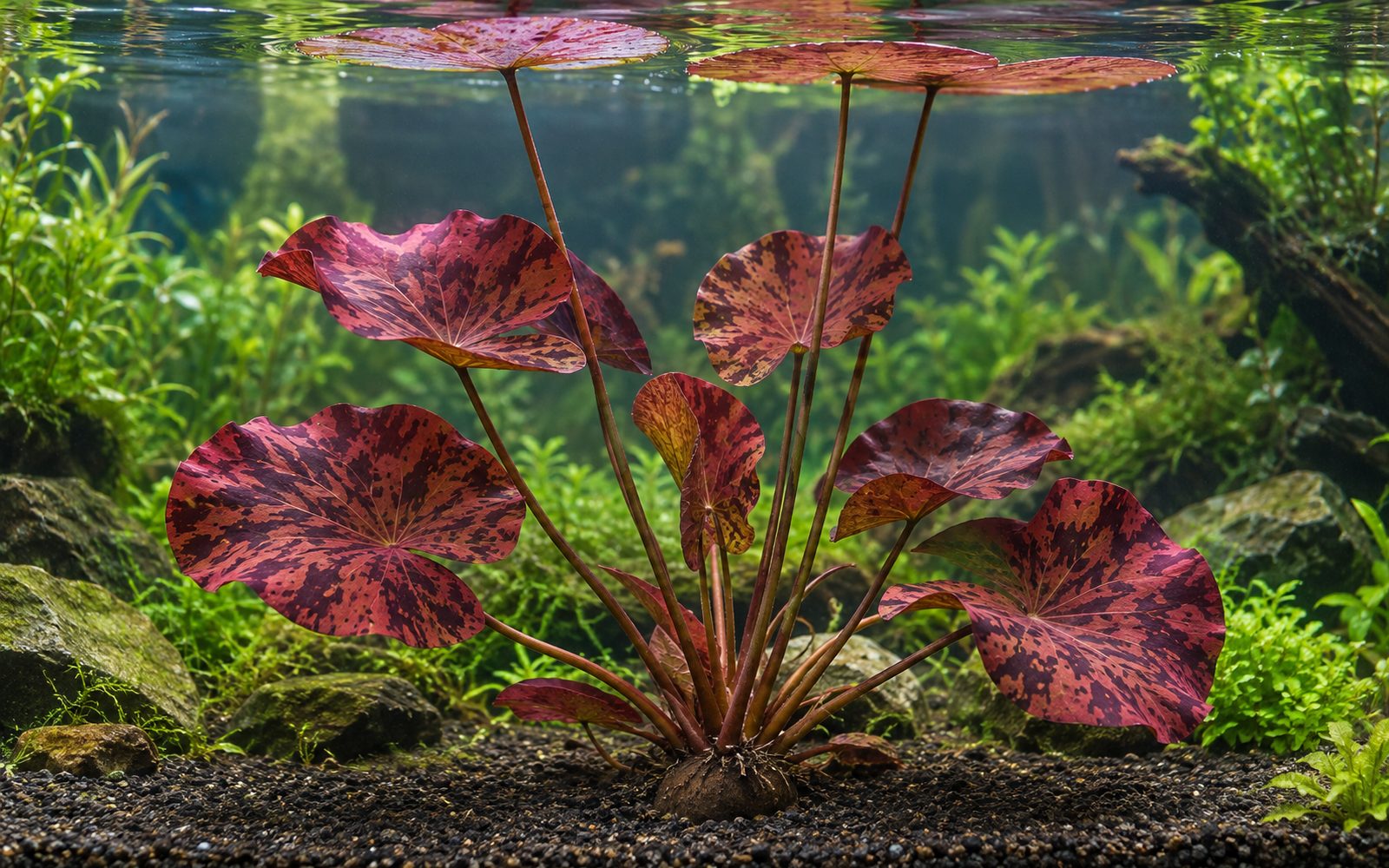
The tiger lotus is a water lily from the tropical waters of Africa that grows from a bulb. Its submersed leaves are broad, nearly round and arrow-shaped with a deep notch at the base; the surface has dark blotches. Two color forms are common in the trade: the red form, with burgundy blotches on a deep red background, and the green form, with reddish-brown blotches on a green background.
In the aquarium a single plant reaches 30–50 cm in width and height. A mature plant eventually produces floating lily pads on long stalks; if allowed, it also produces white flowers that open at night.
Planting and Placement
- Bury the bulb lightly so that its upper half stays above the substrate; a fully buried bulb can rot.
- Bulbs sold dry sometimes sprout only after a few weeks; during this time you can also keep the bulb on top of the substrate.
- Plant it on its own in the midground, leaving 20–30 cm of space around it.
Care and Fertilization
- Light: Medium. The red form takes on a deeper color with sufficient light and iron.
- CO₂: Not required; with it, leaves appear more often.
- Fertilizer: A root tab once a month; a liquid fertilizer containing iron is beneficial.
- Floating leaves: Cut long-stalked leaves stretching toward the surface off at the base early. This way the plant puts its energy into the submersed leaves and stays low. Floating leaves also block light from the plants below.
Propagation
It forms plantlets at the ends of runners growing from the bulb. When the plantlets have opened a few leaves and rooted, they can be cut off and planted elsewhere. Plants that flower at the surface can also set seed, but in the aquarium propagating from plantlets is easier.
Common Problems
- Constantly producing floating leaves: cut floating leaves regularly; keep the photoperiod at 8 hours a day.
- Color fading: lack of light or iron.
- Rotting bulb: planted too deep; bring the bulb closer to the surface, and remove it if it has gone soft.
Hobbyist notes
Things you won't find in books, learned by trial and error. The most helpful ones are on top.
Change history and contributors
- Page created · October 16, 2026