
Water parameters
Overview
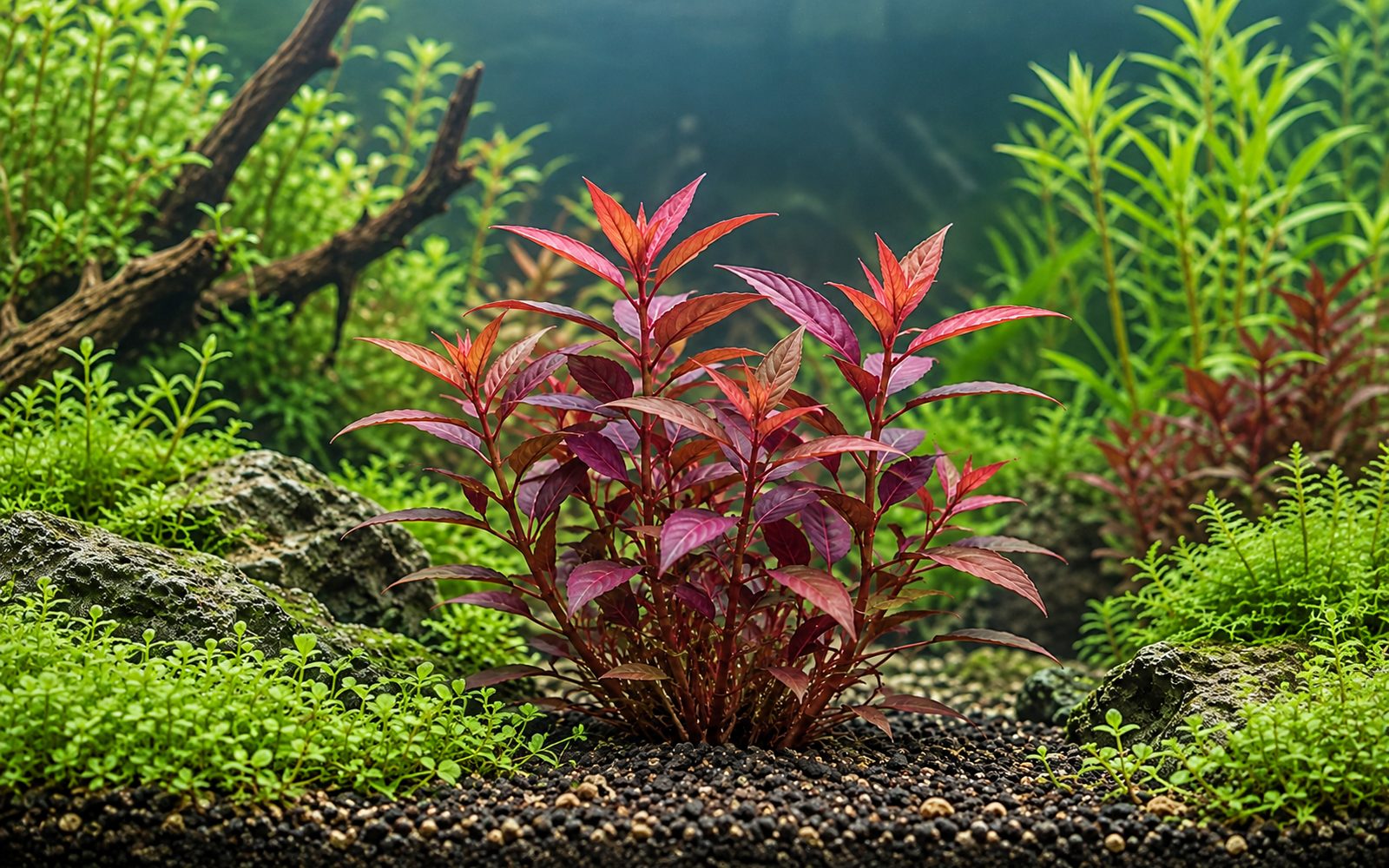
Alternanthera reineckii is one of the plants most often chosen to add a strong red accent to a mostly green aquarium. Its lance-shaped leaves are arranged in opposite pairs; the upper side of the leaf is pink, copper or brownish, and the underside is deep purple-red. With strong light and good nutrition, the whole plant turns bright pinkish red.
There are many forms in the trade: 'Rosaefolia' and 'Pink' are medium-sized with pink tones, 'Lilacina' is larger with purple leaf undersides, and 'Mini' is a form that stays very short and suits the foreground to midground. It can also live in an aquarium without CO₂, but it grows slowly and its colors stay pale.
Planting and Placement
- Stems are planted in groups of 3–5, leaving 3 cm between groups.
- The lower leaf pairs are removed and the stem is buried about 3 cm deep.
- It looks most striking when used in the midground as a "focal point" surrounded by green-leaved plants.
- A nutrient-rich substrate or root tabs noticeably support growth.
Care and Fertilization
- Light: High; it survives in medium light, but its color turns brownish.
- CO₂: Not required, but beneficial; recommended for color and dense growth.
- Fertilizer: Iron and potassium should be dosed regularly; this plant is sensitive to deficiencies.
- Trimming: Cut from the top; side shoots grow from the cut point and the clump becomes bushier.
Propagation
It is propagated by top cuttings. The cut tops are replanted; the lower stem also produces several side shoots. Shoots growing from nodes near the substrate can be separated and planted elsewhere.
Common Problems
- Small holes in the leaves, browning edges: Usually potassium deficiency.
- Curling, stunted new leaves: Nutrient imbalance or unstable CO₂.
- Pale or greenish color: Light is insufficient or iron is lacking.
- Lower leaves dropping: Shading; trim the tall plants around it.
Hobbyist notes
Things you won't find in books, learned by trial and error. The most helpful ones are on top.
Change history and contributors
- Page created · October 16, 2026