
Water parameters
Temperature22–28°C
pH6–7.5
General hardness (GH)2–12 dGH
Recommended range
Overview
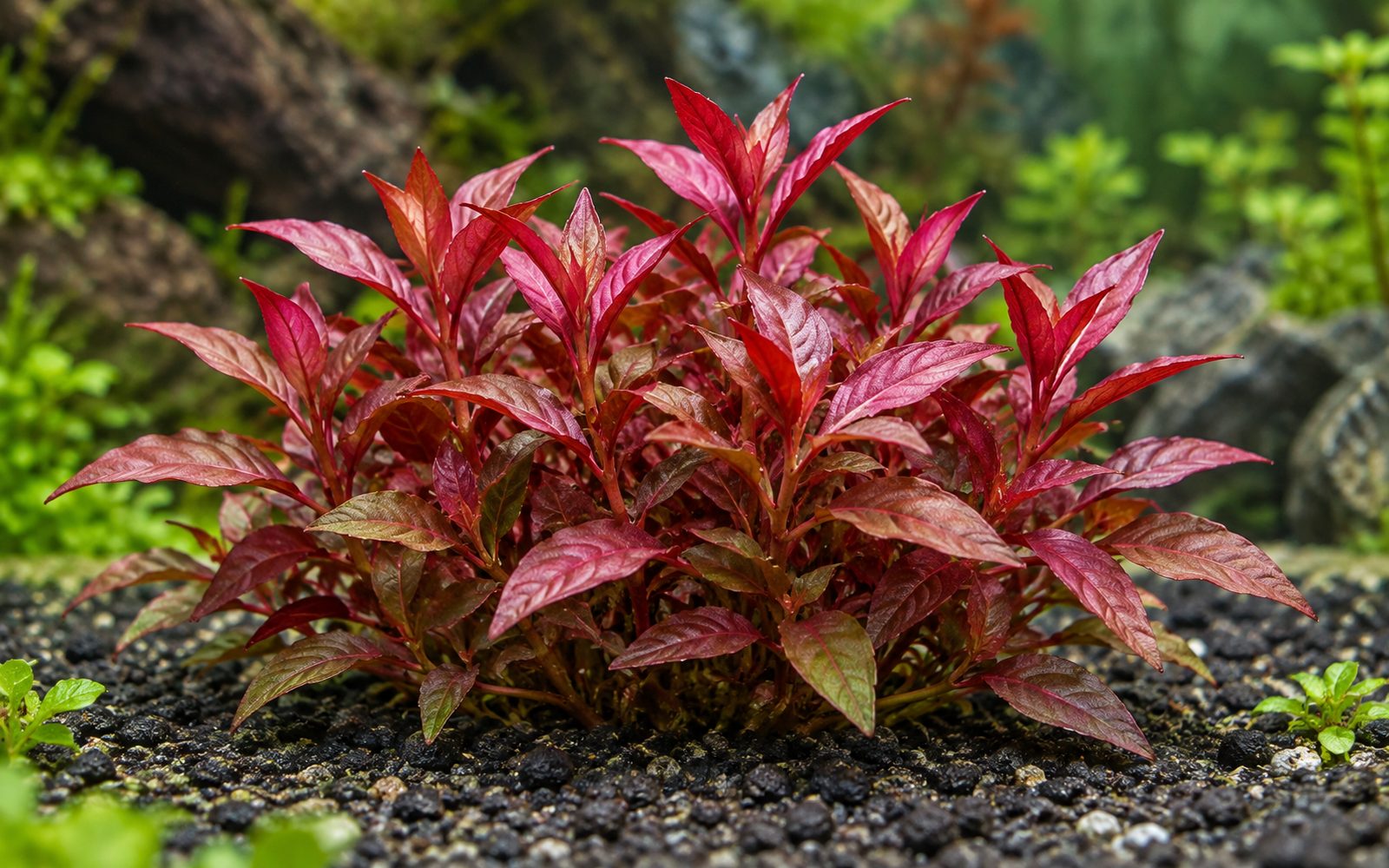
Alternanthera reineckii 'Mini' is a short-growing form of the well-known red alternanthera. Its internodes are very short and its leaves small; the plant stays 10–15 cm tall and branches densely into a low, red bush. This makes it one of the easiest ways to bring red color into the foreground and midground of the aquarium. In strong light the tops of the leaves are pinkish red and the undersides deep red; in weak light the color turns brownish.
Planting and Placement
- Stems are planted singly or in twos or threes, 2–3 cm apart and 2–3 cm deep.
- It is used in the foreground and midground as a color focal point, at the base of stones or among green carpeting plants.
Care and Fertilization
- Light: High.
- CO₂: Not required, but beneficial for color and dense growth.
- Fertilizer: Iron and potassium should be dosed regularly; when lacking, holes and fading appear in the leaves.
- Trimming: It grows slowly; its bushy shape is kept by clipping it with scissors now and then.
Propagation
This section has not been written yet. How is it propagated?
Be the first to write it
Common Problems
This section has not been written yet. Problems such as melting, yellowing and algae, and how to fix them.
Be the first to write it
Hobbyist notes
Things you won't find in books, learned by trial and error. The most helpful ones are on top.
No notes yet. If you have experience with this species, leave the first note.
Was this page helpful?
Change history and contributors
- Page created · October 16, 2026