
Water parameters
Overview
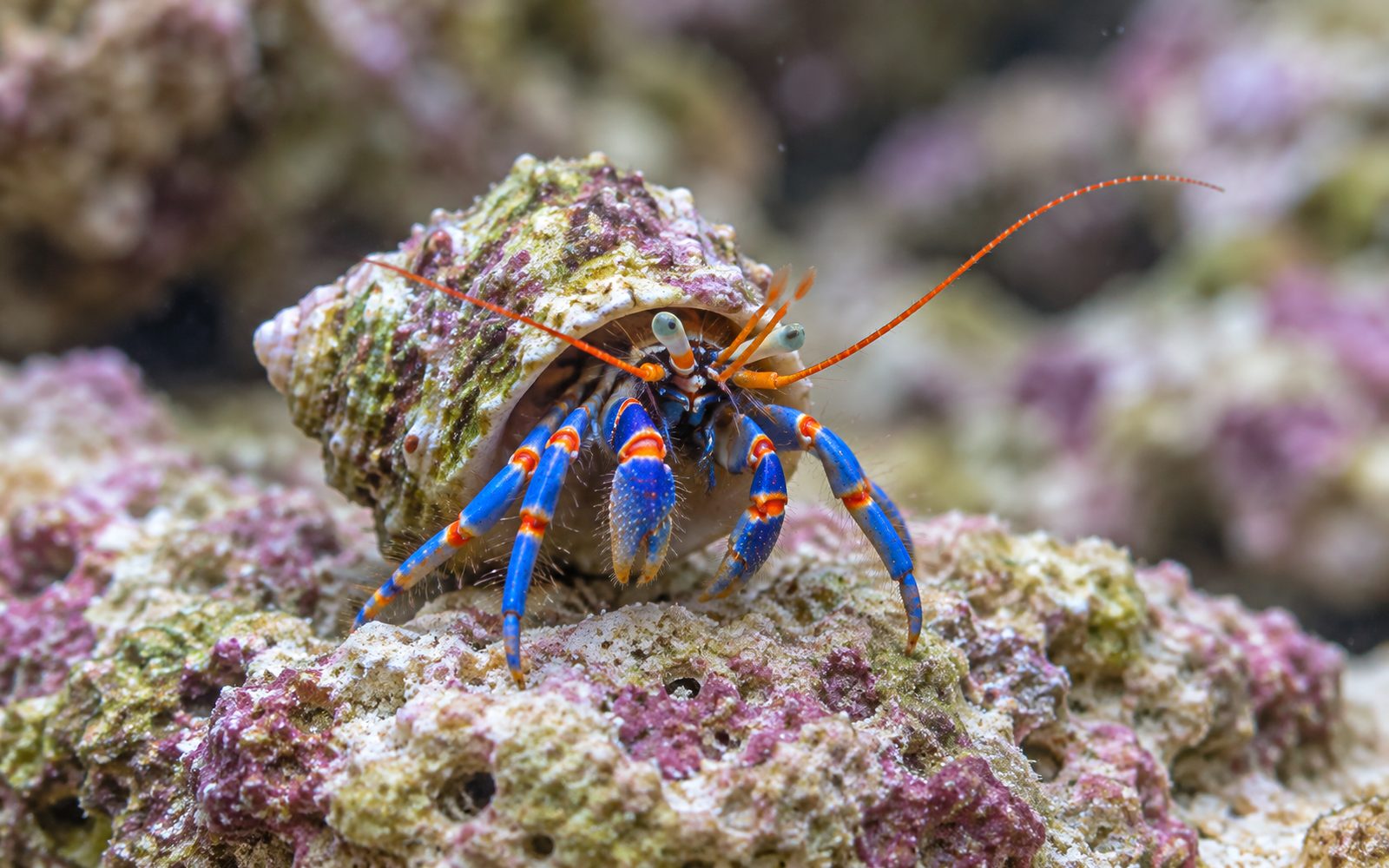
The blue legged hermit crab is one of the most common members of the marine aquarium "cleanup crew." It is recognized by its bright blue legs and the orange-red rings at the joints. It lives in empty snail shells to protect its soft abdomen; as it grows, it moves into a larger shell.
It is inexpensive, hardy and active; it picks up the algal film on rock surfaces, leftover food and detritus. The downside is that when it cannot find a suitable empty shell it may attack live snails and take their shells. Specimens in the trade are wild-collected.
Natural Habitat
It lives in large groups in the Caribbean, Florida and the Bahamas, on shallow rocky areas, in seagrass beds and among coral rubble, from the intertidal zone down to a few meters deep. Because these shallow environments vary in temperature and salinity, it is quite hardy.
Tank Setup
- Volume: 40 liters or more; as a cleanup crew, 1 crab per 20–40 liters is enough.
- Water: salinity 1.023–1.026 specific gravity, pH 8.1–8.4, temperature 24–27°C. Calcium and alkalinity should be kept stable for molting.
- Reef compatibility: Reef-safe with caution. It usually leaves corals alone, but it can knock over small coral frags and may attack snails.
- Spare shells: keep 2–3 empty shells with slightly larger openings for each crab.
- Acclimation and medication: Acclimate by the drip method for at least 1 hour. Copper-based medications are lethal.
Diet
An omnivorous scavenger. It eats the algal film on rock surfaces, short hair algae, leftover food and detritus. In a large cleanup crew, algae and leftovers may not be enough; giving sinking granules or algae wafers 2–3 times a week makes the crabs less likely to turn on snails.
Behavior and Compatibility
Active all day; it roams over the rocks and the glass. They may push and shove each other over shells. It leaves fish alone, but a crab wanting to change shells may kill a snail and move into its shell.
Good companions: clownfish, gobies, blennies, cleaner and peppermint shrimp; emerald crab.
Avoid: valuable or few snails (if there are no spare shells), triggerfish, pufferfish, large wrasses.
Group and Colony Structure
It has no social needs; the number is determined by the amount of algae and leftover food in the aquarium. The general rule is one crab per 20–40 liters. Too many crabs attack both snails and each other when food runs low. When setting up a cleanup crew, snails should outnumber crabs.
Breeding
The female carries her eggs attached to her abdomen inside the shell. The larvae develop in the plankton and do not survive in home aquariums; for this reason it does not reproduce in the aquarium.
Health and Common Problems
- Shell swapping: the crab may be seen outside its shell; it is very vulnerable during this time. Spare shells of a suitable size reduce stress.
- Molting: a molt may be found left at the mouth of the shell; it is not a sign of death.
- Sudden deaths: copper, rapid acclimation, sudden salinity changes.
Sexing
Practically impossible to tell apart externally. In individuals out of their shells, a cluster of eggs may be visible on the female's abdomen.
Tank mates
This list is calculated automatically from the species profile and grows as new species are added to the catalog. Try it in the planner for a definite answer.
Hobbyist notes
Things you won't find in books, learned by trial and error. The most helpful ones are on top.
Change history and contributors
- Page created · October 16, 2026