
Water parameters
Overview
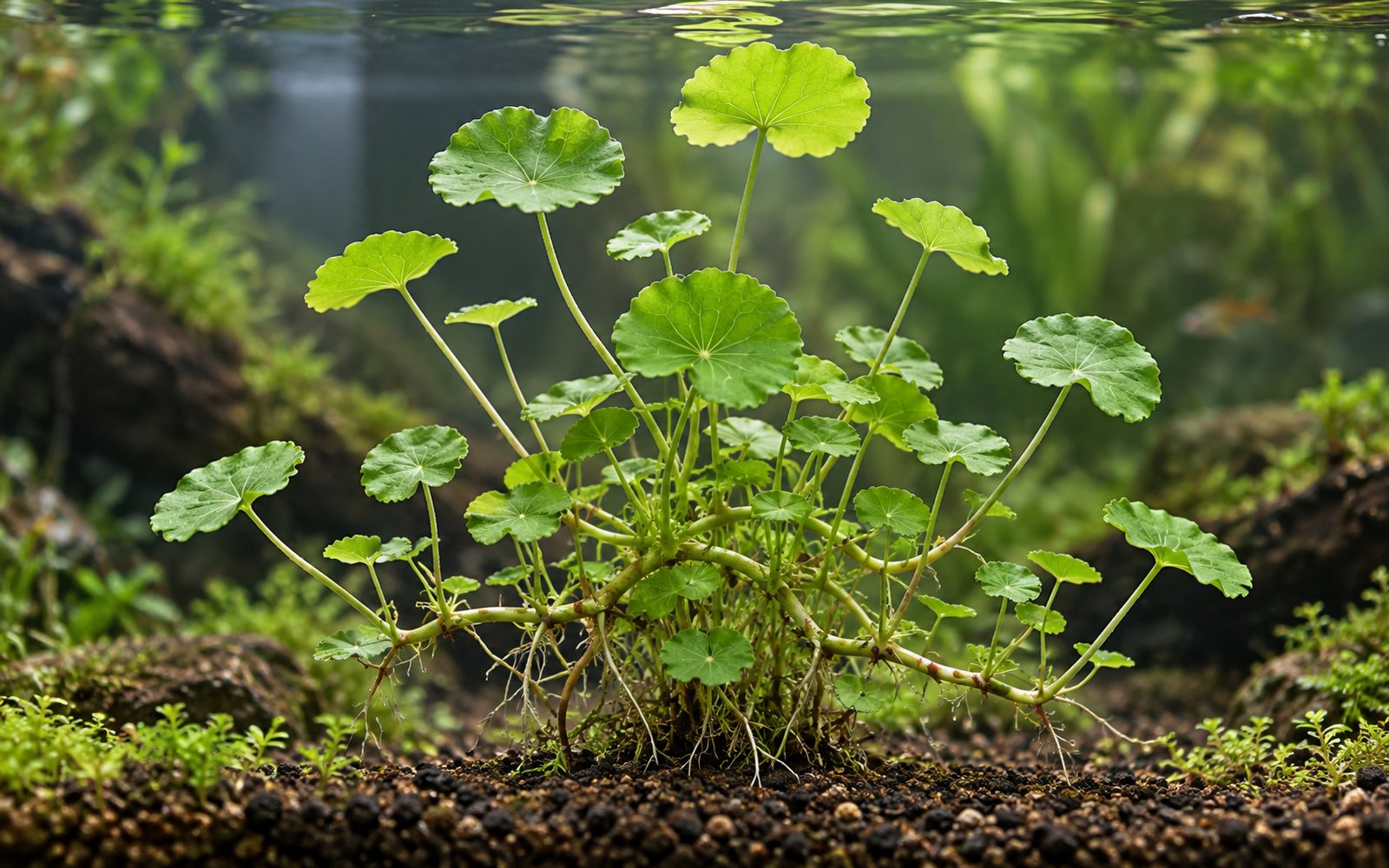
Hydrocotyle leucocephala is one of the easiest and most versatile plants in the aquarium. Its light green, round to kidney-shaped leaves with wavy edges are attached by long petioles to a thin stem that zigzags. A leaf and roots grow from every node.
It can be used in many ways: it can be planted in the background and allowed to grow toward the surface, tied to wood or stone, or even left floating freely at the surface without being planted at all. When it floats at the surface it diffuses the light and provides shade for surface-loving fish such as bettas and gouramis. It grows fast in an aquarium without CO₂ and uses up excess nutrients in the water.
Planting and Placement
- The stems are buried 3–4 cm deep; the roots that grow from the nodes anchor in the substrate.
- It can be tied to wood or stone with fishing line; over time its roots attach to the decor.
- If it is to float, the stem is simply dropped into the water; within a few days its leaves turn toward the light.
- It is used in the background or in a corner as a curtain reaching up to the surface.
Care and Fertilization
- Light: Medium; it survives in low light, but the internodes become longer.
- CO₂: Not required.
- Fertilizer: Occasional liquid fertilizer is enough; it takes most of its nutrients from the water.
- Trimming: Shoots that reach the surface and spread horizontally are cut; otherwise they cover the surface completely and shade the plants below.
Propagation
It is very easily propagated by dividing the stem into pieces; because every node has a leaf and roots, any piece with a few nodes becomes a new plant.
Common Problems
- Covering the surface: It grows fast; if not thinned out regularly, it blocks the light.
- Yellowing leaves: Lack of nutrients or insufficient light.
- Long, sparse internodes: Weak light; position it closer to the light.
- Nibbled leaves: Some plant-eating fish and snails may eat its soft leaves.
Hobbyist notes
Things you won't find in books, learned by trial and error. The most helpful ones are on top.
Change history and contributors
- Page created · October 16, 2026