
Water parameters
Temperature20–28°C
pH6–7.5
General hardness (GH)2–12 dGH
Recommended range
Overview
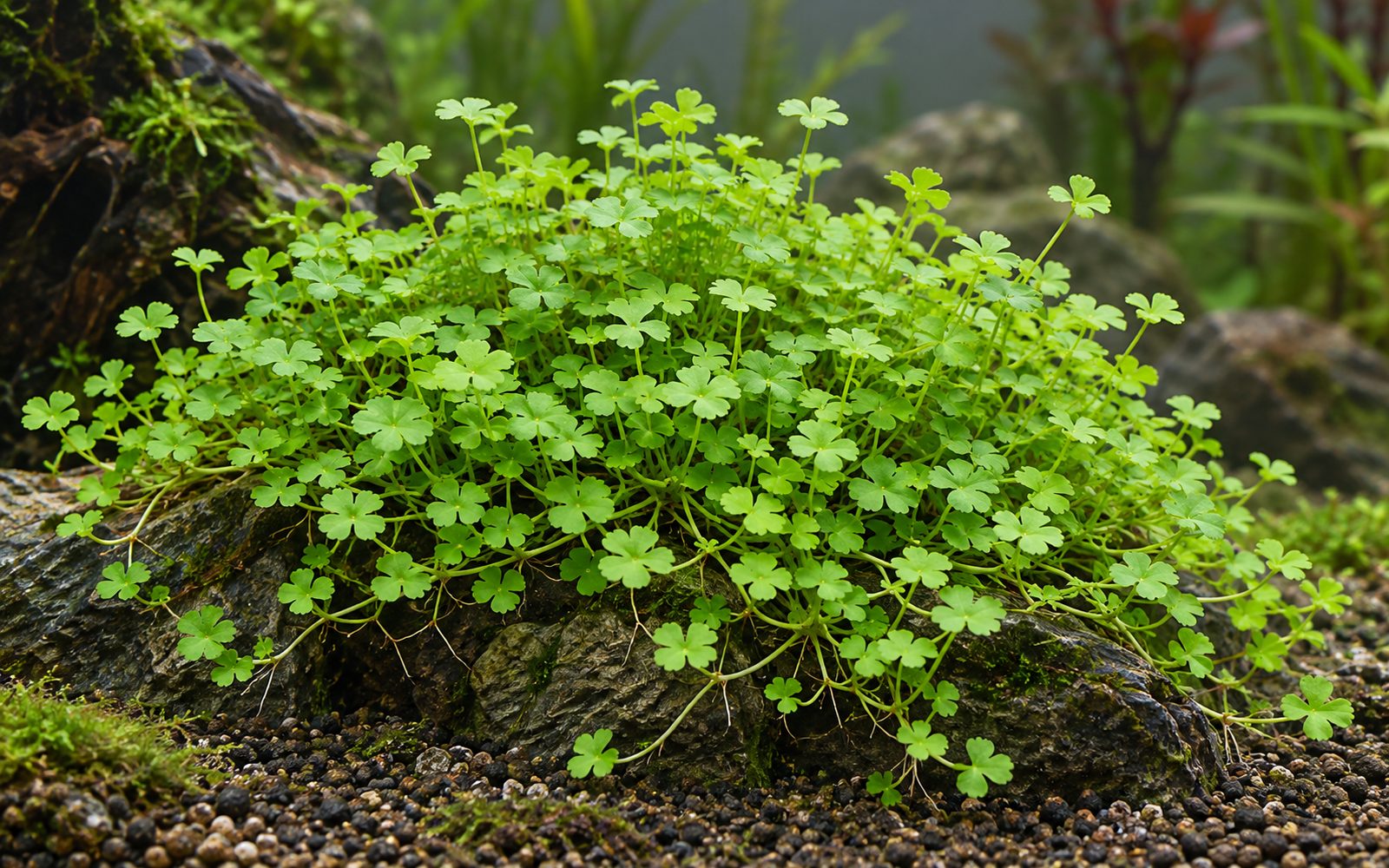
Hydrocotyle tripartita resembles miniature clover with its small, light green leaves deeply divided into three lobes. Its creeping stems spread quickly in every direction and form a soft, wavy cushion on the substrate, stones or driftwood. In the hobby it was long sold as Hydrocotyle sp. 'Japan'; its species identity is still considered disputed. It is an easy plant: it grows under medium light in an aquarium without CO₂, and with CO₂ and strong light it stays lower and denser.
Planting and Placement
- Divide the stems into pieces with a few nodes and plant them just below the substrate, 3–4 cm apart.
- It can also be grown wedged between stones and driftwood; the shoots gradually spread over the decor.
Care and Fertilization
- Light: Medium; under strong light it stays lower and denser.
- CO₂: Not required, but beneficial.
- Fertilizer: Regular liquid fertilizer; when nutrients are low the leaves yellow.
- Trimming: Because it grows fast, it is trimmed regularly; shoots spreading over neighboring plants are cut.
Propagation
This section has not been written yet. How is it propagated?
Be the first to write it
Common Problems
This section has not been written yet. Problems such as melting, yellowing and algae, and how to fix them.
Be the first to write it
Hobbyist notes
Things you won't find in books, learned by trial and error. The most helpful ones are on top.
No notes yet. If you have experience with this species, leave the first note.
Was this page helpful?
Change history and contributors
- Page created · October 16, 2026