
Water parameters
Temperature15–25°C
pH6–8
General hardness (GH)4–18 dGH
Recommended range
Overview
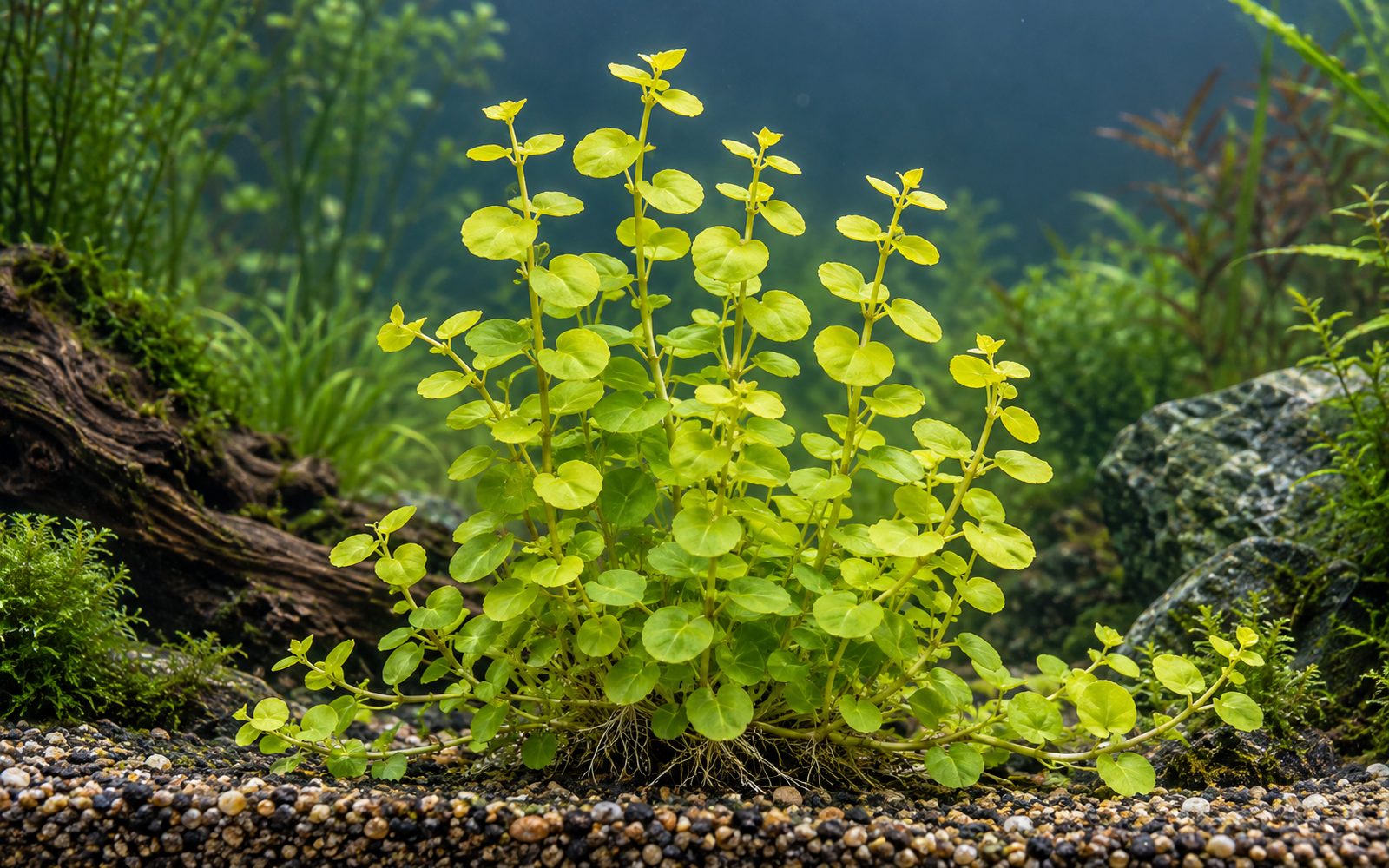
Lysimachia nummularia is a marsh plant that grows in the damp meadows and along the water margins of Europe and Western Asia. Its round, coin-like leaves are arranged in opposite pairs; this is where its English name "moneywort" comes from. In the aquarium, the 'Aurea' form, with golden-yellow to light green leaves, is used most. Because it is by nature a waterside plant, it grows slowly underwater, but it lasts a long time in cool water. At tropical temperatures it weakens over time; for this reason it is best suited to unheated aquariums and the edges of garden ponds.
Planting and Placement
- Stems are planted one by one with 3 cm between them, 3 cm deep.
- It is used in the midground as a light-colored accent in front of dark green plants.
Care and Fertilization
- Light: Medium; the golden color becomes distinct in strong light.
- CO₂: Not required.
- Temperature: Should be kept below 25 °C.
- Fertilizer: Occasional liquid fertilizer and root tabs are enough.
- Trimming: Because it grows slowly, it is rarely needed; tops cut from the top can be replanted.
Propagation
This section has not been written yet. How is it propagated?
Be the first to write it
Common Problems
This section has not been written yet. Problems such as melting, yellowing and algae, and how to fix them.
Be the first to write it
Hobbyist notes
Things you won't find in books, learned by trial and error. The most helpful ones are on top.
No notes yet. If you have experience with this species, leave the first note.
Was this page helpful?
Change history and contributors
- Page created · October 16, 2026