
Water parameters
Overview
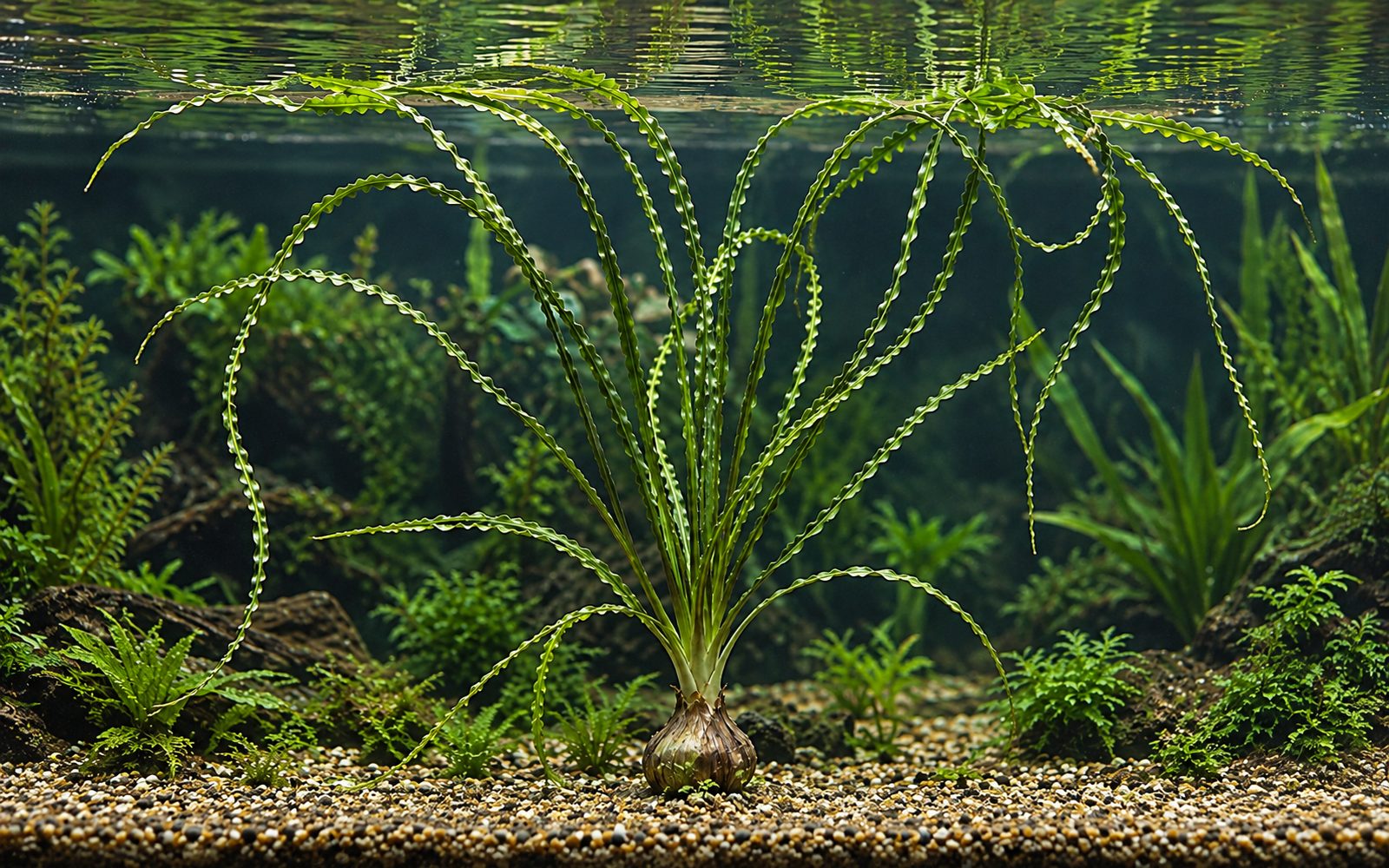
Crinum calamistratum is an aquatic plant endemic to the rivers of Cameroon that grows from a bulb. Its leaves are very narrow (3–7 mm), dark green and densely crinkled along the edges, giving a "curly" look. In the aquarium they can grow between 50 cm and 1.5 m long; leaves that reach the surface lie on the water and sway with the current.
Thanks to their tough, thick structure, many plant-eating fish do not nibble these leaves; that makes it one of the few tall plants that can also be used in cichlid tanks. It grows very slowly, but once established it lives for years.
Planting and Placement
- Bury the bulb halfway so that its top and neck stay above the substrate; a fully buried bulb can rot.
- Its roots go deep; it needs at least 6 cm of substrate and root tabs.
- In tall aquariums, plant it in the background or in areas with flow near the filter outlet.
- In aquariums with fish that dig in the sand, protect the area around the bulb with stones.
Care and Fertilization
- Light: Medium.
- CO₂: Not required, but speeds up growth.
- Fertilizer: A root tab every 2 months.
- Patience: It may produce only a few new leaves a year. Do not disturb the bulb and its roots often.
- Trimming: If necessary, cut very long leaves off at the base; leaves cut at the tip turn brown.
Propagation
Over time, offset bulbs form next to the mother bulb. When these have produced a few leaves and roots, they can be carefully separated without damaging the mother bulb and planted elsewhere. Propagation is very slow.
Common Problems
- Bulb rot: planting too deep or a damaged bulb; remove a soft, foul-smelling bulb.
- No new leaves: nutrient-poor substrate or insufficient light; add root tabs.
- Algae on the leaf tips: cut old leaves lying at the surface off at the base.
Hobbyist notes
Things you won't find in books, learned by trial and error. The most helpful ones are on top.
Change history and contributors
- Page created · October 16, 2026