
Water parameters
Temperature18–26°C
pH5.5–7
General hardness (GH)2–10 dGH
Recommended range
Overview
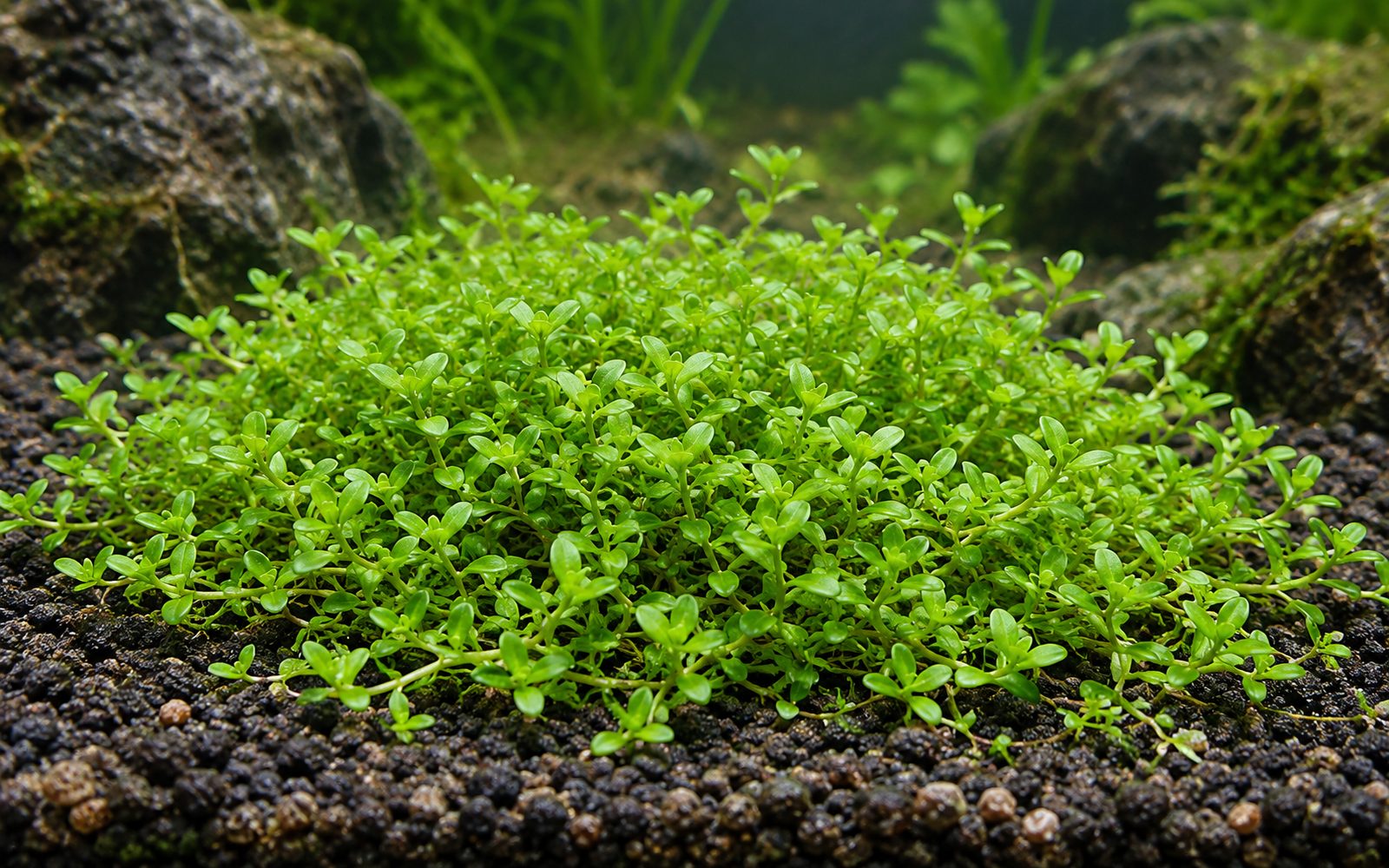
Elatine hydropiper is a small wetland plant whose range extends from Europe to Siberia and northern China. In the aquarium it forms tiny, spoon-shaped leaves arranged in opposite pairs on thin, creeping stems and weaves a light green carpet 2–3 cm high. It resembles Glossostigma but grows more slowly, so it is easier to control. Because of its small roots, it can be hard for it to take hold in the substrate after planting.
Planting and Placement
- Wash the gel off the plant from the tissue-culture cup, divide it into very small pieces and plant them deep in a fine-grained substrate with tweezers, 1–2 cm apart.
- Pieces floating up to the surface are common; a dry start (rooting the plants by keeping the aquarium only moist for a few weeks) reduces this problem.
Care and Fertilization
- Light: High; in weak light the stems grow upright and the carpet thins out.
- CO₂: Required for a low, dense carpet. Thinning, shrinking leaves usually indicate a lack of CO₂.
- Fertilizer: Regular liquid fertilizer and a nutrient-rich substrate.
- When the carpet gets thick, cut it back with scissors; the cut pieces can be replanted.
Propagation
This section has not been written yet. How is it propagated?
Be the first to write it
Common Problems
This section has not been written yet. Problems such as melting, yellowing and algae, and how to fix them.
Be the first to write it
Hobbyist notes
Things you won't find in books, learned by trial and error. The most helpful ones are on top.
No notes yet. If you have experience with this species, leave the first note.
Was this page helpful?
Change history and contributors
- Page created · October 16, 2026