
Water parameters
Overview
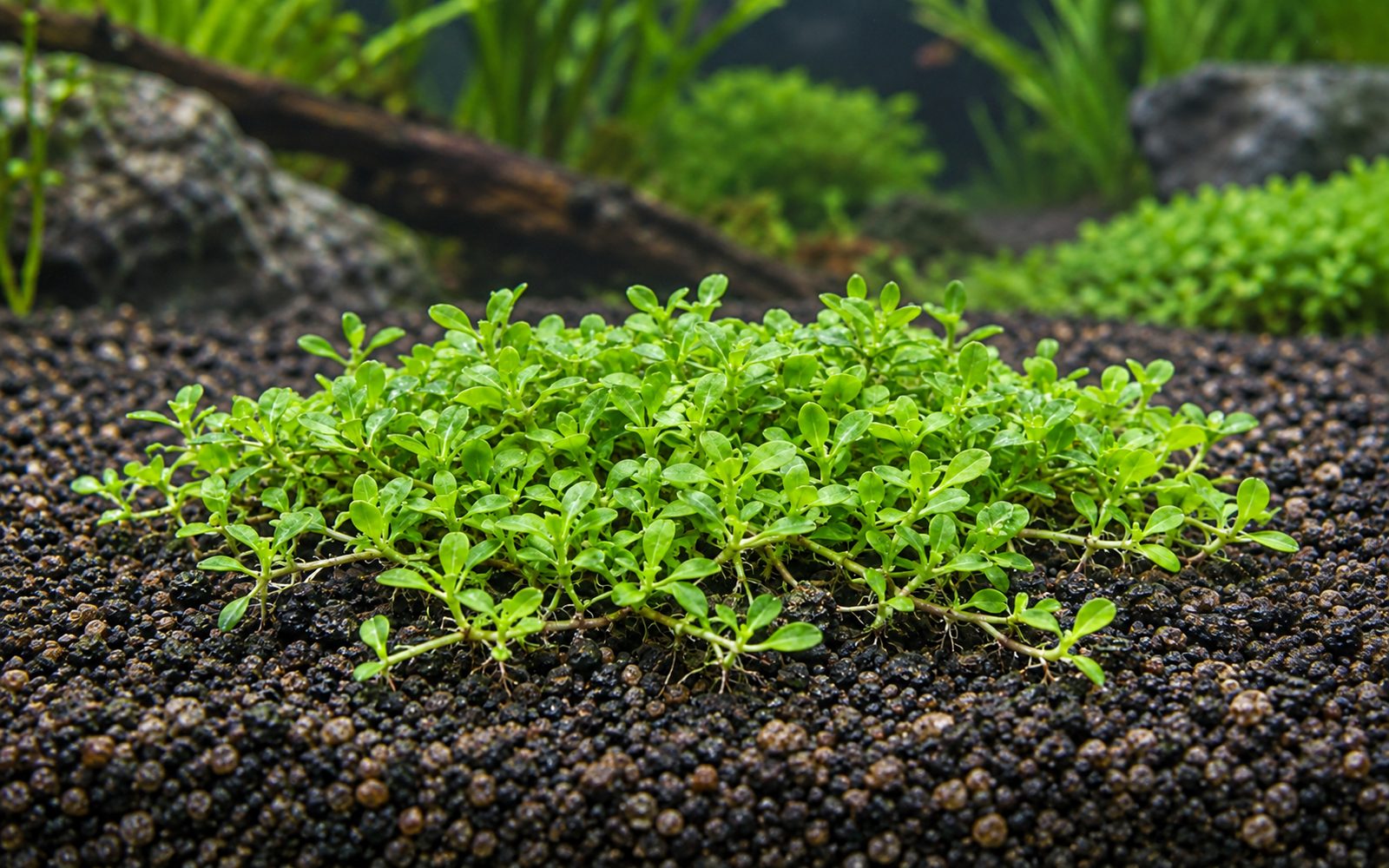
Glossostigma is one of the lowest carpeting plants in the aquarium. Its spoon-shaped, light green leaves, up to 1 cm long, are arranged in pairs on creeping runners that hug the substrate tightly. Under the right conditions it spreads very quickly and within a few weeks forms a dense carpet 2–3 cm high that covers the substrate.
This speed is only possible with strong light and regular CO₂. When light is insufficient, the plant grows upward instead of spreading across the substrate, the leaf pairs become sparse and the carpet falls apart. For this reason it is not suitable for aquariums without a CO₂ system.
Planting and Placement
- Divide the plant from the nursery pot into small pieces with 1–2 leaf pairs.
- Push the pieces into a fine-grained substrate with tweezers, 1–2 cm apart.
- Plant it in the front of the aquarium where it gets the most light; there should be no tall plants shading the area in front of it.
- The dry start method also works well with this plant.
Care and Fertilization
- Light: High; essential for keeping the carpet low.
- CO₂: Required.
- Temperature: It can weaken above 26 °C; keeping it on the cooler side is good.
- Fertilizer: A nutrient-rich substrate and regular liquid fertilizer; its fast growth increases nutrient consumption.
- Trimming: When the carpet gets thick, trim it from the top or thin it out by pulling up some sections.
Propagation
It spreads on its own by creeping runners; roots and new leaf pairs grow from each node. Pieces taken from the carpet are planted elsewhere to propagate it.
Common Problems
- Growing upward: light is insufficient or it is being shaded from above.
- Spreading over neighboring plants: it grows fast; the edges of the carpet should be cut back regularly.
- Yellowing: a drop in CO₂ or a nutrient deficiency.
- Carpet lifting: a thickening carpet can detach from the substrate; thin it out regularly.
Hobbyist notes
Things you won't find in books, learned by trial and error. The most helpful ones are on top.
Change history and contributors
- Page created · October 16, 2026