
Water parameters
Overview
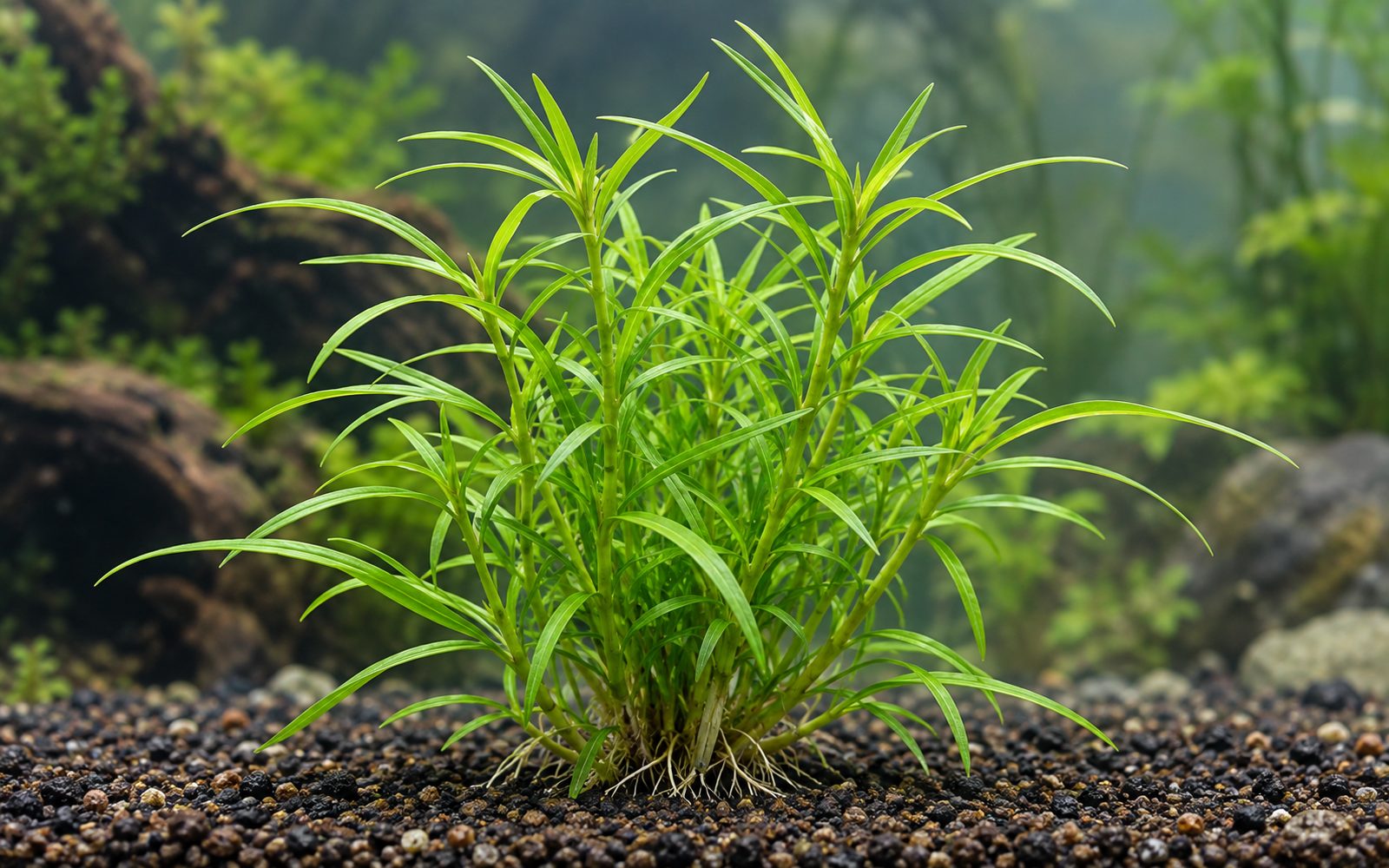
Heteranthera zosterifolia adds a light, lively green to the aquarium with its thin, grass-like bright green leaves, 3–5 cm long, arranged alternately along the stem. Because its leaves open like a star when seen from above, it is called "stargrass" in English.
Its growth form changes with light: in medium light it grows upright and becomes a full cluster in the midground to background. In strong light, however, the stems can spread horizontally close to the substrate and form a low, dense cover. It grows fast; it lives in an aquarium without CO₂, but becomes much denser and brighter with CO₂.
Planting and Placement
- Stems are planted in groups of 3–5, with 3–4 cm between groups.
- The lower leaves are removed and the stem is buried about 3 cm deep.
- In the midground it creates a strong color contrast next to red plants; it can also be used as a tall cluster in the background.
Care and Fertilization
- Light: Medium; in strong light it grows lower and more spreading.
- CO₂: Not required, but beneficial.
- Fertilizer: Regular liquid fertilizer; because it grows fast, its nutrient demand is medium to high.
- Trimming: Trimmed often. It becomes bushier when cut from the top; stems spreading horizontally are cut back and tidied when they overstep their bounds.
Propagation
It is easily propagated from top cuttings. Horizontally spreading stems root from their nodes; these can be separated to get new plants.
Common Problems
- Sparse stems with long internodes: Light is insufficient.
- Pale new leaves: Iron deficiency.
- Bare lower stems: When the cluster becomes too dense, the lower leaves get no light; thin out the cluster.
- Spreading across the surface: Stems that reach the surface shade the plants below; cut them regularly.
Hobbyist notes
Things you won't find in books, learned by trial and error. The most helpful ones are on top.
Change history and contributors
- Page created · October 16, 2026