
Water parameters
Temperature10–28°C
pH6–8
General hardness (GH)5–20 dGH
Recommended range
Overview
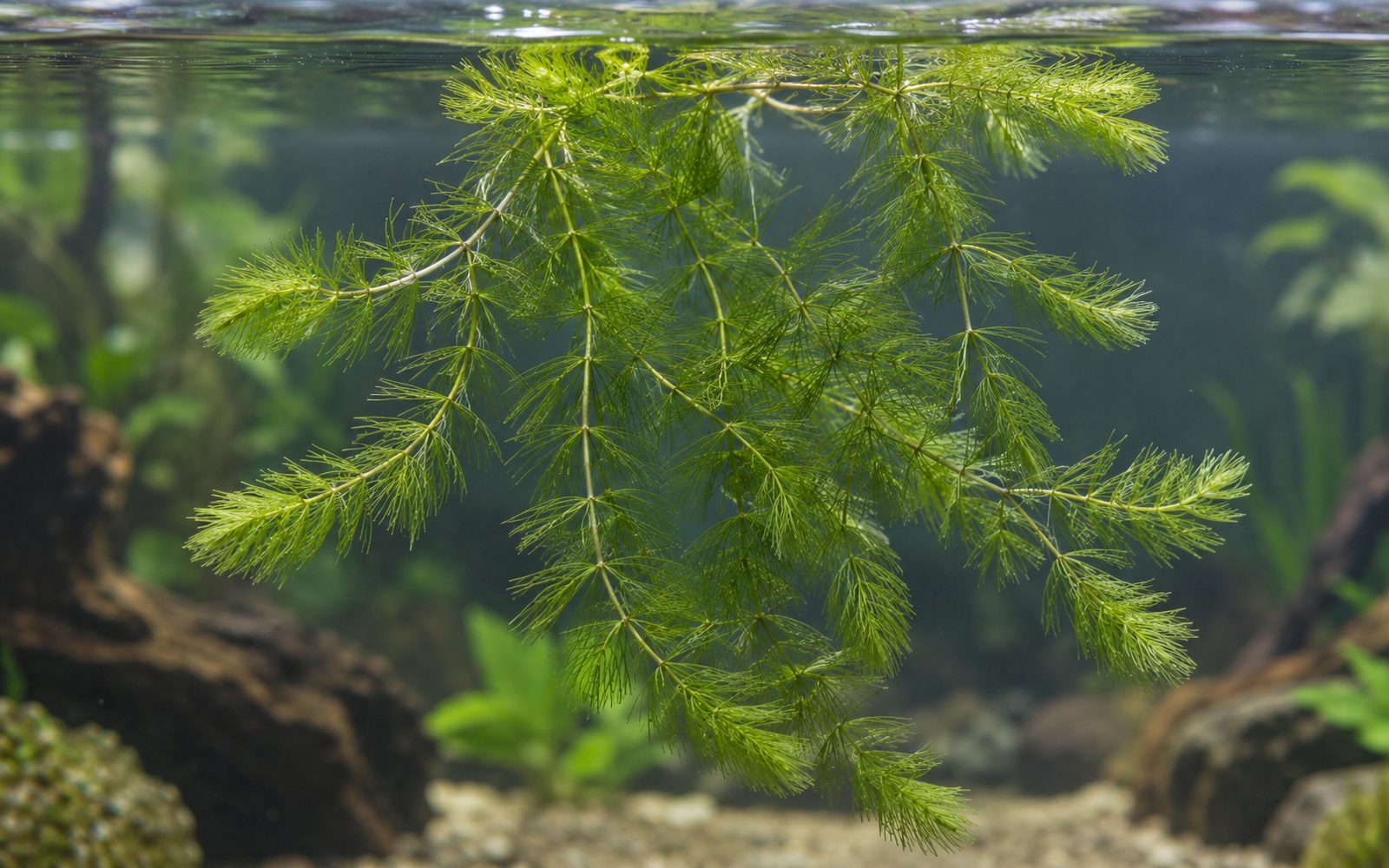
With its fine, forked, stiff needle-like leaves arranged in whorls along the stem, hornwort resembles a fox's tail. It has no true roots: it either floats freely or is anchored by burying its lower end in the sand or wedging it under a rock. It also occurs naturally in the lakes and ponds of Türkiye.
Its biggest benefit is that it feeds directly from the water and grows very fast: it absorbs excess nitrate and phosphate and competes with algae for nutrients. It is very useful in newly set-up aquariums, goldfish aquariums and fry tanks.
Planting and Placement
- It can be left floating freely; it forms a dense cover at the surface and diffuses the light.
- By lightly burying the lower end of the stem in the sand or anchoring it with a weight, it can be used as a vertical "forest" in the background. The buried part may rot; if this becomes a problem, cut the end of the stem again.
Care and Fertilization
- Light: Moderate; in high light it grows even faster.
- CO₂: Not required.
- Fertilizer: Usually not needed; when nutrients are lacking, the needles turn yellow and fall off.
- Trimming: Because it grows fast it needs frequent cutting and thinning; remove the excess from the aquarium.
Propagation
The stem is divided into pieces; each piece becomes a new plant.
Common Problems
- Needle shedding: adjusting to a new environment, a sudden temperature change or nutrient deficiency. Shed needles can clog the filter; check the filter sponge during the first weeks.
- Sensitivity to liquid CO₂ (glutaraldehyde) products.
- Do not release into the wild: aquarium plants must not be thrown into natural waters.
Hobbyist notes
Things you won't find in books, learned by trial and error. The most helpful ones are on top.
No notes yet. If you have experience with this species, leave the first note.
Was this page helpful?
Change history and contributors
- Page created · October 16, 2026