
Water parameters
Temperature15–26°C
pH6–7.5
General hardness (GH)3–15 dGH
Recommended range
Overview
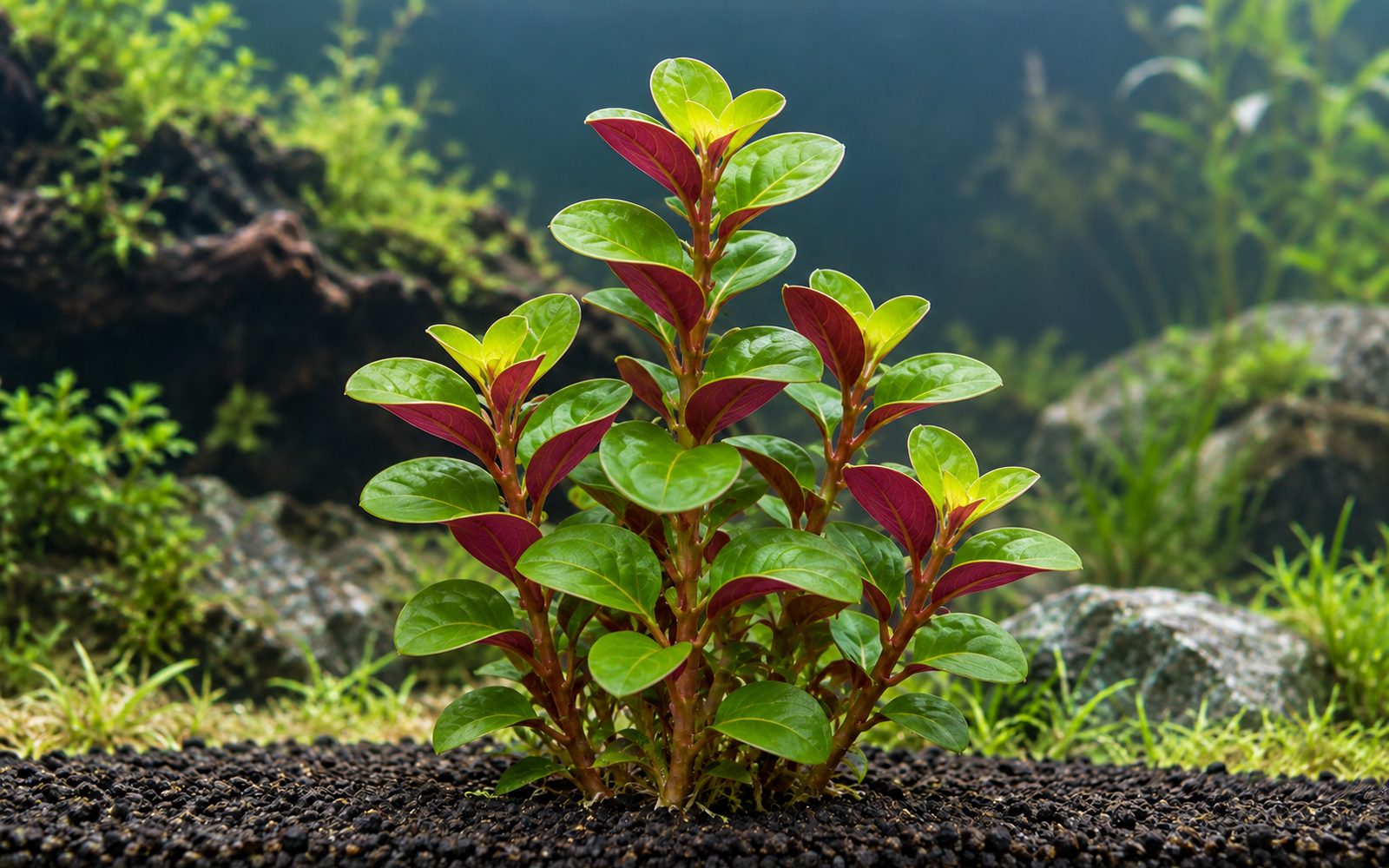
Lobelia cardinalis is a plant that grows along the edges of streams and swamps in North and Central America and is known for its bright red flowers above water. It does not flower in the aquarium; underwater it forms oval, fleshy leaves arranged alternately on a thick stem. The upper side of the leaves is bright light green and the underside purple-red. It grows slowly and keeps its shape for a long time. Because it tolerates cool water, it can also be used in unheated aquariums. The 'Mini' form, commonly found in the trade, stays shorter and denser.
Planting and Placement
- Stems are planted one by one with 3–4 cm between them, 3 cm deep.
- The regular form is used in the midground and the 'Mini' form in the foreground and midground, in groups.
Care and Fertilization
- Light: Medium; in strong light it stays denser and shorter.
- CO₂: Not required, but it speeds up growth.
- Fertilizer: Root tabs and occasional liquid fertilizer are enough.
- Trimming: Because it grows slowly, it is rarely needed. When the top is cut, the remaining stem produces side shoots; the cut top can be replanted.
Propagation
This section has not been written yet. How is it propagated?
Be the first to write it
Common Problems
This section has not been written yet. Problems such as melting, yellowing and algae, and how to fix them.
Be the first to write it
Hobbyist notes
Things you won't find in books, learned by trial and error. The most helpful ones are on top.
No notes yet. If you have experience with this species, leave the first note.
Was this page helpful?
Change history and contributors
- Page created · October 16, 2026