
Water parameters
Temperature20–28°C
pH6–7.5
General hardness (GH)2–15 dGH
Recommended range
Overview
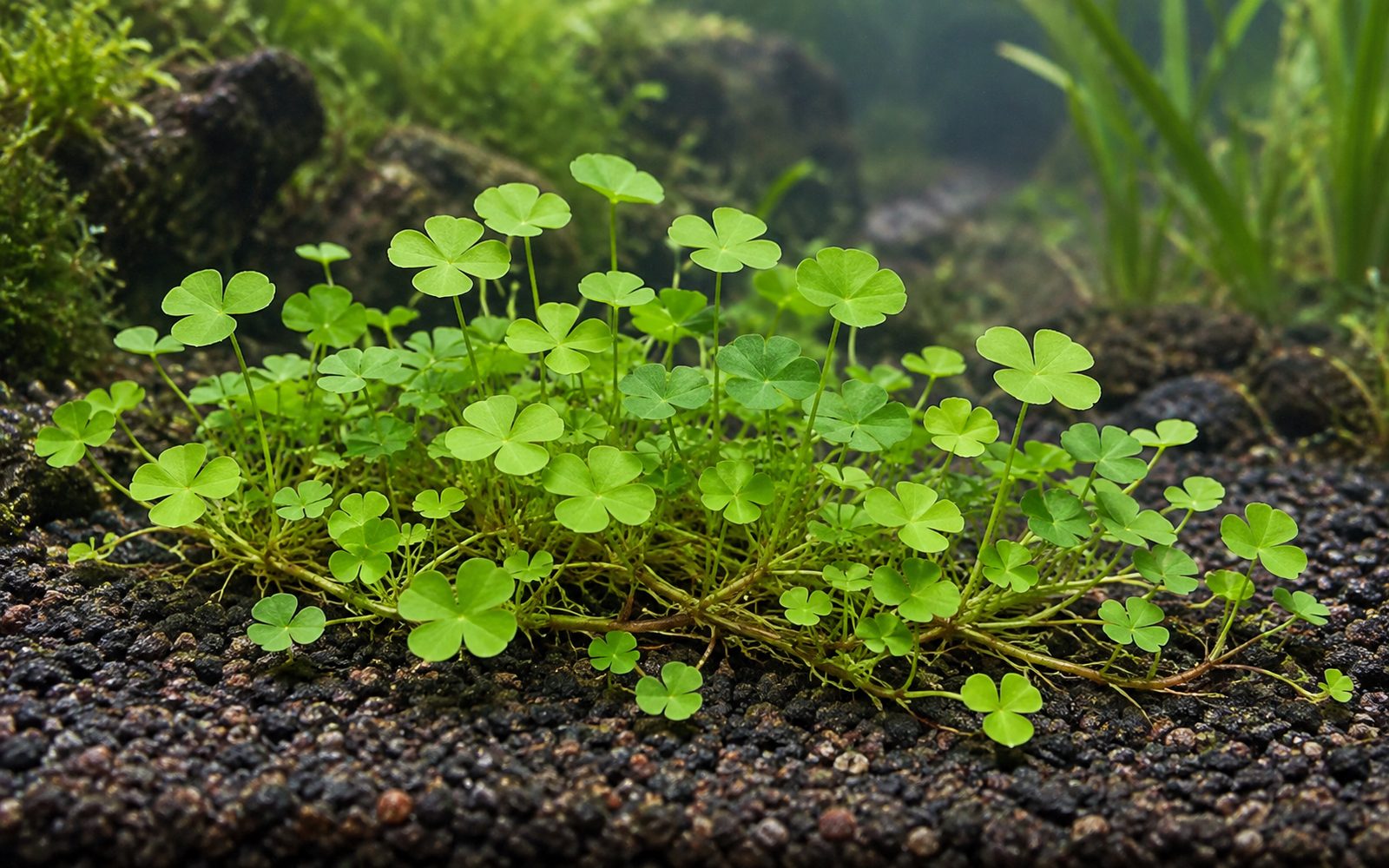
Marsilea crenata is an aquatic fern that grows in the rice paddies and shallow waters of Southeast Asia; in Indonesia it is also eaten as a vegetable under the name "semanggi". Short-stalked leaves grow from a thin stem (rhizome) creeping just below the substrate. Above water the leaves are four-parted and clover-shaped; underwater, smaller leaves form that are mostly single or have few parts. Like its relative Marsilea hirsuta it is undemanding: it survives under medium light in an aquarium without CO₂ and slowly spreads across the substrate.
Planting and Placement
- Divide the plant from the nursery pot into small pieces containing a few leaves and roots.
- Plant the pieces 2–3 cm apart so that the rhizome stays just below the substrate.
- Place it in the foreground, in an open area well reached by light.
Care and Fertilization
- Light: Medium; under strong light the leaves become smaller and denser.
- CO₂: Not required, but speeds up spreading.
- Fertilizer: Root tabs and occasional liquid fertilizer are enough.
- Trimming: Almost never needed; rhizomes spilling outside the area are cut to keep it tidy.
Propagation
This section has not been written yet. How is it propagated?
Be the first to write it
Common Problems
This section has not been written yet. Problems such as melting, yellowing and algae, and how to fix them.
Be the first to write it
Hobbyist notes
Things you won't find in books, learned by trial and error. The most helpful ones are on top.
No notes yet. If you have experience with this species, leave the first note.
Was this page helpful?
Change history and contributors
- Page created · October 16, 2026