
Water parameters
Overview
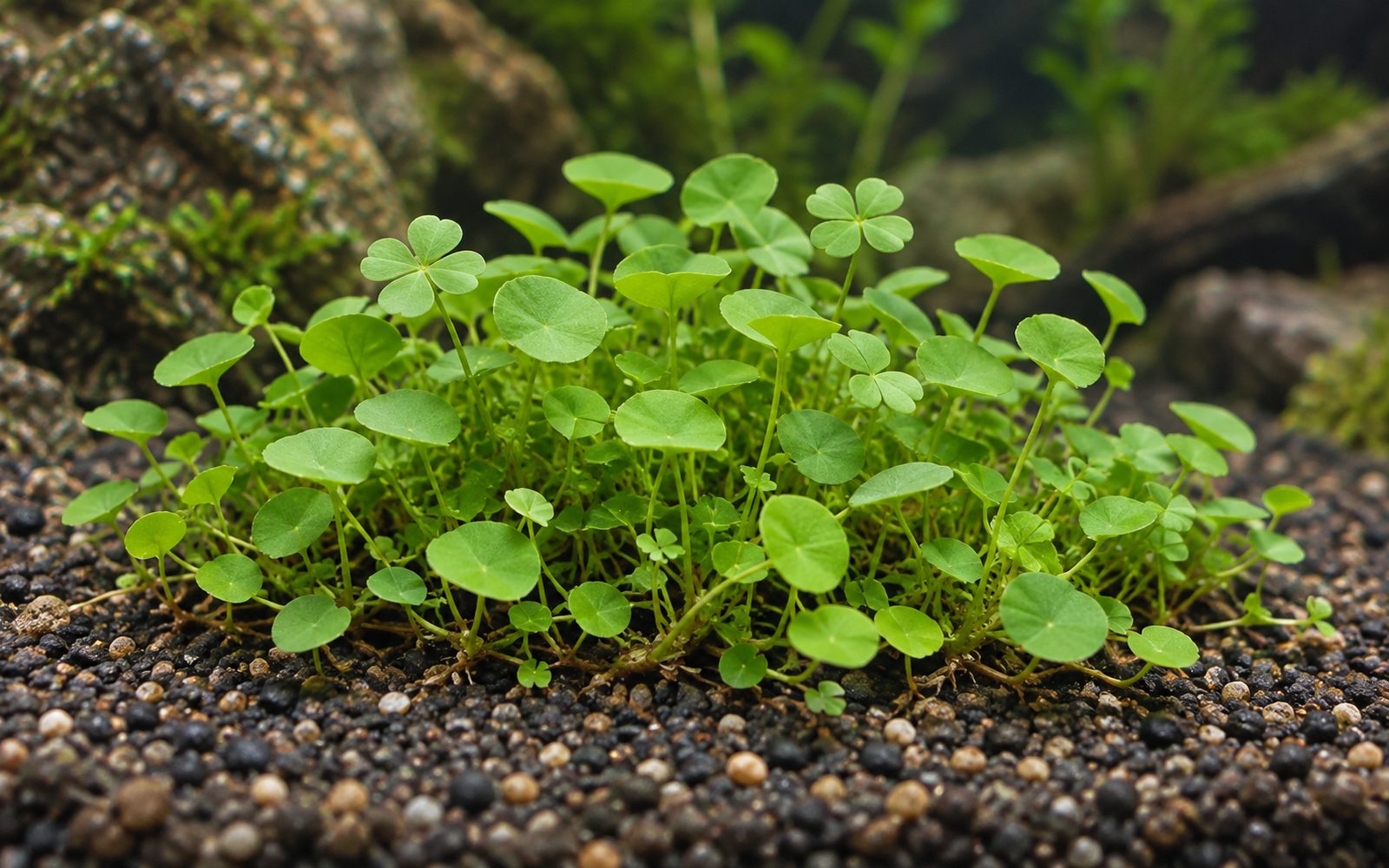
Although Marsilea hirsuta looks like clover, it is actually an aquatic fern; it reproduces not by seed but by spore capsules. Short-stalked leaves grow from a thin creeping stem (rhizome) running just below or on top of the substrate. Above water the leaves are four-parted and clover-shaped; underwater it mostly forms single, round, small leaves. In weak light, two- to four-parted leaves can also appear now and then.
It is one of the least demanding carpeting plants: it survives in an aquarium without CO₂, under medium or even low light. It grows slowly but spreads steadily, and once established it stays for many years without needing care.
Planting and Placement
- Divide the plant from the nursery pot into small pieces, each with a few leaves and roots.
- Plant the pieces 2–3 cm apart so that the rhizome stays just below the substrate.
- Plant it in the foreground, in open areas well reached by light; the bases of stones and driftwood are also suitable.
Care and Fertilization
- Light: Medium; under strong light the leaves become smaller and denser, under low light the leaf stalks get longer.
- CO₂: Not required, but speeds up spreading.
- Fertilizer: Root tabs and occasional liquid fertilizer are enough.
- Trimming: Almost never needed; rhizomes that cross the boundary are cut to tidy the area.
Propagation
As the rhizome spreads across the substrate it forms new leaves and roots. It is propagated by cutting a leafy section of the rhizome and planting it elsewhere. Spore formation is not expected in the aquarium.
Common Problems
- Very slow start: it may hardly grow at all in the first weeks; spreading begins once the roots are established.
- Long-stalked, untidy leaves: the light is weak; move the plant to a brighter spot.
- Algae on the leaves: slow-growing leaves can catch algae; algae-eating shrimp help.
Hobbyist notes
Things you won't find in books, learned by trial and error. The most helpful ones are on top.
Change history and contributors
- Page created · October 16, 2026