
Water parameters
Overview
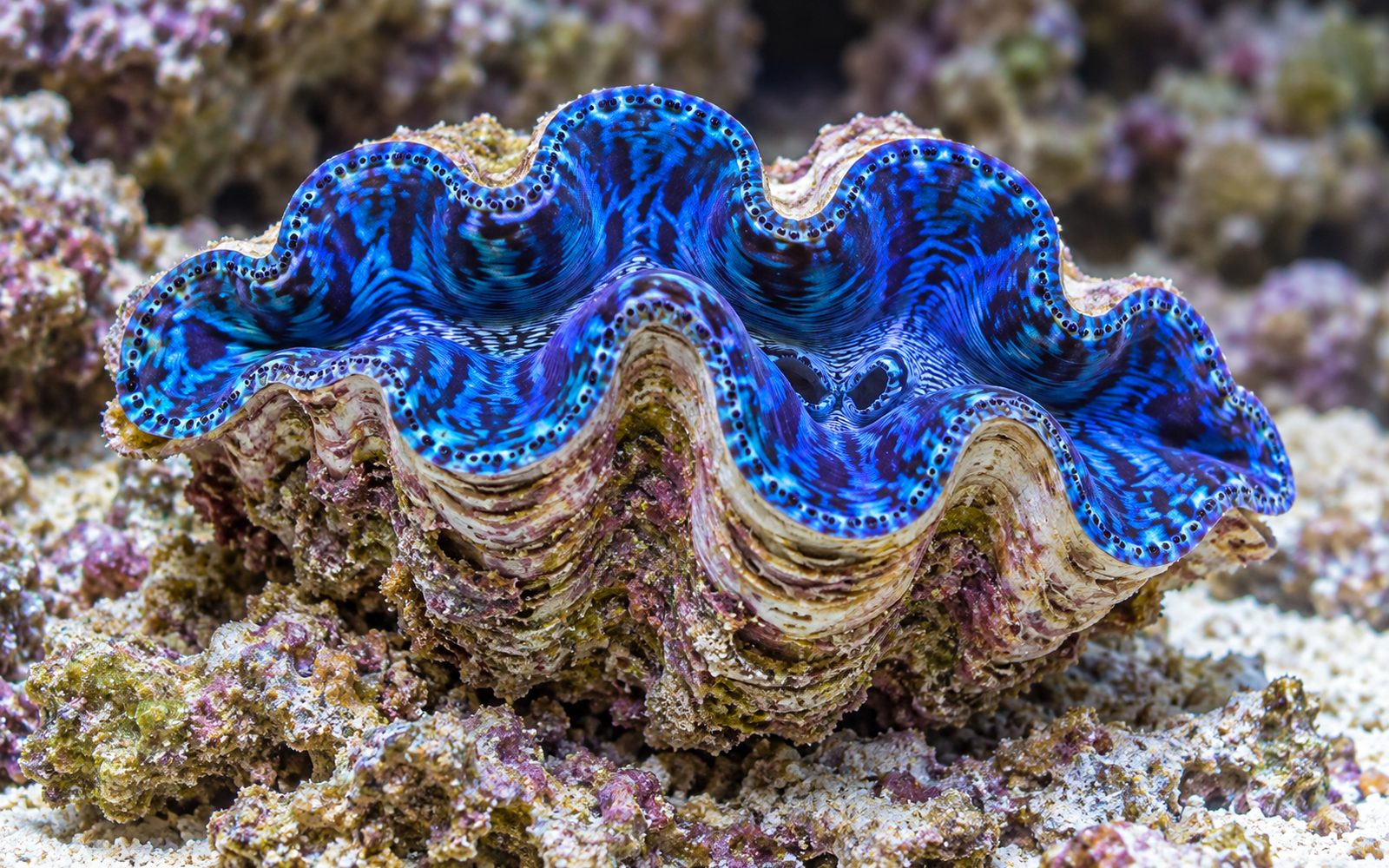
The maxima clam is one of the most colorful and most commonly kept species of the genus Tridacna. The edge of its shell is wavy and bears dense rows of scale-like projections. The mantle spilling out between the shell valves is blue, green, gold and brown, often patterned and shiny. Symbiotic algae in the mantle produce nutrients from light; the clam obtains most of its food this way.
Legal note: All Tridacna species are listed in CITES Appendix II; their international trade requires a permit. Only documented, preferably farm-raised (maricultured) individuals should be bought. Captive-raised individuals adapt to the aquarium more easily and protect wild stocks.
Natural Habitat
It lives on shallow, sunny reef flats and in lagoons from the Red Sea and East Africa to Polynesia. It embeds part of its shell in rock or coral, attaches with threads (byssus) and opens its mantle to full sunlight.
Tank Setup
- Volume: at least 150 liters and a reef aquarium mature for at least 6–12 months.
- Water: salinity 1.024–1.026 specific gravity, pH 8.1–8.4, temperature 24–27°C; calcium 400–450 mg/L, alkalinity 7–9 dKH, magnesium 1250–1350 mg/L, all stable.
- Light: strong reef lighting is essential. It is placed in the upper half of the aquarium on a solid rock in direct light, or on a flat stone on the sand; it should not be moved often.
- Reef compatibility: Reef-safe; it does not harm corals. It should not be shaded by corals.
- Acclimation and medication: Acclimate by the drip method for at least 1 hour and do not expose it to air. Copper-based medications are lethal.
Diet
It gets most of its food from light; it also filters fine particles and phytoplankton from the water. Juveniles smaller than 5 cm cannot produce enough food from light, so they should be supplemented with live or concentrated phytoplankton several times a week. For adults, the particles in a mature aquarium are usually enough.
Behavior and Compatibility
It does not move; it only opens and closes its mantle. When a shadow falls over it or the water is disturbed, it quickly retracts its mantle and may squirt water from its siphon.
Good companions: clownfish, gobies, cardinalfish, tangs, six line wrasse (it hunts parasitic snails); shrimp, snails.
Avoid: dwarf angelfish, large angelfish, butterflyfish and some filefish that pick at the mantle; triggerfish and pufferfish; chocolate chip starfish.
Group and Colony Structure
Kept singly, but several clams live together in the same aquarium without problems; enough space should be left so that each gets sufficient light and their mantles do not touch.
Breeding
It first matures as a male, then becomes a hermaphrodite functioning as both male and female (protandrous hermaphrodite). It releases eggs and sperm into the water. Breeding is done on specialized farms; no offspring are obtained in home aquariums.
Health and Common Problems
- Parasitic snails: small white snails smaller than a grain of rice (pyramidellids) that feed at night on the edge and underside of the shell. They are removed by hand or with a toothbrush; the six line wrasse hunts them.
- Bleaching: the mantle turning pale; sudden changes in light, temperature or water parameters.
- Mantle not opening and the shell gape widening: a sign of a serious problem; a dying clam fouls the water quickly.
Sexing
As it is a hermaphrodite, there is no distinction between male and female.
Tank mates
This list is calculated automatically from the species profile and grows as new species are added to the catalog. Try it in the planner for a definite answer.
Hobbyist notes
Things you won't find in books, learned by trial and error. The most helpful ones are on top.
Change history and contributors
- Page created · October 16, 2026