
Water parameters
Overview
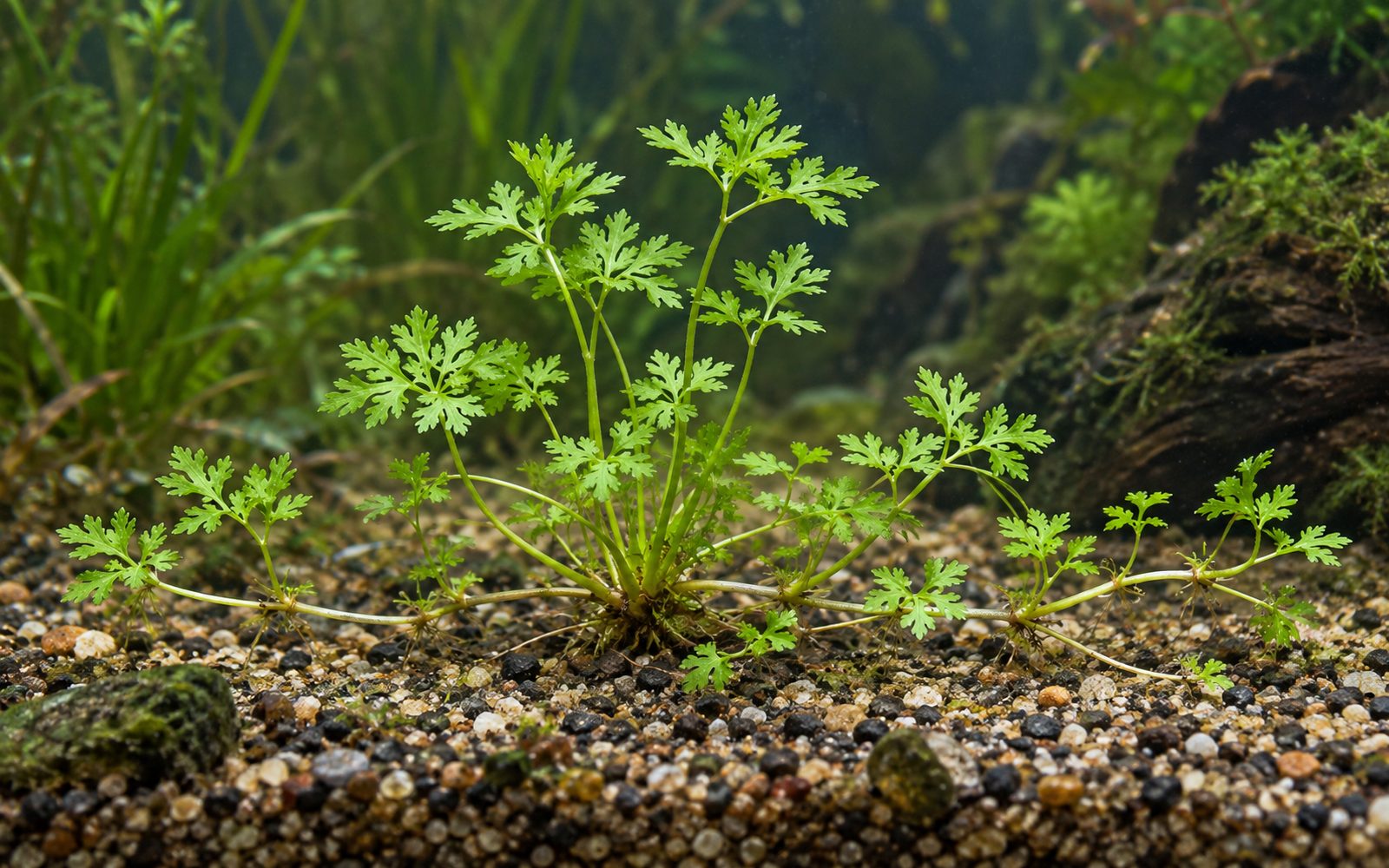
Ranunculus inundatus is one of the few members of the buttercup genus grown in aquariums. In southeastern Australia it lives on the muddy banks of ponds and creeks, submerged or in shallow water. Its leaves are deeply divided and look like small parsley leaves; each leaf sits at the end of a thin, long stalk.
The plant spreads by sending runners across the substrate and over time forms a soft, airy cover in the foreground and midground. Because it gives a finely textured look unlike most carpeting plants, it is popular in nature-style layouts. It is tolerant of water parameters; it adapts to soft and moderately hard water and also tolerates cool water.
Planting and Placement
- Divide the plant from the pot or tissue-culture cup into 6–8 small pieces.
- Plant the pieces with tweezers 3–4 cm apart, with the roots buried.
- Choose a spot in the foreground or the foreground–midground transition that will not be shaded.
Care and Fertilization
- Light: Medium to high. As light decreases the leaf stalks get longer and the plant thins out; under strong light it stays low and dense.
- CO₂: Not required, but clearly beneficial for a dense, healthy cover.
- Fertilizer: Under strong light, dose macro and micronutrients regularly; root tabs also help.
- Trimming: Cut leaves that grow too long at the base of the stalk. Pluck off runners spilling over the edge of the cover.
Propagation
It multiplies on its own through plantlets that form at the ends of runners. Once the plantlets have rooted, the runner is cut and the plants can be planted where you want. When the clump gets dense it can also be propagated by dividing it into small pieces.
Common Problems
- Long-stalked, sparse growth: light is insufficient.
- Yellowing leaves: nutrient deficiency; under strong light in particular, there is too little fertilizer.
- Pieces floating to the surface: planting is too shallow; plant the pieces deeper or support them with small stones until they settle.
Hobbyist notes
Things you won't find in books, learned by trial and error. The most helpful ones are on top.
Change history and contributors
- Page created · October 16, 2026