
Water parameters
Overview
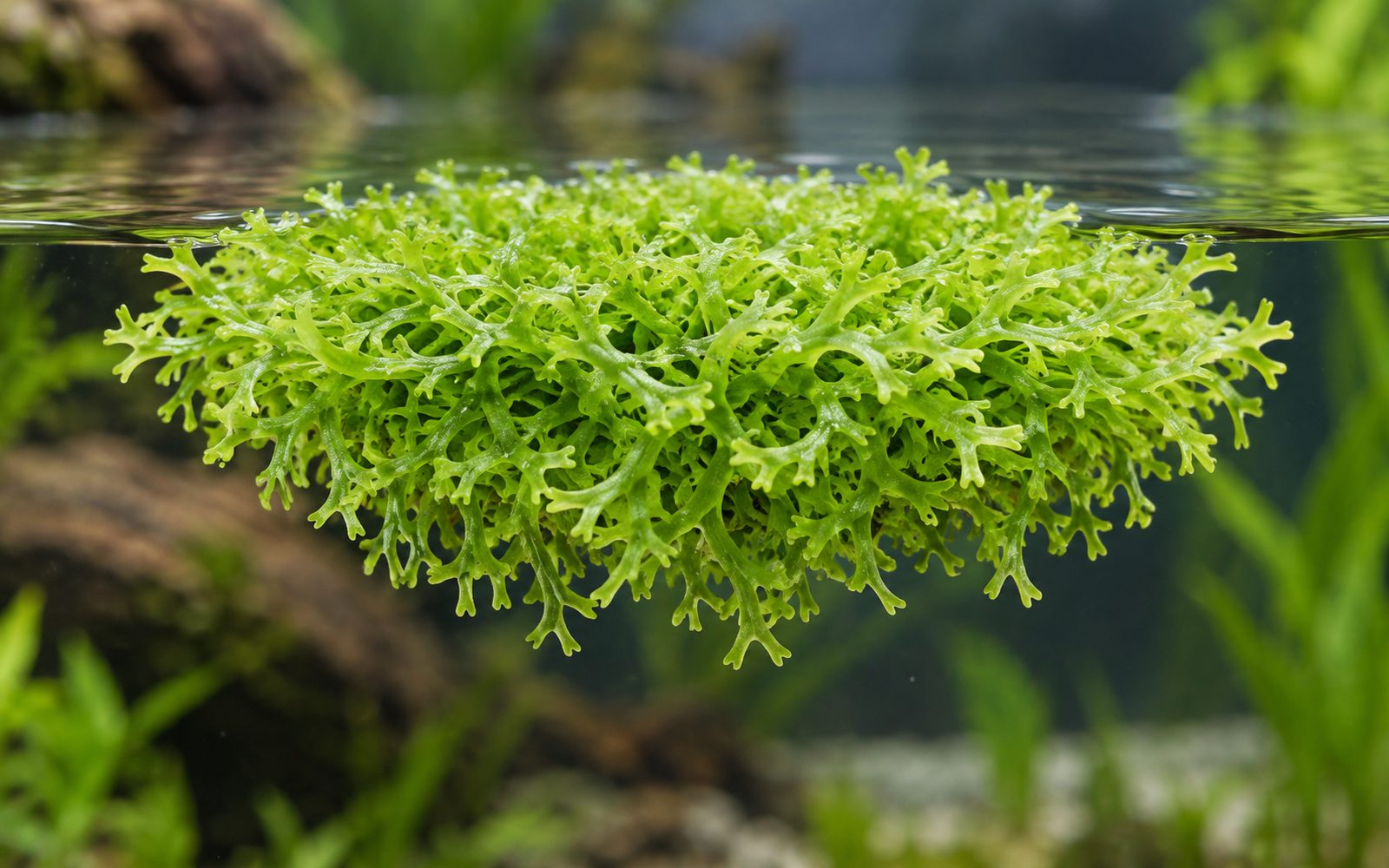
Riccia is a liverwort with no true roots or leaves. Light green, flat branches a few millimeters wide, forking again and again, tangle together to form a soft, fluffy mat just below the water surface. Floating, it grows very fast and provides an excellent hiding place for fry and shrimp.
Riccia's fame comes from aquascape layouts, where it is tied to stones and grown underwater. Grown this way, with strong light and CO₂ it forms a bright green, dense carpet and releases the oxygen it produces through photosynthesis as silvery bubbles. This use requires much more maintenance than the floating use.
Planting and Placement
- Floating use: place it directly on the surface.
- Underwater carpet: spread it in a thin layer over flat stones and wrap it tightly with fine mesh (netting) or fishing line. Riccia does not attach to any surface on its own; if it is not tied down, it soon floats up to the surface.
Care and Fertilization
- Light: Moderate; strong light is needed if it is to form a carpet underwater.
- CO₂: Not needed when floating; almost essential for an underwater carpet.
- Fertilizer: Liquid fertilizer supports growth and color.
- Trimming: A tied carpet should be cut back every 2–3 weeks; when it gets thick, the lower layers cannot get light and rot, and the whole layer can lift off.
Propagation
It reproduces as branches break off and separate on their own; each piece becomes a new plant. A small tuft taken from the surface soon multiplies in another aquarium.
Common Problems
- Pieces scattered everywhere: fragments that break off during trimming float to the surface and collect at the filter intake; clean the surface with a net after cutting.
- Carpet rotting from below and lifting off: the layer is too thick; trim more often and re-wrap the stone if necessary.
- Pale, brownish color: insufficient light, CO₂ or nutrients.
- Covering the surface: when floating it can cover the surface completely; remove the excess regularly.
Hobbyist notes
Things you won't find in books, learned by trial and error. The most helpful ones are on top.
Change history and contributors
- Page created · October 16, 2026