
Water parameters
Overview
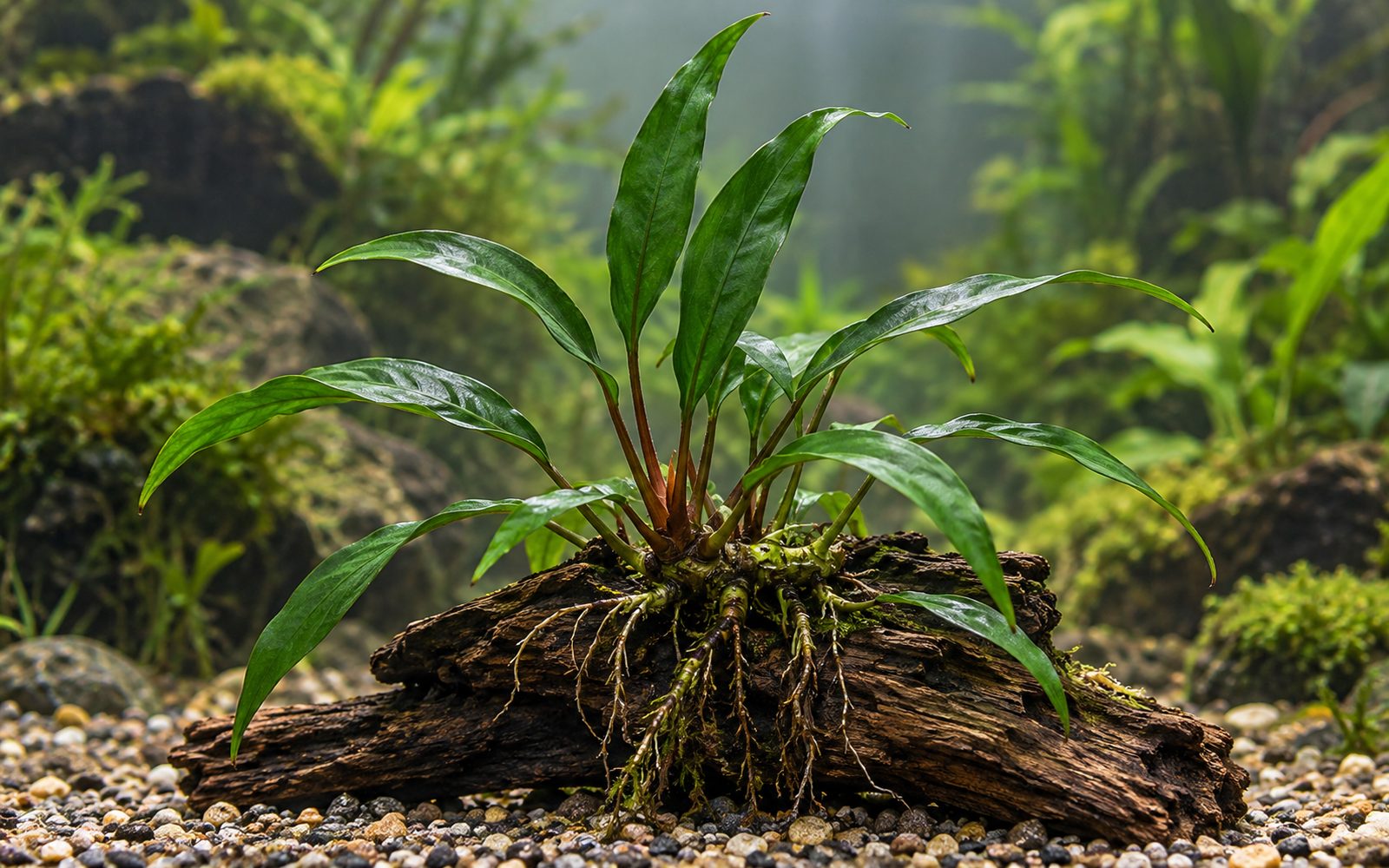
Anubias barteri var. angustifolia comes from the forest streams of West Africa and is the species' thinnest-leaved variety. The leaf blade is 10–25 cm long but quite narrow; the edges are smooth and the stalks often have a reddish-brown tint. In the aquarium the plant reaches a height of 20–30 cm. For a long time it was sold in the trade as Anubias afzelii; the true A. afzelii is a much larger species. The similar-looking var. glabra has wider, oval leaves.
Planting and Placement
Never bury the rhizome; a buried rhizome rots. Tie it to driftwood or stone with fishing line or cotton thread, or fix it with gel glue. Its thin leaves create a contrast in texture next to broad-leaved anubias; it is used in the midground and in driftwood clusters.
Care and Fertilization
- Light: Low to medium; under strong light the leaves collect algae.
- CO₂: Not required.
- Fertilizer: Liquid fertilizer and fish waste are enough.
- Cut old and algae-covered leaves off at the base. You can propagate it by dividing the rhizome into pieces with a few leaves each.
Propagation
Common Problems
Hobbyist notes
Things you won't find in books, learned by trial and error. The most helpful ones are on top.
Change history and contributors
- Page created · October 16, 2026