
Water parameters
Overview
Anubias barteri is a very variable species that lives in West Africa along the banks of forest streams, clinging to rocks and to roots hanging into the water. Botanically it is divided into several varieties; var. barteri on this page is the type form that bears the species name. The leaf blade reaches 7–20 cm in length and sits on a stalk at least as long as the blade, and in the aquarium the plant reaches a total height of 20–40 cm.
The leaves are dark green, glossy and thick. Thanks to this tough texture, it is one of the few plants that can be kept with goldfish, cichlids and other plant-nibbling fish. Some of the plants sold in the trade simply labeled "Anubias barteri" are other varieties or forms; they need to be told apart by leaf shape.
Planting and Placement
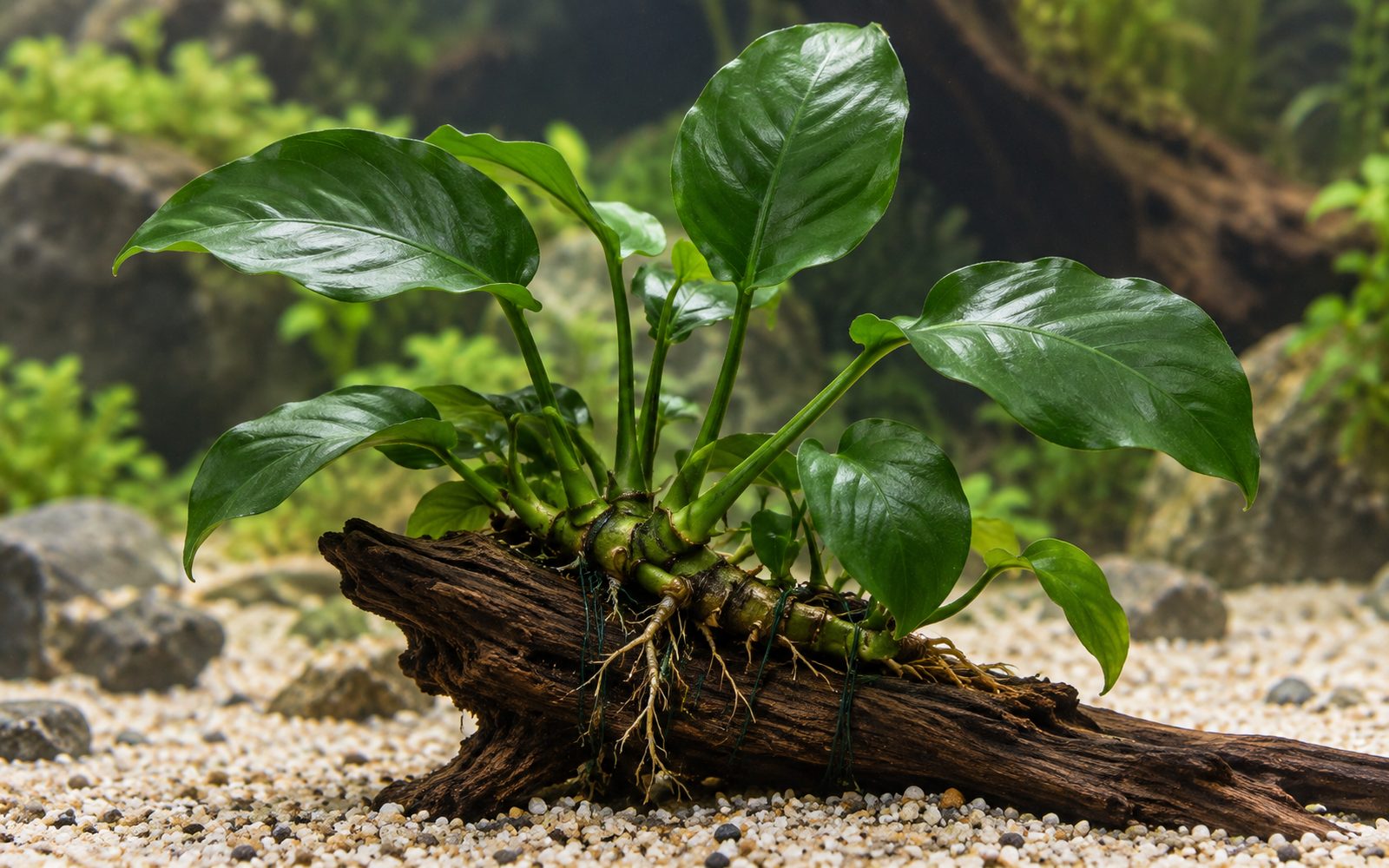
Never bury the rhizome (the thick, horizontal stem from which the leaves grow) in the substrate; a buried rhizome rots within a few weeks.
- Tie it to wood or rock with fishing line or cotton thread; the roots grip the surface in a few weeks, after which the thread can be removed.
- You can also fix it at a few points with aquarium-safe cyanoacrylate gel glue.
- The roots may grow down into the sand; this is not a problem as long as the rhizome stays exposed.
- Because of its height it looks good in the midground, on top of wood and rock clusters or in shaded corners.
Care and Fertilization
- Light: low to medium. In strong light, green spot algae builds up on the slow-growing leaves.
- CO₂: not required; if added, new leaves appear a little faster.
- Fertilizer: liquid fertilizer and fish waste are enough. Pale leaves may indicate a nitrogen, potassium or iron deficiency.
- Trimming: cut only old, torn or algae-covered leaves at the base of the stalk.
Propagation
The rhizome branches as it grows longer. Divide it with sharp scissors so that each piece keeps at least 3–4 leaves, and tie the pieces in separate places. Side shoots that appear on their own on the rhizome can also be separated once they have opened a few leaves. Because the plant grows slowly, propagation takes patience.
Common Problems
- Rhizome rot: the rhizome has been buried or crushed. Cut away the soft, foul-smelling part back to healthy tissue and reattach the plant.
- Green spot and brush algae: too much light and unbalanced nutrients. Move the plant into the shade; nerite snails help clean the leaf surfaces.
- Holes in leaves: mostly potassium deficiency; rarely snail grazing.
Hobbyist notes
Things you won't find in books, learned by trial and error. The most helpful ones are on top.
Change history and contributors
- Page created · October 16, 2026