
Water parameters
Overview
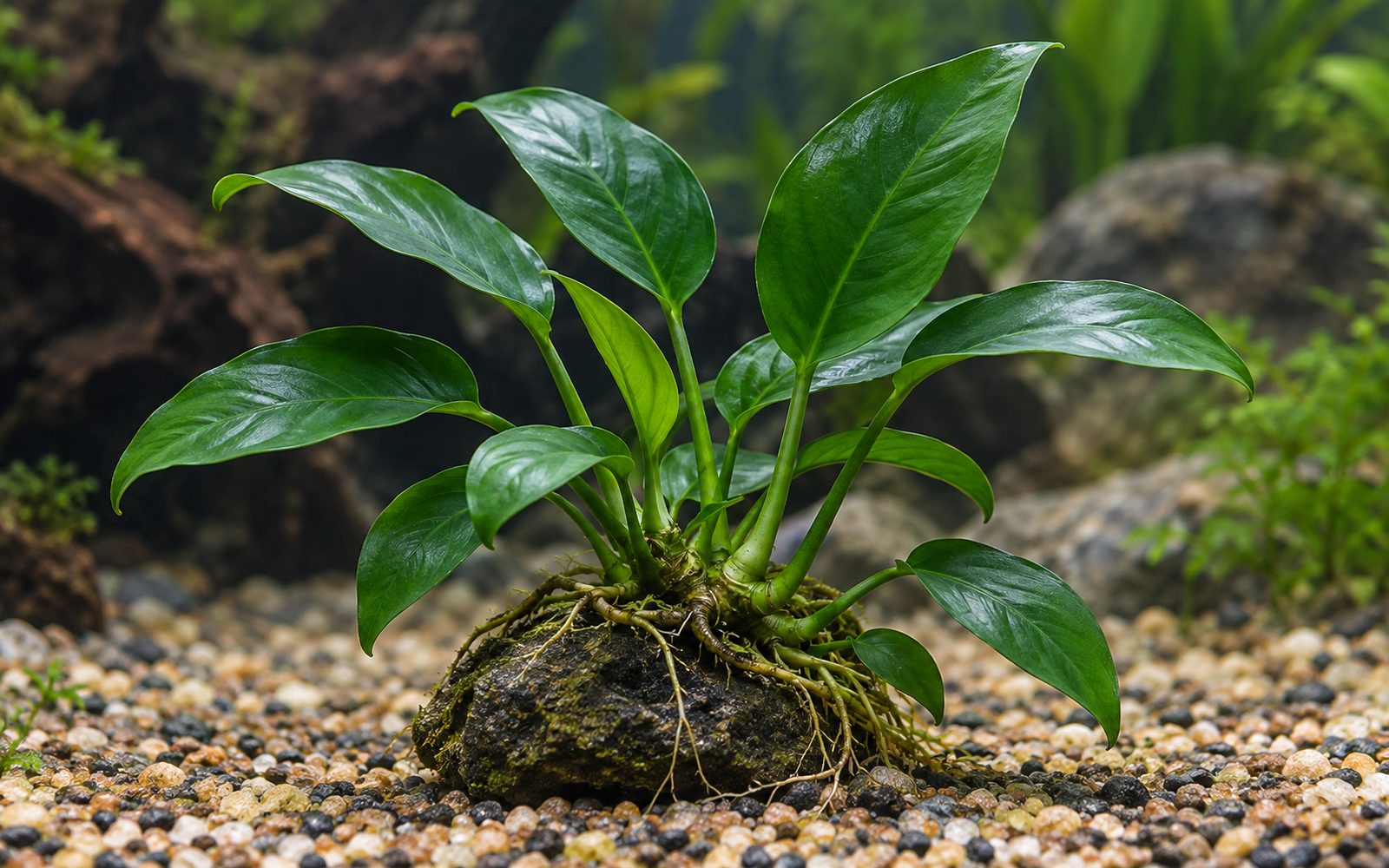
Anubias barteri var. glabra is the most widely distributed variety of the species; from Guinea to Gabon and the Congo it forms dense clumps on rocks along the banks of forest streams. Its leaves range between oval and lance-shaped, have smooth edges and grow 10–20 cm long. It is really a broad group covering many forms of different sizes. In the trade it is sold under its synonyms Anubias lanceolata and Anubias minima. It can be confused with var. angustifolia, which has narrower, strap-like leaves.
Planting and Placement
Never bury the rhizome. Tie it to driftwood or stone with thread or fix it with gel glue; over time the roots grip the surface. It looks good in the midground, between stones and on driftwood. Forms that stay small can also be tied to foreground stones.
Care and Fertilization
- Light: Low to medium; under strong light the leaves collect green spot algae.
- CO₂: Not required.
- Fertilizer: Liquid fertilizer and fish waste are enough.
- Cut old leaves off at the base of the stalk. The rhizome is propagated by dividing it so that each piece keeps at least 3–4 leaves.
Propagation
Common Problems
Hobbyist notes
Things you won't find in books, learned by trial and error. The most helpful ones are on top.
Change history and contributors
- Page created · October 16, 2026