
Water parameters
Temperature22–28°C
pH6–7.5
General hardness (GH)2–15 dGH
Recommended range
Overview
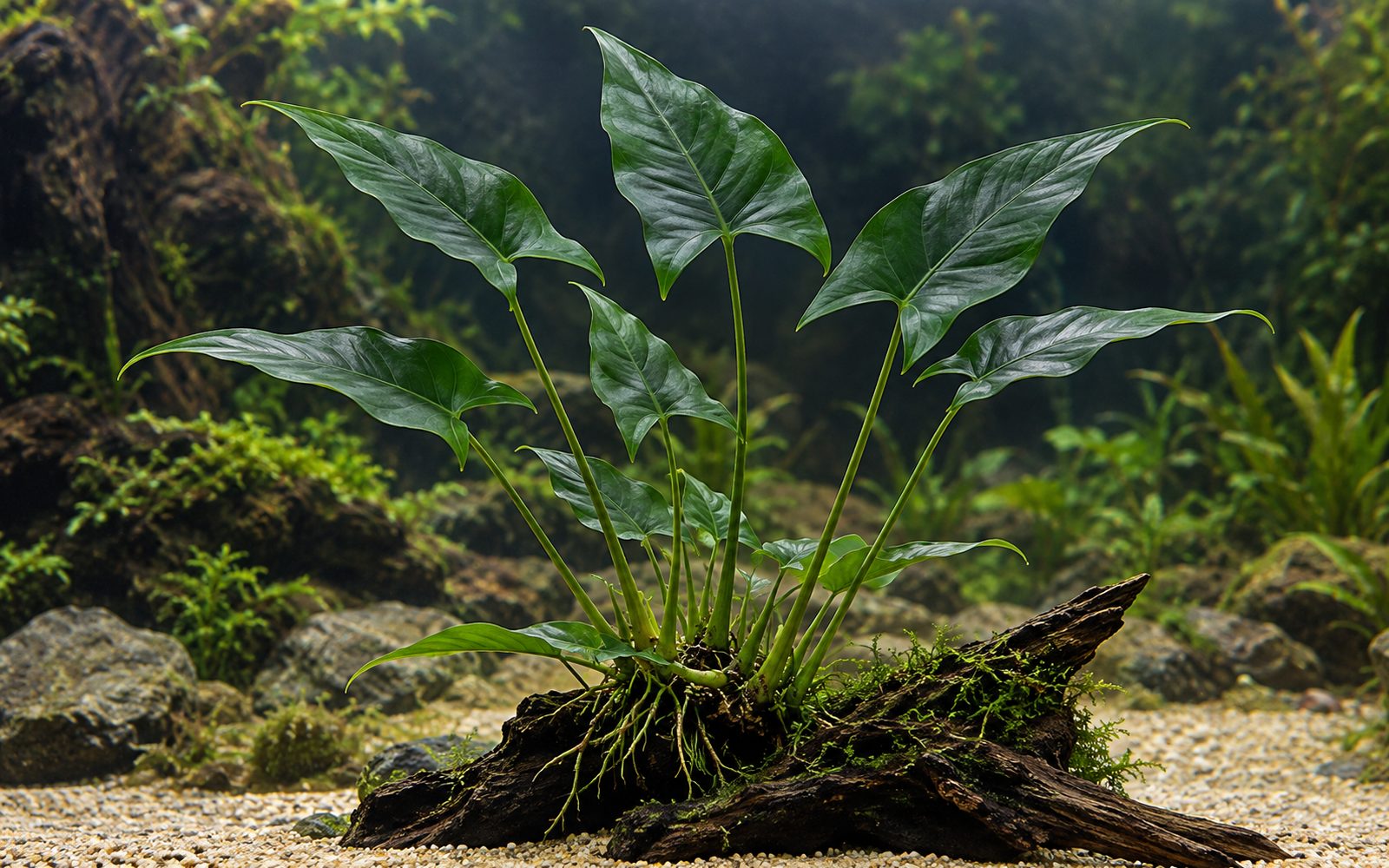
Anubias hastifolia is a large anubias that lives along forested stream banks in West and Central Africa. The leaf blade is spear- or arrowhead-shaped, with two lobes at the base extending backward. The leaves are carried on long stalks and the plant can reach 30–60 cm. In nature it mostly grows at the water's edge, partly emersed; in the aquarium it also grows slowly fully submerged.
Planting and Placement
The rhizome is never buried. It is tied to a large root or stone with thread or wedged between stones. The roots can reach into the substrate, but the rhizome must stay exposed. Because of its size it suits the background or midground of large aquariums.
Care and Fertilization
- Light: Low to medium.
- CO₂: Not required.
- Fertilizer: Liquid fertilizer is enough.
- Because it grows slowly, algae can build up on old leaves; cut these off at the base. The rhizome is propagated by dividing it so that each piece keeps a few leaves.
Propagation
This section has not been written yet. How is it propagated?
Be the first to write it
Common Problems
This section has not been written yet. Problems such as melting, yellowing and algae, and how to fix them.
Be the first to write it
Hobbyist notes
Things you won't find in books, learned by trial and error. The most helpful ones are on top.
No notes yet. If you have experience with this species, leave the first note.
Was this page helpful?
Change history and contributors
- Page created · October 16, 2026