
Water parameters
Overview
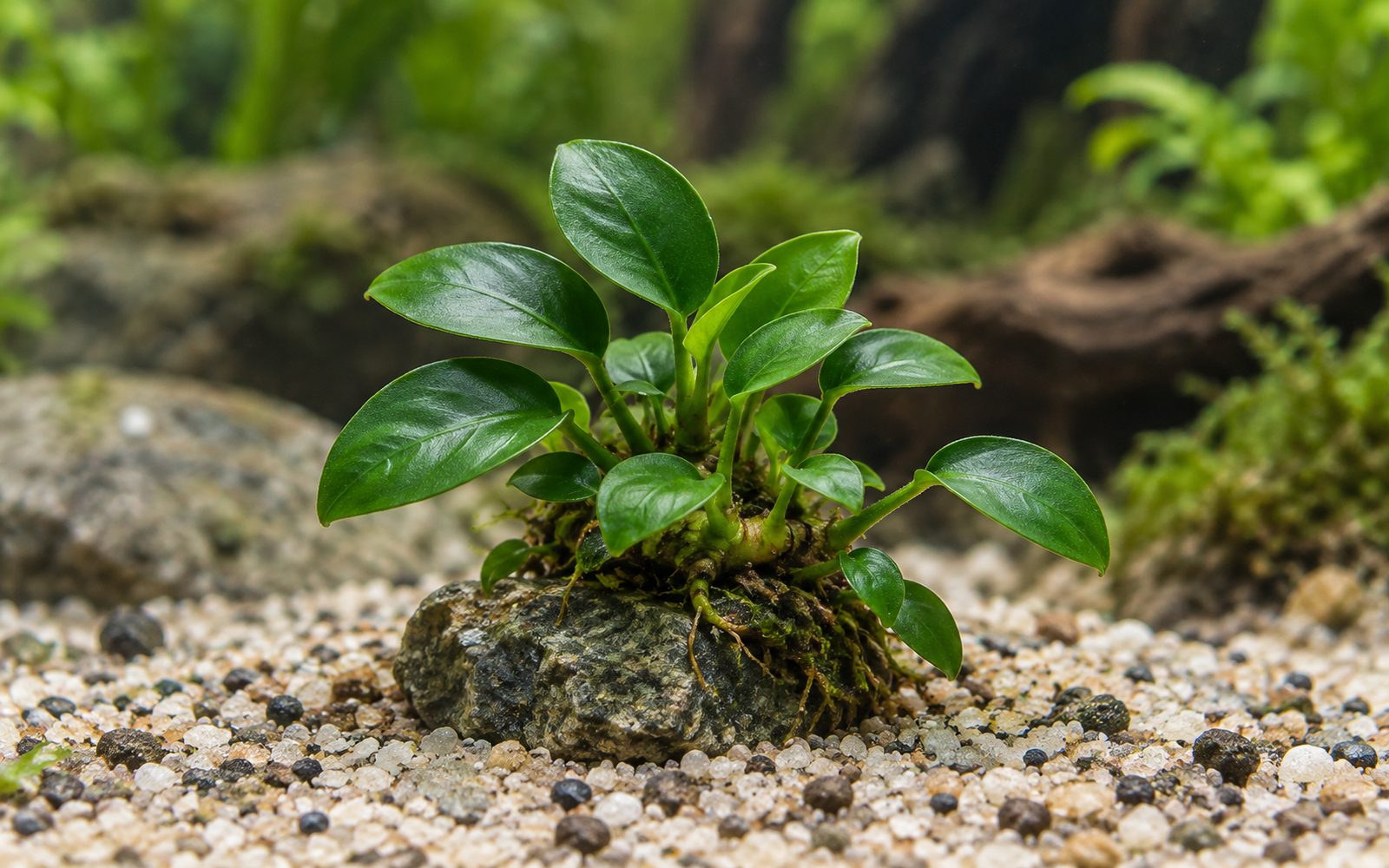
Anubias nana 'Petite', also sold in the trade under the name 'Bonsai', is one of the smallest forms of Anubias nana. Its leaves are oval, dark glossy green and only 1–2 cm long; the whole plant usually stays at 3–6 cm. Thanks to its rhizome with short, closely spaced nodes, it forms a compact, small clump.
This small size makes it ideal for nano tanks, shrimp tanks and the details of foreground rocks in large aquariums. Its care is the same as for Anubias nana; the only difference is that it grows even more slowly.
Planting and Placement
Never bury the rhizome. Place it on a small rock or piece of wood, or wedge it into cracks between rocks.
- Tie it with thin fishing line or cotton thread, or fix it at one or two points with aquarium-safe gel glue.
- The roots grip the surface in a few weeks.
- For plants taken out of pots, carefully clean off the rock wool.
Care and Fertilization
- Light: low to medium. Under strong light it easily collects algae, since its leaves are renewed slowly.
- CO₂: not required.
- Fertilizer: liquid fertilizer and fish waste are enough.
- Position: a slightly shaded spot where the flow keeps the leaves clean is ideal.
Propagation
The rhizome is divided with sharp scissors so that each piece keeps at least 2–3 leaves. Because the plant grows very slowly, only a few new pieces can be obtained per year; this is why it usually costs more than regular nana.
Common Problems
- Rhizome rot: buried or constantly covered by sand; expose the rhizome.
- Leaves collecting algae: reduce the light; nerite snails and shrimp help.
- Leaves growing larger: some plants may grow toward regular nana size with plenty of light and nutrients; in that case separate and propagate the pieces with the smallest leaves.
Hobbyist notes
Things you won't find in books, learned by trial and error. The most helpful ones are on top.
Change history and contributors
- Page created · October 16, 2026