
Water parameters
Overview
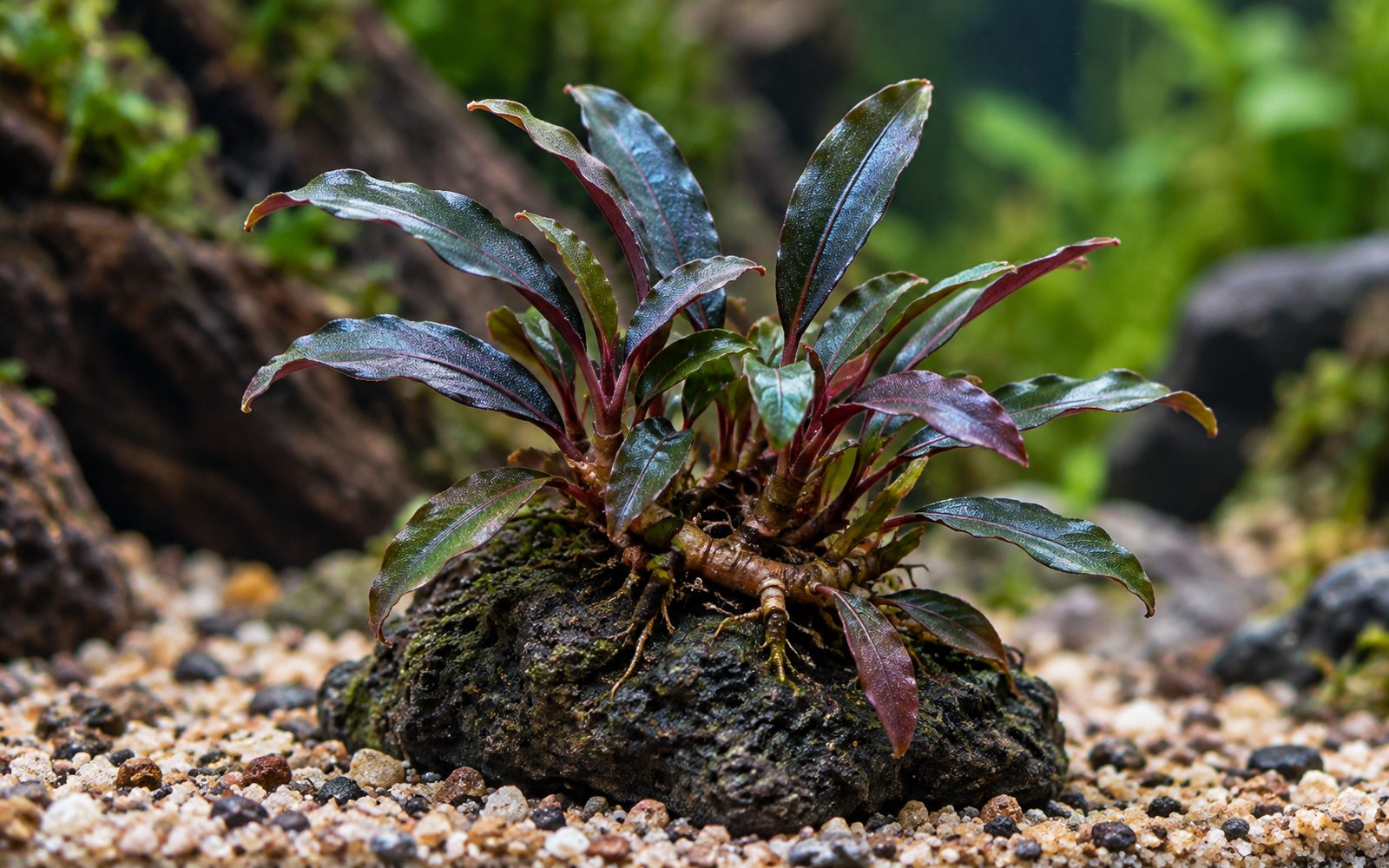
Bucephalandra is a genus of small plants endemic to the island of Borneo that live clinging to rocks along stream banks. In the wild, depending on the water level, they are sometimes submersed and sometimes emersed. In the aquarium they grow from a rhizome much like Anubias, but stay much smaller and attract collectors with their variety of colors and textures. In the hobby the name is shortened to "buce".
'Kedagang' is one of the most common commercial forms of the genus. Its leaves are narrow and lance-shaped; the color ranges from dark green to bluish green, and in sufficient light purple and red tones appear on new leaves. As in many buce forms, fine dots that sparkle in the light may be seen on the leaf surface. The plant usually stays at 5–10 cm.
Overcollection from the wild threatens some Bucephalandra populations. Prefer plants from tissue culture (in vitro cups) or nursery production.
Planting and Placement
Never bury the rhizome; a buried rhizome rots.
- Tie it to rock or wood with thin fishing line or cotton thread, or fix it with cyanoacrylate gel glue.
- The roots grip the surface firmly within a few weeks.
- Used between rocks, in the foreground and midground, or on wood branches.
- For tissue culture plants, carefully rinse off the gel under running water.
Care and Fertilization
- Light: low to medium. The colors become more pronounced in medium light; in strong light the leaves easily collect algae.
- CO₂: not required but supports growth and coloration.
- Fertilizer: liquid fertilizer is enough.
- Flow: gentle flow helps keep the leaves clean.
- Water: it lives without problems in soft to moderately hard water.
Propagation
The rhizome is divided with sharp scissors so that each piece keeps at least 3–4 leaves, and the pieces are tied in separate places. The clump widens over time as the rhizome branches sideways, but since only a few new leaves appear each year, propagation is slow. Under suitable conditions it can also produce small flowers underwater.
Common Problems
- Buce melt: leaves becoming transparent and falling off after transport or a sudden change. If the rhizome is healthy it will sprout again; cut off the rotting parts.
- Algae: because the leaves are long-lived, spot and brush algae can build up. Reduce the light; Amano shrimp and otocinclus help.
- Rhizome rot: buried or in contact with the substrate; keep the rhizome exposed.
Hobbyist notes
Things you won't find in books, learned by trial and error. The most helpful ones are on top.
Change history and contributors
- Page created · October 16, 2026