
Water parameters
Overview
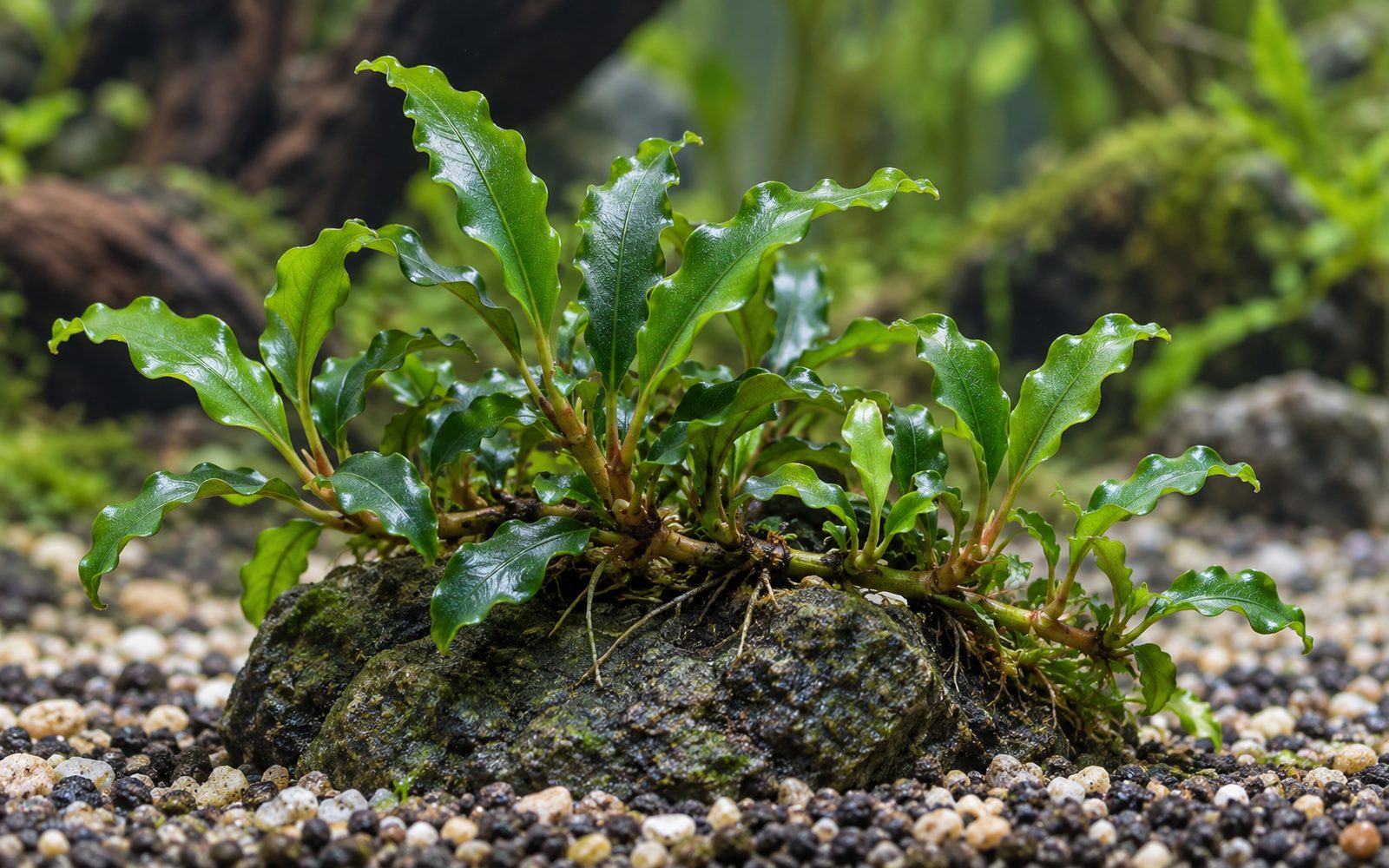
'Wavy Green' is a very common form in the trade, attributed to Bucephalandra pygmaea, a species endemic to Borneo. Its lance-shaped, glossy green leaves have distinctly wavy edges. The plant stays at 5–10 cm in height and forms a dense clump that slowly widens as the rhizome branches.
It is more forgiving than the colorful buce forms: it grows while keeping its green color even in low light and without CO₂. This makes it a good start for anyone who wants to get to know Bucephalandra. Most plants sold now come from tissue culture or nurseries; prefer these over wild-collected plants.
Planting and Placement
The rhizome is not buried.
- Tie it to rock or wood with thin thread or fix it with gel glue.
- Wedging it between rocks also works; the roots take hold in a short time.
- In the foreground and midground, between rock groups, it gives a natural look.
Care and Fertilization
- Light: low to medium.
- CO₂: not required; if present, growth speeds up.
- Fertilizer: liquid fertilizer is enough.
- Flow: gentle flow reduces the buildup of debris and algae on the leaves.
Propagation
The rhizome is divided with sharp scissors so that each piece keeps a few leaves; the pieces are tied to separate rocks. Side branches of the rhizome can also be separated over time. Propagation is slow and requires patience.
Common Problems
- Melting: leaves may drop off in newly bought plants or after a sudden water change; if the rhizome is healthy it will sprout again.
- Algae: too much light and slow growth lead to algae on the leaves; reduce the light and add algae-eating shrimp and snails.
- Rhizome rot: the rhizome is buried or stays buried in the substrate; expose the rhizome.
Hobbyist notes
Things you won't find in books, learned by trial and error. The most helpful ones are on top.
Change history and contributors
- Page created · October 16, 2026