
Water parameters
Overview
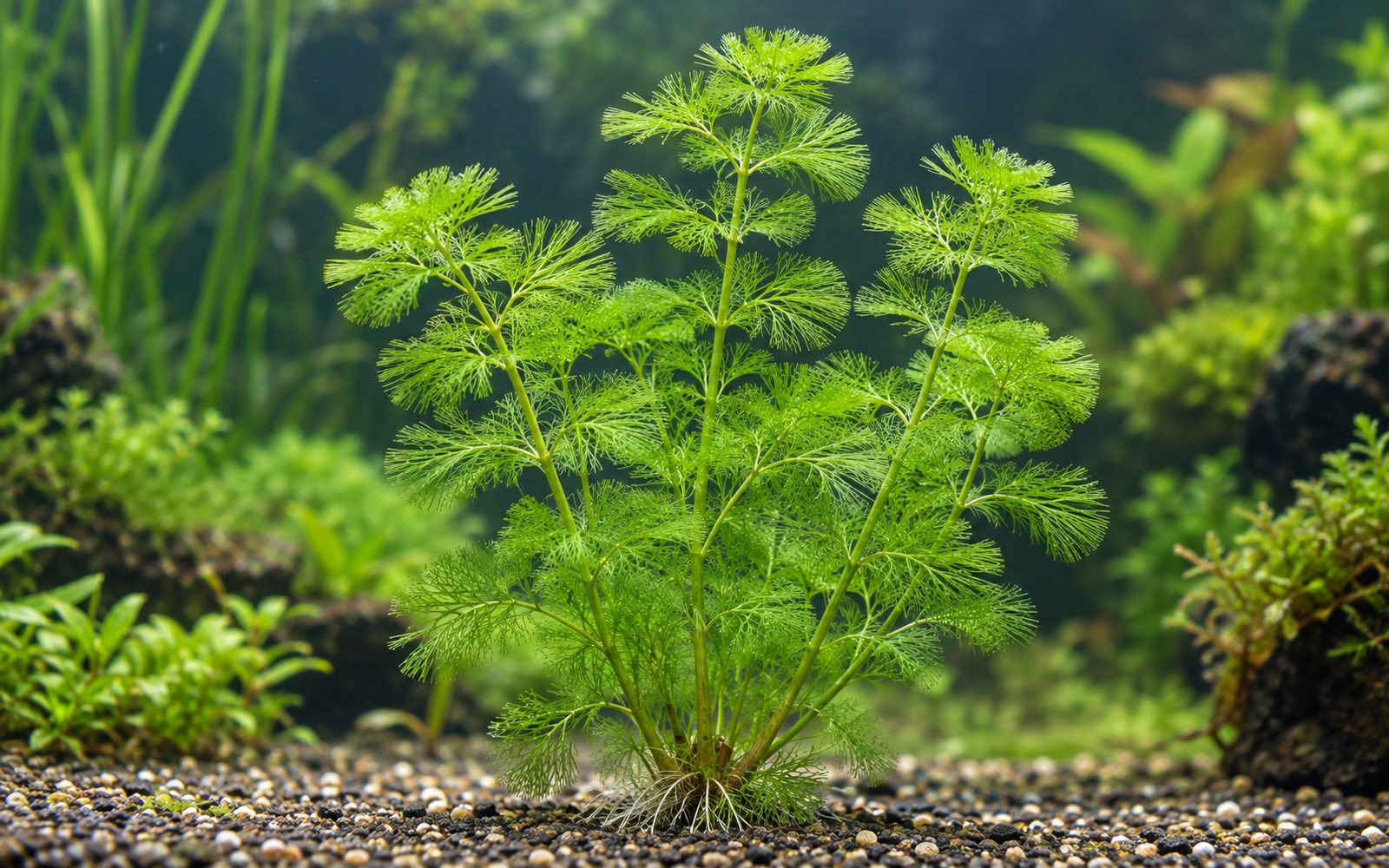
Cabomba gives the background of the aquarium a soft, feathery look with its finely divided, fan-shaped leaves. The leaves are arranged in opposite pairs along the stem; when the stems reach the surface, they can also produce small floating leaves and white flowers. From a distance it resembles ambulia, but it is more demanding.
It grows fast; however, when it does not get enough light and nutrients, its lower leaves drop quickly and the stems become bare. It likes slightly soft water and good light. Its stems are brittle, and it does not like being pulled up and replanted often.
Invasive species: In many countries where it has escaped, cabomba is a serious invasive that chokes lakes and canals. It is on the European Union's list of invasive species, and its sale is banned in EU countries. Trimmings and surplus plants must never be dumped into natural waters; they should be dried and put in the trash.
Planting and Placement
- Stems are planted one by one with 3–4 cm between them; the leaves should not shade each other.
- The leaves on the lower nodes are removed and the stem is buried 3–4 cm deep. The brittle stems are held gently with tweezers.
- It is planted in the background, in a spot that light reaches directly and where the current is not strong.
Care and Fertilization
- Light: Medium to high; in weak light the stems become thin and the lower leaves drop.
- CO₂: Not required, but beneficial; with CO₂ the stems become denser.
- Water: Slightly soft, near-neutral water; it weakens in very hard water.
- Fertilizer: Regular liquid fertilizer, especially iron; the fine structure of the leaves shows deficiencies quickly.
- Trimming: Stems that reach the surface are cut from the top and replanted.
Propagation
It is propagated by top cuttings; the cuttings root easily. The cut lower stem produces side shoots, but because the older lower parts become bare quickly, replanting the tops gives better results.
Common Problems
- Lower leaves dropping and bare stems: The most common problem; caused by insufficient light or shading.
- Pale, yellowish leaves: Iron deficiency.
- Debris caught in the leaves: The fine leaves trap particles; good filtration is needed.
- Reaction to being moved: If pulled up and replanted often, the stem tips die back; choose its spot once and leave it alone.
Hobbyist notes
Things you won't find in books, learned by trial and error. The most helpful ones are on top.
Change history and contributors
- Page created · October 16, 2026