
Water parameters
Overview
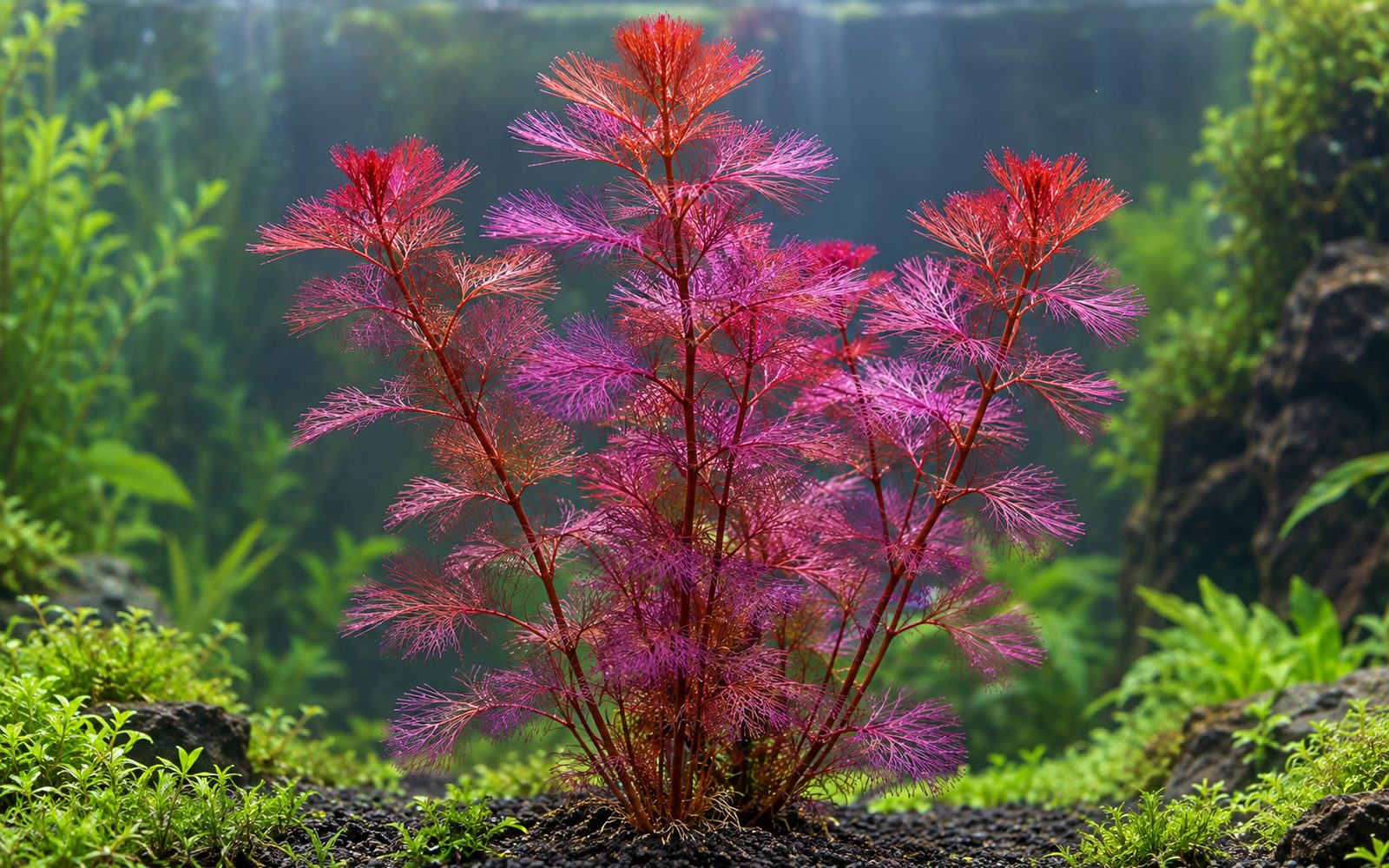
Red cabomba is the red-purple-leaved relative of green cabomba. Its thin, feathery, divided leaves take on red, pink and purple tones in strong light, and when planted in a cluster it becomes the most eye-catching point in the aquarium. However, it is very demanding: it needs soft, acidic water, strong light, constant CO₂ and regular iron supplementation. When any of these conditions is lacking, the leaves fade, the lower parts become bare and the plant falls apart. Its stems are brittle, and it does not like being pulled up and replanted often.
Do not release it into the wild: Cabomba species can become invasive when they get into natural waters; trimmings should go in the trash.
Planting and Placement
- Stems are planted one by one with 3–4 cm between them, held gently with tweezers and buried 3–4 cm deep.
- It is planted in the background, in a spot that gets direct light and where the current is not strong.
Care and Fertilization
- Light: High.
- CO₂: Required.
- Water: Soft (GH 1–8), pH 5.0–7.0.
- Fertilizer: Regular iron and micronutrients; a deficiency quickly shows up as pale leaves.
- Trimming: Cut from the top and replanted; because the older lower parts quickly become bare, the cluster is renewed with fresh tops.
Propagation
Common Problems
Hobbyist notes
Things you won't find in books, learned by trial and error. The most helpful ones are on top.
Change history and contributors
- Page created · October 16, 2026