
Water parameters
Overview
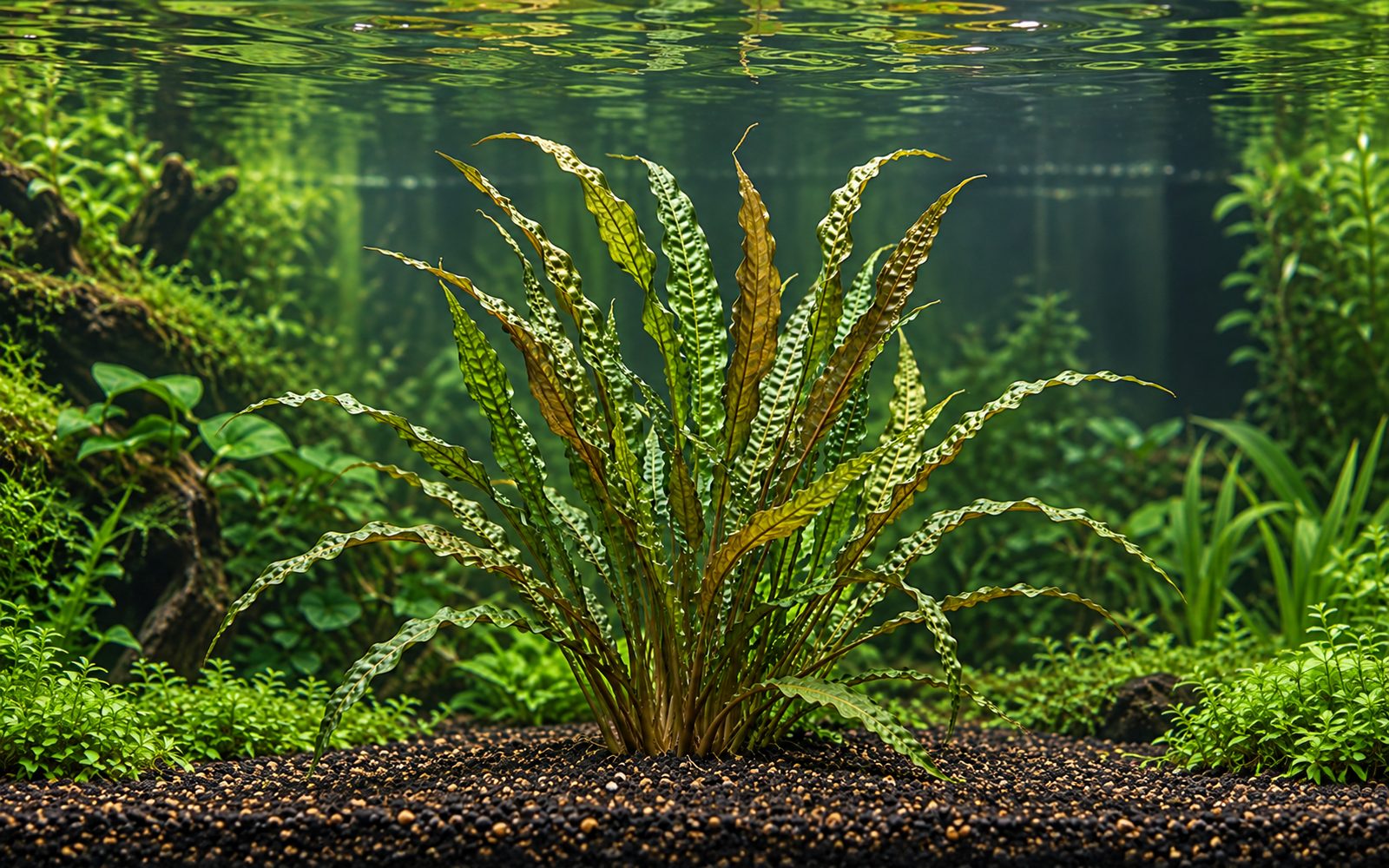
The plant aquarists call "balansae" is, botanically, a variety of the species C. crispatula. Its leaves are 1–2 cm wide, 30–50 cm long, and have a distinctly puckered, crinkled surface. The color ranges from green to bronze; under strong light the reddish tones increase.
Because in nature it grows in streams in limestone regions, it does well in hard, slightly alkaline water. This makes it a good background plant to use instead of soft-water plants in regions where tap water is hard.
Planting and Placement
- Plant it in the background of aquariums at least 40–45 cm tall.
- Its roots go deep; the substrate should be at least 5–6 cm, and root tabs should be placed next to the roots.
- Plant it so that the crown stays exposed.
- Plant clumps 5–8 cm apart; over time they join up through runners.
Care and Fertilization
- Light: Medium. In low light the leaves grow longer but become thin and flop over.
- CO₂: Not essential; with it, it makes a clear difference.
- Fertilizer: A root tab once a month or every two months; it likes water rich in calcium and potassium.
- Water: In very soft water below GH 5, the leaf structure can deteriorate.
- Trimming: You can cut very long leaves lying at the surface off at the base.
Propagation
It multiplies slowly by underground runners. Plantlets can be separated with their roots once they have opened 4–5 leaves. Because it grows slowly, it can take about a year for one clump to fill the background.
Common Problems
- Melting: it may shed its leaves when it comes from an aquarium with different water parameters; if the roots are healthy, it sprouts again.
- Thin, pale leaves: insufficient light or nutrients; add root tabs.
- Algae on the leaf tips: builds up on long-lived leaves; remove algae-covered leaves at the base.
Hobbyist notes
Things you won't find in books, learned by trial and error. The most helpful ones are on top.
Change history and contributors
- Page created · October 16, 2026