
Water parameters
Overview
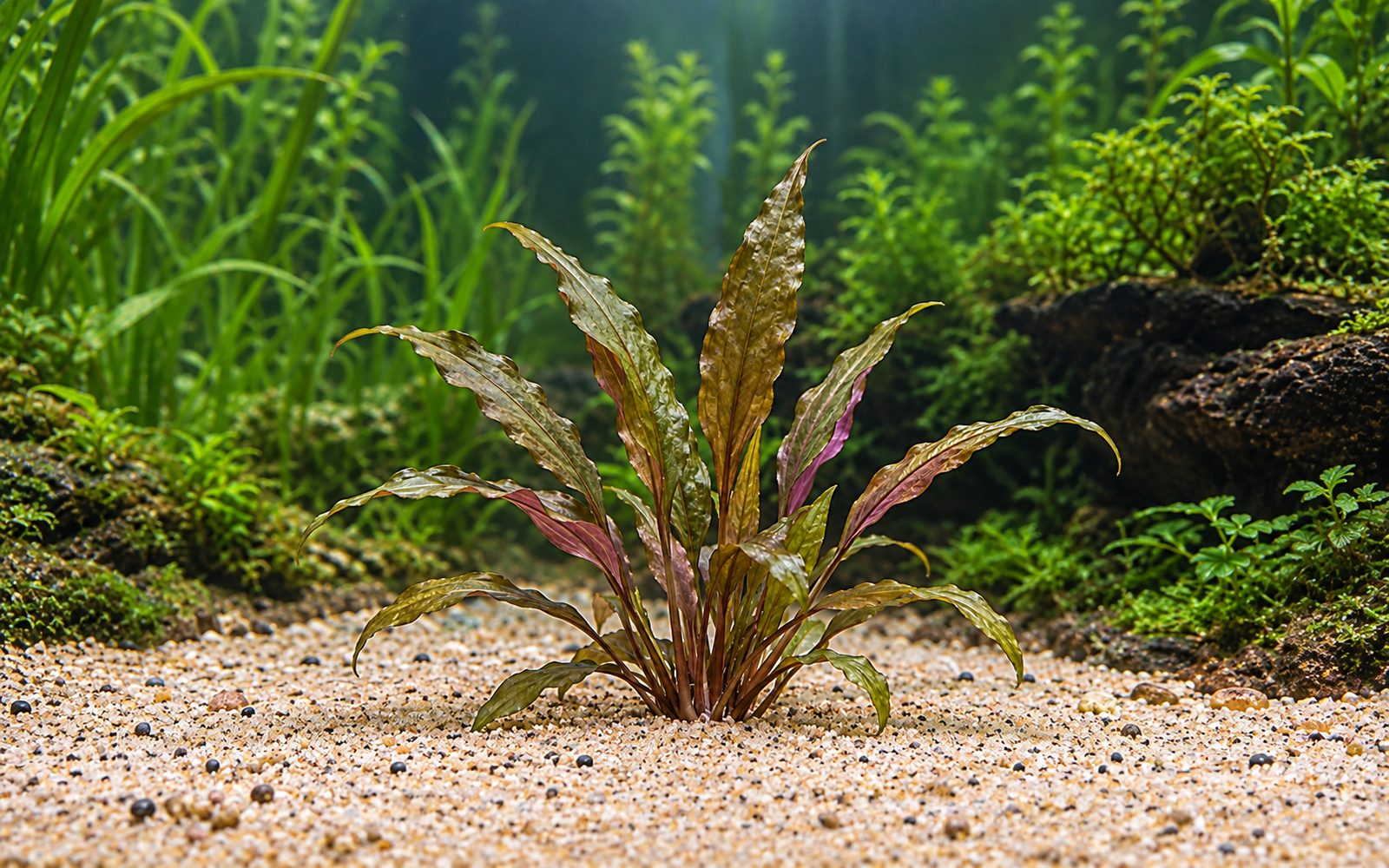
Cryptocoryne beckettii comes from the streams of Sri Lanka and has been kept in aquariums for a very long time. Its lance-shaped leaves range from olive green to bronze-brown on top and are pinkish or purplish underneath; a slight waviness is seen along the edges. Its height varies between 10 and 20 cm depending on the light.
It looks similar to some forms of C. wendtii and is sometimes confused with it in the trade. Its care is also similar: it makes do with little light and, once established, lives for years without problems.
Planting and Placement
- The roots are buried in the sand, and the crown where the leaves emerge stays at the substrate surface.
- It is a plant that feeds through its roots; a nutrient-rich substrate or a root tab buried next to the roots speeds up growth.
- Plant it in the midground in groups of 3–5 plants, leaving 4–5 cm between them.
- Once established, do not move it often; every uprooting means a new adjustment period.
Care and Fertilization
- Light: Low to medium. With more light the leaves get shorter and the bronze tones deepen.
- CO₂: Not required; with it, growth speeds up.
- Fertilizer: A root tab every 2–3 months is enough.
- Water: It also adapts to moderately hard water. It does not like sudden, large water changes; limit changes to 20–30% a week.
Propagation
It multiplies on its own by underground runners; young rosettes appear around the mother plant. When the plantlets have opened a few leaves, they can be separated with their roots and planted elsewhere. As the clump grows, it fills the midground by itself.
Common Problems
- Crypt melt: after planting or when water parameters change suddenly, the leaves turn translucent and rot. If the roots are healthy, new leaves appear within a few weeks; remove the rotting leaves and do not pull up the plant.
- Pale, small leaves: nutrient-poor substrate; add root tabs.
- Holes in the leaves: may be potassium deficiency or snails nibbling.
Hobbyist notes
Things you won't find in books, learned by trial and error. The most helpful ones are on top.
Change history and contributors
- Page created · October 16, 2026