
Water parameters
Overview
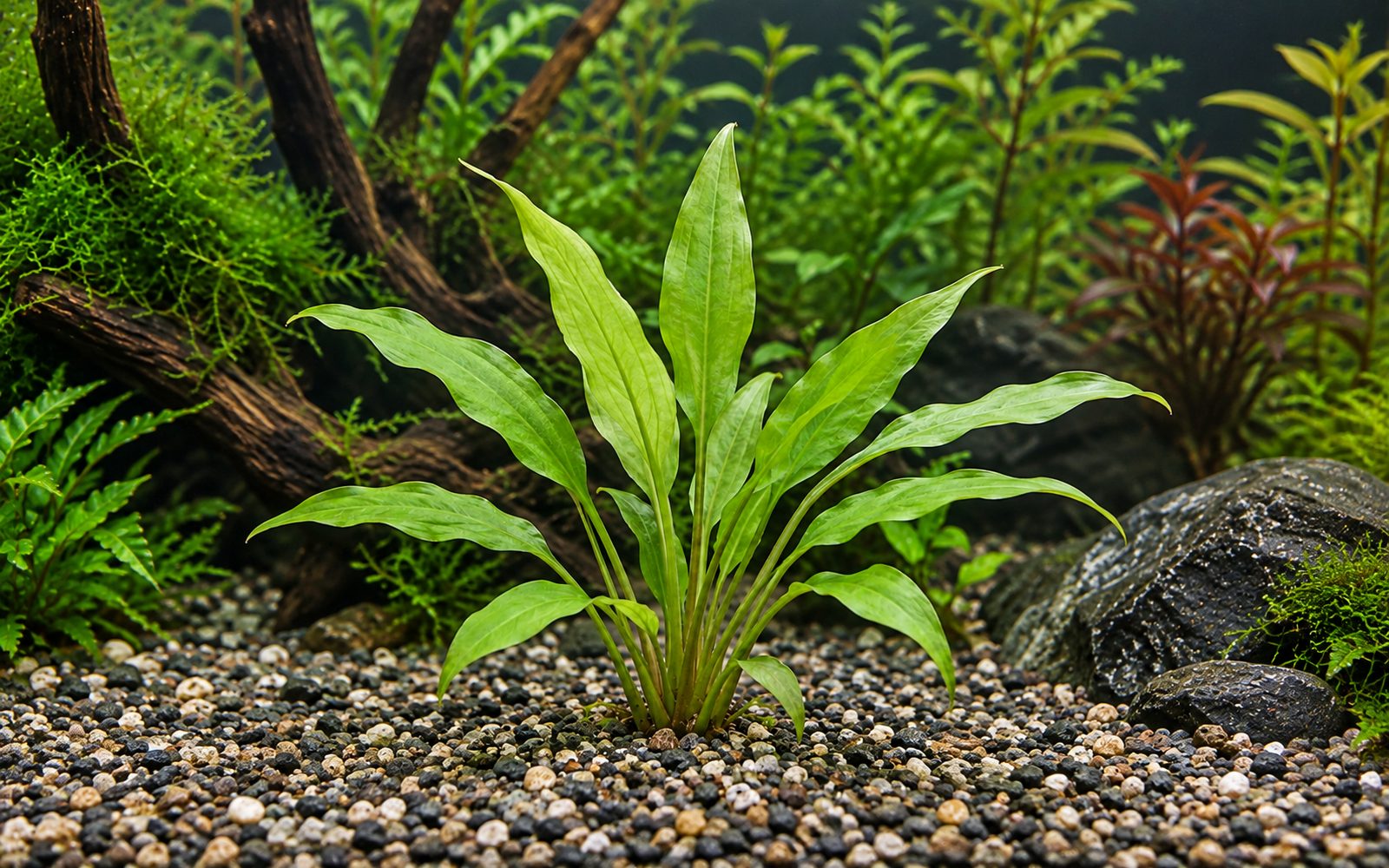
The plant aquarists know as "Cryptocoryne lutea" is botanically considered a form of C. walkeri, which is endemic to Sri Lanka. Its leaves are elongated, lance-shaped, smooth-edged and light to medium green; the surface is smooth. Its height mostly stays between 10 and 20 cm.
It is one of the most forgiving crypts: it grows in soft and moderately hard water, in low light and without CO₂. Its green tone gives a nice contrast when planted next to brown or red crypts.
Planting and Placement
- Bury the roots and leave the crown exposed.
- With a nutrient-rich substrate or root tabs it settles in much faster.
- It is used in the midground, at the base of driftwood and stones, or as an edge plant in small aquariums.
- Plant clumps about 5 cm apart; over time they join up.
Care and Fertilization
- Light: Low to medium. In too much shade the leaves get longer and the stalks thinner.
- CO₂: Not required; with it, new leaves appear more often.
- Fertilizer: A root tab every 2–3 months, optional liquid fertilizer.
- Trimming: Only cut old, yellowed or algae-covered leaves off at the base.
Propagation
It regularly produces plantlets by underground runners. When the young rosettes reach 3–4 leaves, they can be separated with their roots and planted elsewhere. Because it can also be grown emersed, it is propagated in paludariums and humid boxes too.
Common Problems
- Melting: common in plants newly moved underwater (grown emersed). If the roots are healthy, it sprouts again.
- Yellowing: yellowing of old leaves indicates nitrogen or general nutrient deficiency; add root tabs.
- Slow start: there may be no visible growth for the first 3–6 weeks; this is normal.
Hobbyist notes
Things you won't find in books, learned by trial and error. The most helpful ones are on top.
Change history and contributors
- Page created · October 16, 2026