
Water parameters
Overview
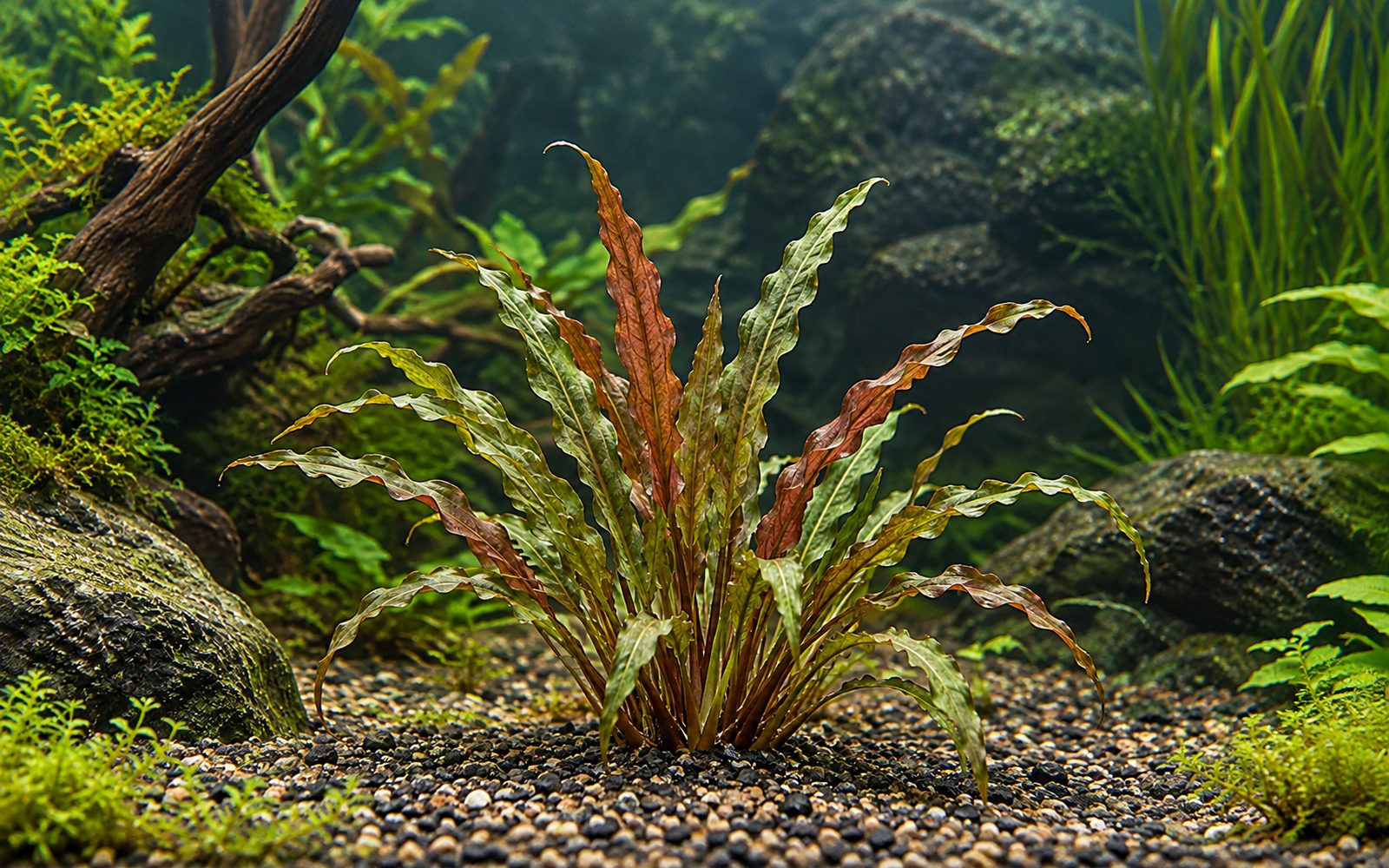
Cryptocoryne undulata takes its name from the distinct waviness of its leaf edges. The leaves are narrow and elongated, lance-shaped; depending on light and form, they can be green, olive green or reddish brown. In the trade there are also broader-leaved forms ("Broad Leaves") and reddish forms.
Its height varies between 15 and 30 cm; so in large aquariums it can be used in the midground, and in 40–60 liter aquariums in the background. It adapts well to hard water and is as easy to care for as C. wendtii.
Planting and Placement
- Bury the roots completely, leaving the crown at the substrate surface.
- Without root tabs or a nutrient-rich substrate it grows slowly and pale.
- Planted in clumps of 3–5 plants along the edges or at the base of driftwood, it gives a natural look.
Care and Fertilization
- Light: Low to medium. Reddish tones become more pronounced with more light.
- CO₂: Not required; with it, growth speeds up and the leaves become denser.
- Fertilizer: A root tab every 2–3 months; a liquid fertilizer containing potassium is beneficial.
- Water changes: 20–30% weekly; avoid sudden changes in temperature and pH.
Propagation
It multiplies by underground runners. Plantlets that appear a few centimeters away from the mother plant can be separated with their roots once they have opened a few leaves. Left undisturbed, the clump eventually forms a dense cluster that fills the background.
Common Problems
- Crypt melt: after fresh planting or a large water change, the leaves may rot and fall off. Leave the roots; it will leaf out again within a few weeks.
- Holes and yellowing at the leaf tips: usually potassium deficiency.
- Leaves stretching and flopping over: too little light; move the plant to a brighter spot or thin out the floating plants above it.
Hobbyist notes
Things you won't find in books, learned by trial and error. The most helpful ones are on top.
Change history and contributors
- Page created · October 16, 2026