
Water parameters
Temperature20–28°C
pH6–7.5
General hardness (GH)2–12 dGH
Recommended range
Overview
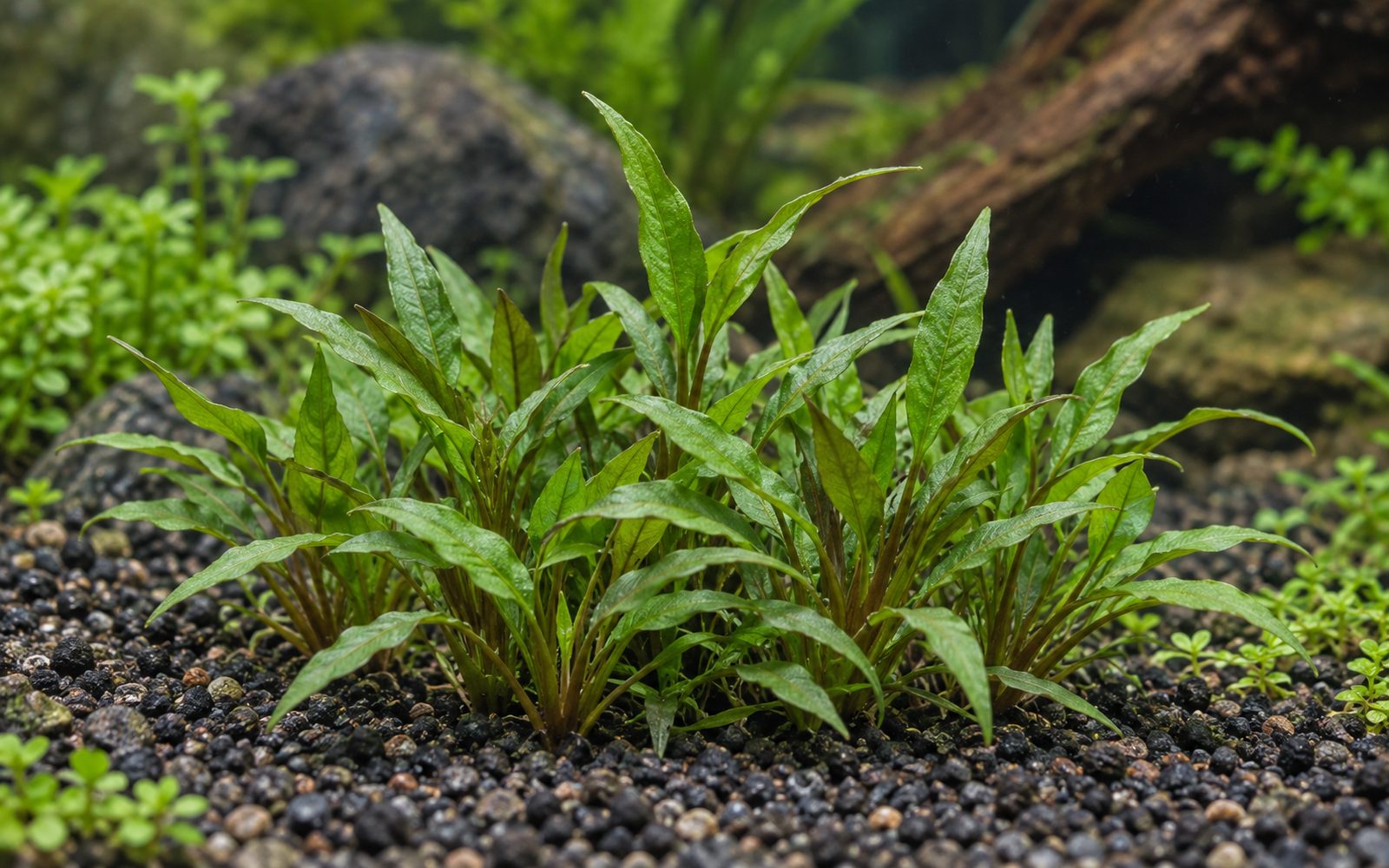
Cryptocoryne × willisii is a hybrid that arose naturally in Sri Lanka. It produces narrow, lance-shaped, medium green leaves and usually stays 5–10 cm tall in the aquarium. Among the crypts used in the foreground, it is an option that is slightly larger and spreads faster than C. parva. It is suitable for a low foreground that needs no trimming.
Planting and Placement
Divide the clump into small pieces and plant them 3–4 cm apart; the roots must be buried and the crown left exposed. Fine-grained sand or a nutrient-rich aquasoil is suitable. Choose a spot where it will not be shaded by tall plants.
Care and Fertilization
- Light: Medium; in low light the leaves stretch and the clump thins out.
- CO₂: Not required, but it speeds up spreading.
- Fertilizer: A root tab every 2–3 months.
- It spreads through underground runners; leave the daughter plants in place for a carpet. Its slow-growing leaves can collect algae, so keep the photoperiod to no more than 8 hours a day.
Propagation
This section has not been written yet. How is it propagated?
Be the first to write it
Common Problems
This section has not been written yet. Problems such as melting, yellowing and algae, and how to fix them.
Be the first to write it
Hobbyist notes
Things you won't find in books, learned by trial and error. The most helpful ones are on top.
No notes yet. If you have experience with this species, leave the first note.
Was this page helpful?
Change history and contributors
- Page created · October 16, 2026