
Water parameters
Overview
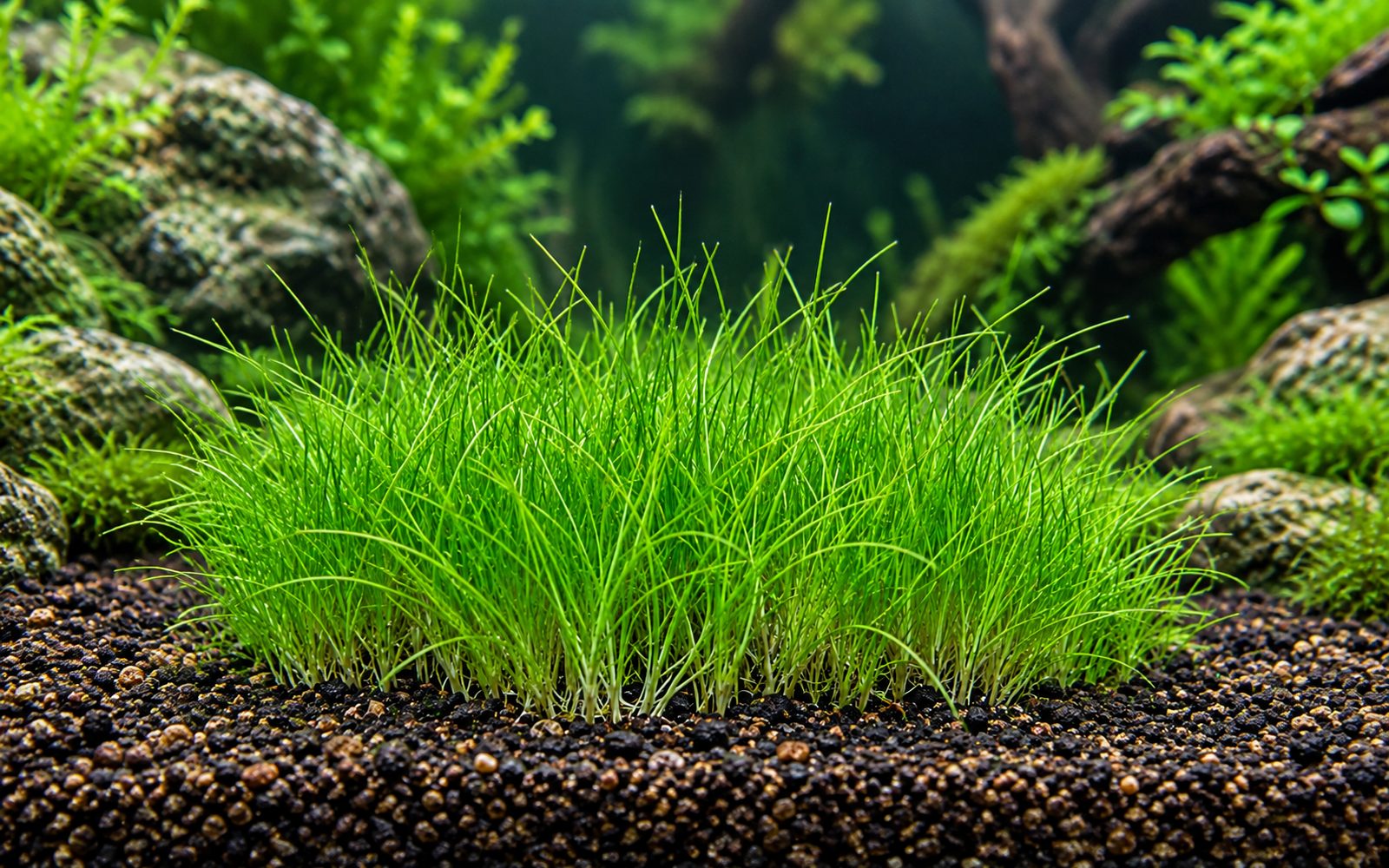
Dwarf hairgrass is a sedge that turns the aquarium foreground into a real lawn with its thin, needle-like leaves and underground runners. It occurs naturally on the shallow shores of lakes and ponds in the temperate regions of the Northern Hemisphere, so it adapts to a wide temperature range.
Its appearance changes with light: in an aquarium with strong light and CO₂ it forms a dense, even lawn 5–10 cm tall; under medium light the leaves grow up to 15 cm and stay sparser. It is often confused with plants sold as Eleocharis parvula; their care is the same. The shorter 'Mini' form is also sold as a separate plant.
Planting and Placement
- Divide the clump from the nursery pot into small, rooted bunches of 5–10 leaves.
- Plant the bunches with tweezers 2–3 cm apart and 1–2 cm deep; dense planting helps the carpet close faster.
- If the leaf tips are trimmed to 3–4 cm before planting, the plant puts its energy into rooting and new runners.
Care and Fertilization
- Light: Medium; strong light is needed for a short, dense lawn.
- CO₂: Not required, but clearly beneficial; it increases the spreading rate.
- Fertilizer: Root tabs and liquid fertilizer; a nutrient-rich substrate speeds up spreading.
- Trimming: Trim to the desired height with long scissors, like mowing a lawn. Regular trimming encourages new shoots.
Propagation
It spreads on its own by underground runners; a new clump forms at the end of each runner. Clumps are propagated by separating them with their roots and planting them elsewhere.
Common Problems
- Slow spreading: insufficient light, CO₂ or nutrients. Patience is needed; the first month is usually slow.
- Browning leaf tips: normal on aging leaves; once trimmed, new ones replace them.
- Algae and debris between the leaves: a dense lawn traps particles; siphon it gently during water changes.
- Thick, old layer rotting: a carpet that becomes too dense is pulled up and renewed in sections from time to time.
Hobbyist notes
Things you won't find in books, learned by trial and error. The most helpful ones are on top.
Change history and contributors
- Page created · October 16, 2026