
Water parameters
Temperature18–28°C
pH6–7.5
General hardness (GH)2–15 dGH
Recommended range
Overview
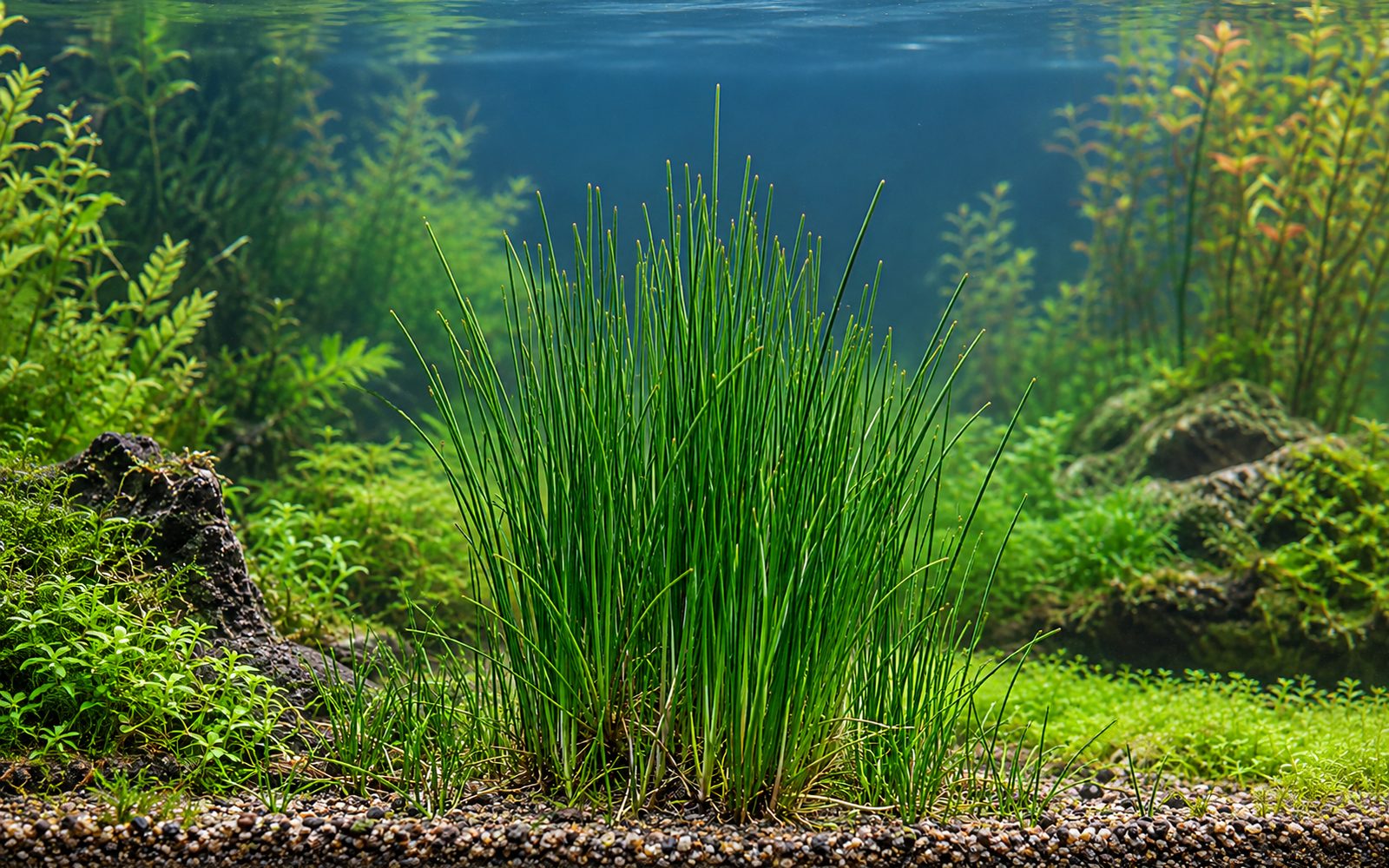
The plant sold in the trade as Eleocharis montevidensis or "giant hairgrass" is a much larger relative of dwarf hairgrass (E. acicularis). Its thin, round, dark green stems rise straight up and reach 30–40 cm. Whether the plants sold under this name really belong to the species E. montevidensis is debated; that is why most sources use the name Eleocharis sp. 'Montevidensis'. It is also confused with the similar-looking E. vivipara; however, 'Montevidensis' does not form plantlets at the stem tips and stays upright.
Planting and Placement
- Divide the clump into small bunches of 3–5 stems and plant them 2–3 cm apart, burying their roots.
- It is used in the background, in corners or behind stones and driftwood.
- Make sure it is not shaded by larger plants; it can take a few weeks after planting before it starts to grow.
Care and Fertilization
- Light: Medium to high. In shallow water the stems can reach the surface and topple over.
- CO₂: Not required, but noticeably speeds up growth.
- Fertilizer: It feeds through its roots; a nutrient-rich substrate or root tabs are recommended.
- When it spreads too much, pluck off runners spilling over the edge; propagation is done with these runners or by dividing the clump.
Propagation
This section has not been written yet. How is it propagated?
Be the first to write it
Common Problems
This section has not been written yet. Problems such as melting, yellowing and algae, and how to fix them.
Be the first to write it
Hobbyist notes
Things you won't find in books, learned by trial and error. The most helpful ones are on top.
No notes yet. If you have experience with this species, leave the first note.
Was this page helpful?
Change history and contributors
- Page created · October 16, 2026