
Water parameters
Overview
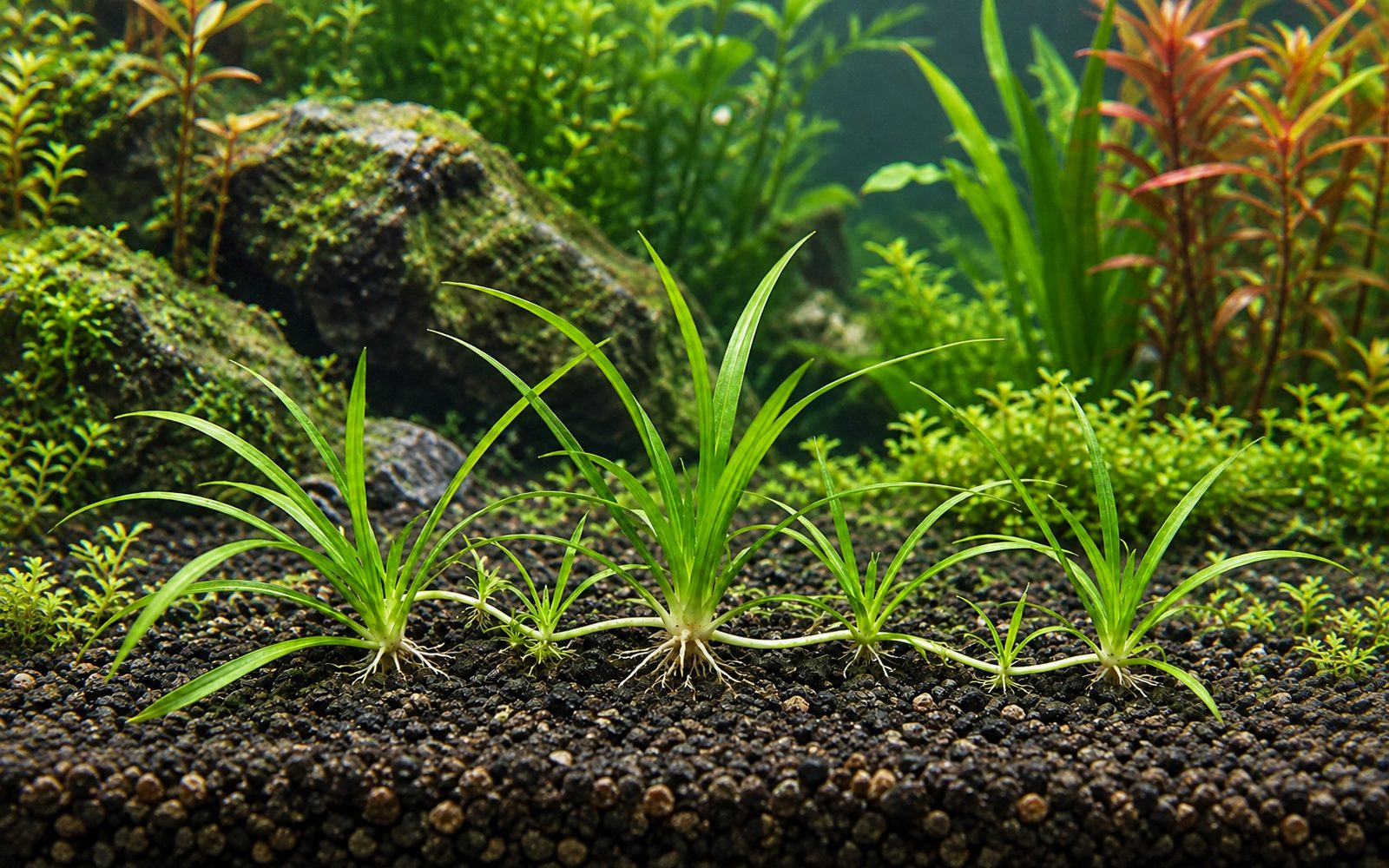
Sagittaria subulata is an aquatic plant that grows as rosettes of narrow, strap-like, dark green leaves. It spreads very easily by runners and covers the substrate with a low lawn. It is one of the hardiest foreground carpeting plants: it needs no CO₂ and adapts to a wide range of temperature and hardness.
Its height depends on light: under strong light it stays at 5–10 cm and behaves like a true foreground plant. In weak light, however, the leaves can grow longer than 30 cm and the plant becomes suitable for the midground and background. This flexibility makes it a good option for those who want a carpet in an aquarium without CO₂.
Planting and Placement
- Separate the rosettes one by one, trim the roots slightly and plant them 3–4 cm apart.
- The crown, where the leaves emerge, should stay just above the substrate.
- Even if planted sparsely over a wide area of the foreground, the runners fill the gaps within a few months.
Care and Fertilization
- Light: Medium; strong light is better for keeping it low.
- CO₂: Not required.
- Fertilizer: It feeds through its roots; root tabs speed up spreading.
- Trimming: Usually not needed. Old leaves that grow too long are cut at the base; runners spreading into unwanted places are pulled out.
Propagation
It multiplies on its own and quickly by runners. When the new plants at the ends of the runners open a few leaves, they are separated and planted elsewhere.
Common Problems
- Leaves growing too long: the light is weak or it is being shaded by tall plants above.
- Yellowing leaves: lack of root nutrients, especially iron.
- Spreading getting out of control: runners push in among neighboring plants; thin them out regularly.
Hobbyist notes
Things you won't find in books, learned by trial and error. The most helpful ones are on top.
Change history and contributors
- Page created · October 16, 2026