
Water parameters
Overview
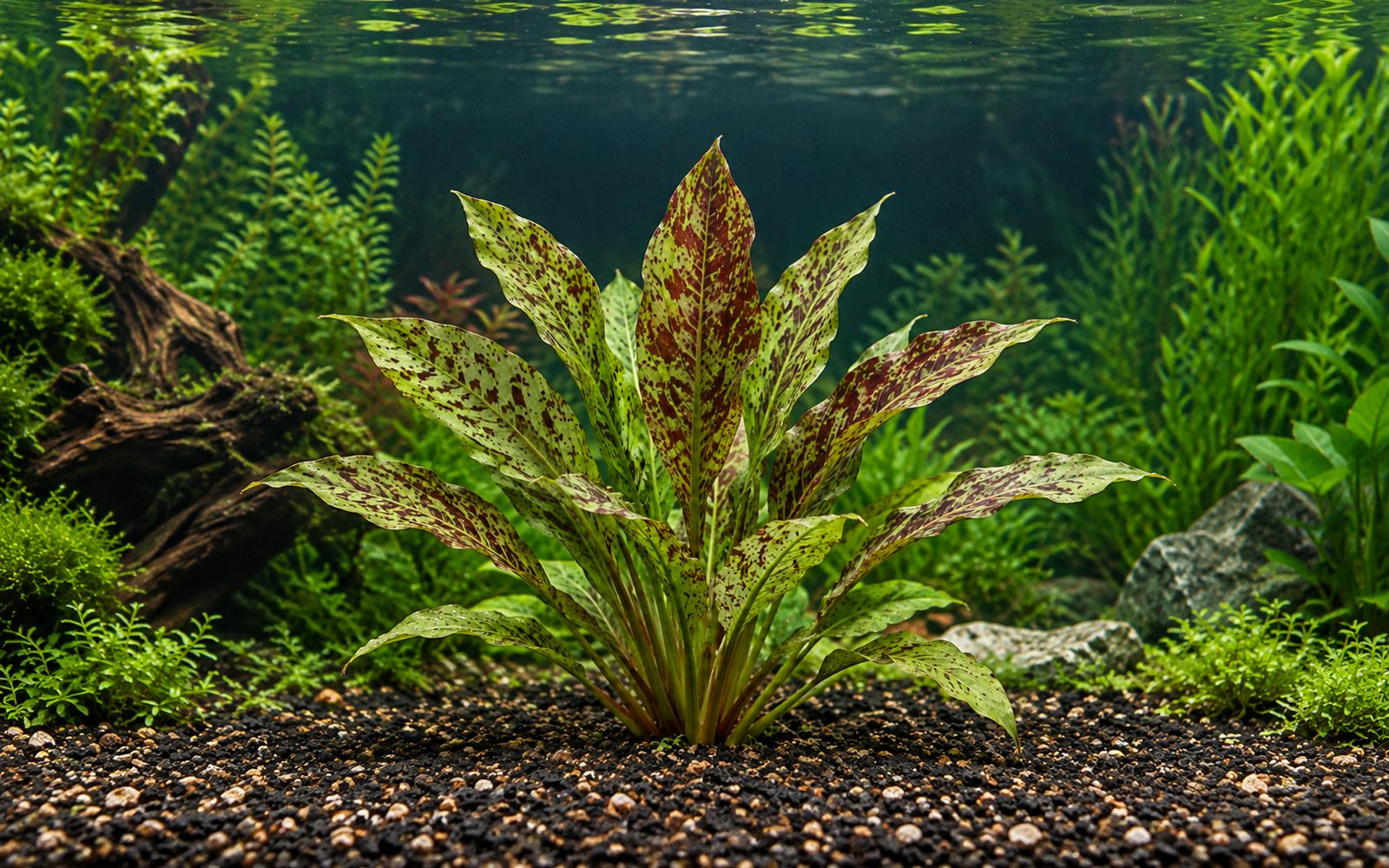
Echinodorus 'Ozelot' is a hybrid bred for the aquarium from South American sword plants. Its lance-shaped or oval leaves are decorated with dark reddish-brown spots on a green background; its name comes from the resemblance of this pattern to the ocelot (German: Ozelot), a wild cat known for its spotted coat. In the trade there are greener ("Ozelot Green") and reddish ("Ozelot Red") forms. In the aquarium it usually stays at 20–40 cm.
Thanks to hybrid vigor it is more forgiving than the Amazon sword: it adapts well to hard water, setups without CO₂ and medium light. In aquariums of 60 liters or more it is used on its own as a focal plant.
Planting and Placement
- Bury the roots completely, leaving the top of the rhizome and the crown where the leaves emerge exposed.
- Its roots spread wide and deep; at least 6 cm of substrate and a root tab placed under the roots are essential.
- Leave at least 20–25 cm of open space around it; as its leaves spread, it shades its neighbors.
Care and Fertilization
- Light: Medium. The spots darken under sufficient light.
- CO₂: Not required; with it the leaves are more numerous and larger.
- Fertilizer: A root tab once a month; a liquid fertilizer containing iron supports the colors.
- Trimming: Cut old, algae-covered or yellowing leaves in the outer ring off at the base of the stalk. It may occasionally produce very long-stalked leaves, which you can also remove.
Propagation
With enough nutrients and light it forms a flower stalk that grows toward the water surface; plantlets develop on this stalk. When the plantlets have produced a few leaves and roots, they are cut off and planted in the substrate. On older plants the rhizome can be divided with a sharp knife so that each piece keeps leaves and roots.
Common Problems
- Yellowing leaves and faded spots: nutrient deficiency, especially iron; add root tabs.
- Leaves with holes: potassium deficiency or snails.
- Leaf loss: it is normal for a few leaves to melt after transport or after the switch from emersed to submersed growth; new leaves come out in the submersed form.
Hobbyist notes
Things you won't find in books, learned by trial and error. The most helpful ones are on top.
Change history and contributors
- Page created · October 16, 2026