
Water parameters
Overview
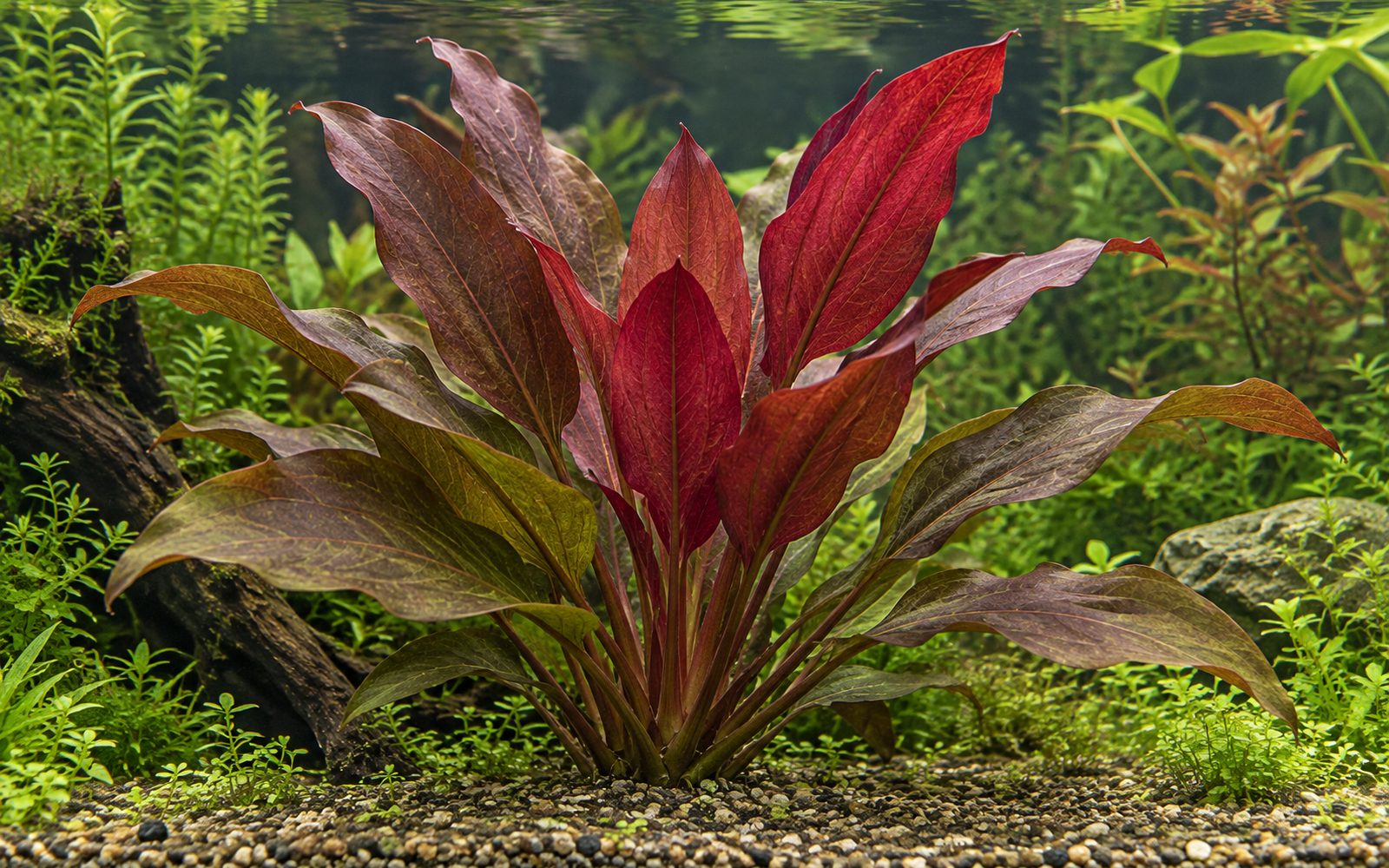
Echinodorus 'Red Rubin', also sold in the trade as 'Rubin', is a large sword plant hybrid bred for the aquarium. New leaves are deep red or wine-colored; as they age they turn reddish brown and olive green. This color transition gives the plant a lively look. In the aquarium it can reach 30–50 cm in height and the same width.
It is easy to care for, but because of its size it is suitable for aquariums of at least 100–120 liters. In small aquariums it soon overshadows the other plants.
Planting and Placement
- Bury the roots completely, leaving the crown exposed.
- Its roots are strong and extensive; provide at least 6–8 cm of substrate and place a root tab under the roots.
- Plant it in the background or, in large aquariums, on its own as a focal plant, leaving plenty of space around it.
Care and Fertilization
- Light: Medium. In low light the leaves turn green and the stalks lengthen.
- CO₂: Not required; red tones and growth rate increase noticeably with CO₂.
- Fertilizer: A root tab once a month; a liquid fertilizer containing iron supports the red color.
- Trimming: Cut old leaves in the outer ring off at the base. You can also remove leaves that stretch toward the surface trying to grow above the water.
Propagation
It forms plantlets on the flower stalk. If the stalk is kept underwater, the plantlets root there; when they have opened a few leaves, they are cut off and planted. It can also be propagated by dividing the rhizome; each piece must have leaves and roots.
Common Problems
- Color fading: insufficient light or iron.
- Small, pale new leaves: root nutrients are depleted; replace the root tabs.
- Algae on old leaves: prune the slowly renewing outer leaves; keep the photoperiod at 8 hours a day.
Hobbyist notes
Things you won't find in books, learned by trial and error. The most helpful ones are on top.
Change history and contributors
- Page created · October 16, 2026