
Water parameters
Overview
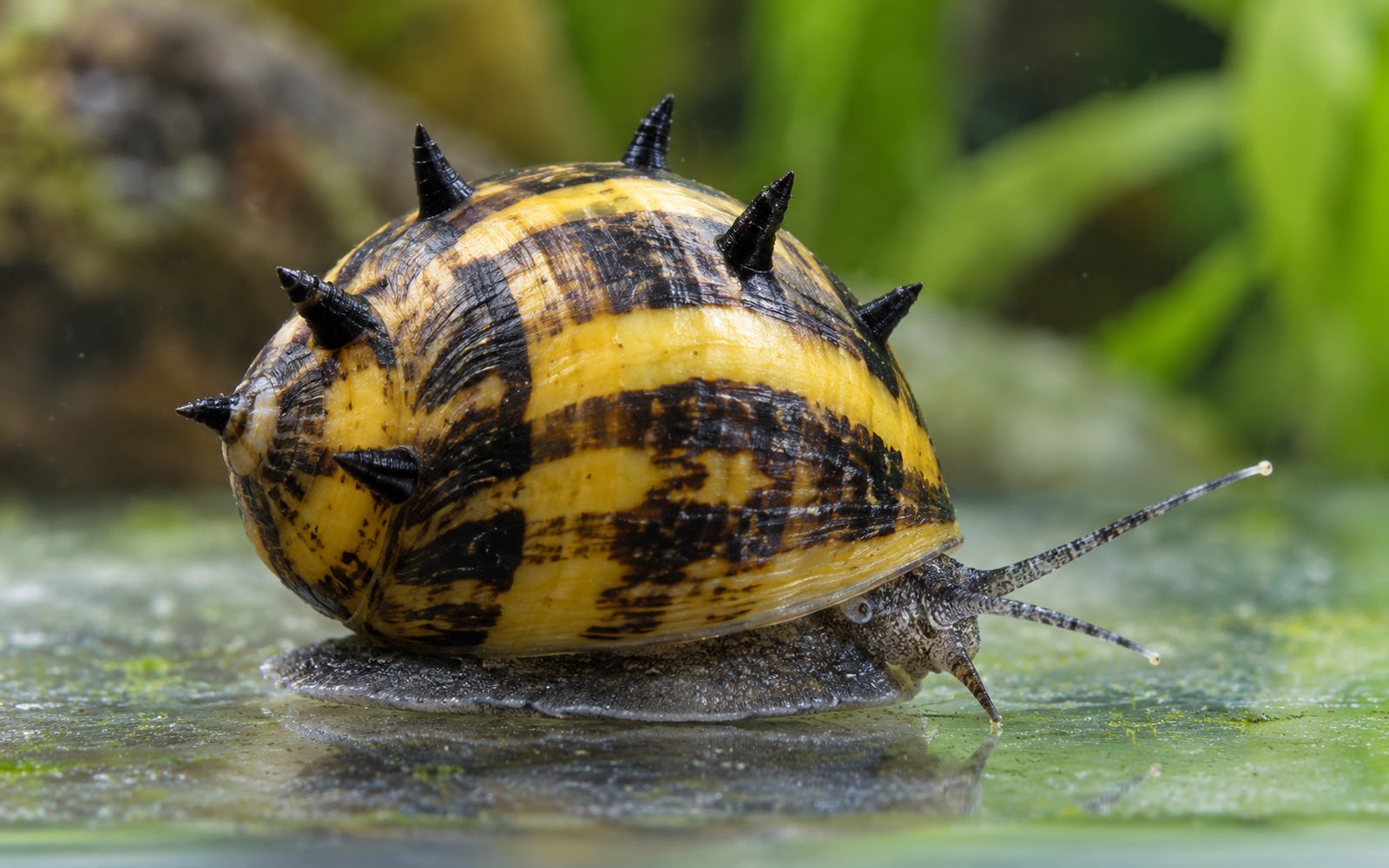
The horned nerite is a small nerite snail recognized by the short, sharp spines protruding from the upper part of its shell. Shell color varies from individual to individual: some are banded yellow and black, while others are almost entirely dark. The number and length of the spines also vary; in some individuals they may be worn or broken.
Like other nerites, it cleans by scraping green algae and biofilm off the glass, stones and leaves. Thanks to its small size it is very well suited to nano aquariums and shrimp tanks. Its biggest advantage is that it does not reproduce in fresh water.
Natural Habitat
It lives in the Indo-Pacific region, in the lower reaches of rivers near the sea and in estuaries. It grazes on algae while clinging to stones and rocks. Its larvae drift out to sea, and the juveniles return to fresh water.
Tank Setup
- Volume: 10 liters or more; 1–2 individuals per 10–20 liters, depending on the amount of algae.
- Water: pH 7 or above, moderately hard to hard water. In soft, acidic water the shell erodes and the spines break.
- Lid: it can climb above the waterline and out of the aquarium; use a lid or keep the water level slightly low.
- Copper: lethal to snails.
- Acclimation: slowly, using the drip method; sudden changes in pH and hardness can cause it to close its shell and stay motionless for days.
Diet
Its main food is algae and biofilm. When algae runs low, it should be supplemented with spirulina tablets, algae wafers and blanched vegetables (zucchini, spinach); a starving nerite weakens. Calcium in the water is important for shell health.
Behavior and Compatibility
Completely peaceful; it leaves fish, shrimp and plants alone. A nerite that flips over may not be able to right itself; turn over any that stay upside down for a long time.
Good companions: almost any peaceful community; shrimp and nano aquariums in particular.
Avoid: snail-eating species (clown loach, pea puffer, large cichlids), crayfish, medications containing copper.
Group and Colony Structure
It has no social needs; it lives on its own. Numbers are determined by the amount of algae in the aquarium; thanks to its small size, 1–2 individuals are enough in a 10-liter nano aquarium. Excess nerites go hungry when the algae runs out; in that case they should be fed tablets and vegetables.
Breeding
Females deposit small, white egg capsules resembling sesame seeds on hard surfaces (stones, roots, glass). The larvae that hatch from these eggs cannot survive in fresh water, so there is no lasting reproduction in the aquarium. The white dots may spoil the look, but they wear away over time.
Health and Common Problems
- Shell erosion: low pH and low hardness. Keep the pH above 7; add coral sand or cuttlebone if needed.
- Starvation: the most common cause of loss in aquariums that have run out of algae.
- Poisoning: copper and many antiparasitic medications are lethal.
Sexing
Cannot be distinguished externally. Individuals that lay eggs are female.
Tank mates
This list is calculated automatically from the species profile and grows as new species are added to the catalog. Try it in the planner for a definite answer.
Usually compatible









Hobbyist notes
Things you won't find in books, learned by trial and error. The most helpful ones are on top.
Change history and contributors
- Page created · October 16, 2026