
Water parameters
Overview
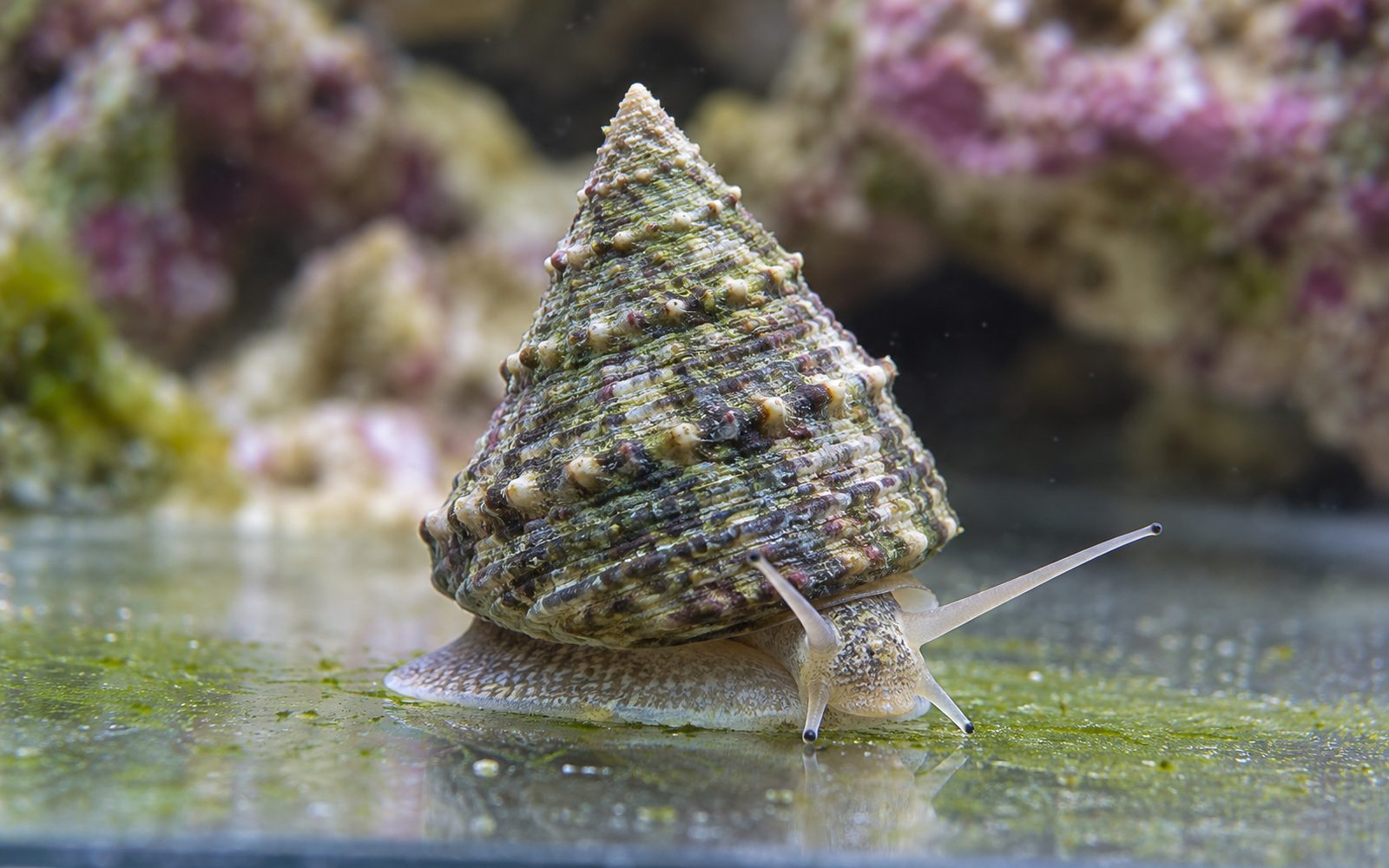
With its pyramid-shaped shell and small size, the Astraea snail is one of the core members of the reef aquarium cleanup crew. Its greenish-gray shell has slanting ridges; the shell is often covered by coralline algae growing on it. Day and night it scrapes the algae film, diatoms and short filamentous algae off the glass, rocks and pipes.
Although it is known in the hobby as "Astraea", the valid scientific name of the species is Lithopoma tectum. Its best-known weakness is that when it falls upside down on the sand, it often cannot right itself. Those on the market are wild-collected.
Natural Habitat
It lives on the shallow rocky areas, seagrass beds and coral rubble of Florida, the Bahamas and the Caribbean. It feeds by roaming over hard surfaces covered in algae. It has little to do with sandy bottoms, which is why it struggles to climb back from the sand onto the rock.
Tank Setup
- Volume: 40 liters and above; 1–2 snails per 20 liters, depending on the amount of algae.
- Water: Salinity specific gravity 1.023–1.026, pH 8.1–8.4, temperature 24–27°C. Calcium and alkalinity should be kept stable for shell health.
- Reef compatibility: Reef-safe; it leaves corals and other organisms alone.
- Acclimation: It is sensitive to differences in salinity; it should be acclimated by the drip method for at least 1 hour.
- Medication: Copper-based medications kill snails.
Diet
Herbivorous; it feeds on algae film, diatoms and short filamentous algae. It is not as effective as the turbo snail against long filamentous algae. When algae run low, it should be supplemented with pieces of nori or algae tablets.
Behavior and Compatibility
Peaceful and slow. During the day it roams the glass and rocks, and at night mostly the rock surfaces. It commonly falls from the tops of rocks onto the sand and ends up upside down; a snail that has not turned over within a few hours should be righted, otherwise it starves or becomes food for scavengers.
Good companions: Almost all reef-safe fish; shrimp, other snails, the scarlet reef hermit crab.
Avoid: Triggerfish, pufferfish, large wrasses; aggressive hermit crabs without spare shells.
Group and Colony Structure
It has no social needs. Thanks to its small size it can be kept in higher numbers than turbo snails; the general rule is 1–2 snails per 20 liters. Excess individuals go hungry once the algae runs out.
Breeding
The sexes are separate; it releases its eggs and sperm into the water. The larvae develop as plankton and do not survive in the aquarium; it does not breed under home conditions.
Health and Common Problems
- Turning upside down: The most common cause of death; regularly check the sand for upside-down snails.
- Shell erosion: Low calcium and alkalinity.
- Starvation: If there is no algae left to clean on the glass and rocks, the snail becomes inactive; supplementary food should be given or the number reduced.
- Sudden deaths: Copper, rapid acclimation, a sudden change in salinity.
Sexing
Cannot be distinguished externally. Spawning is rarely observed and no young are seen in the aquarium; for this reason sex is of no importance for care.
Tank mates
This list is calculated automatically from the species profile and grows as new species are added to the catalog. Try it in the planner for a definite answer.
Hobbyist notes
Things you won't find in books, learned by trial and error. The most helpful ones are on top.
Change history and contributors
- Page created · October 16, 2026