
Water parameters
Overview
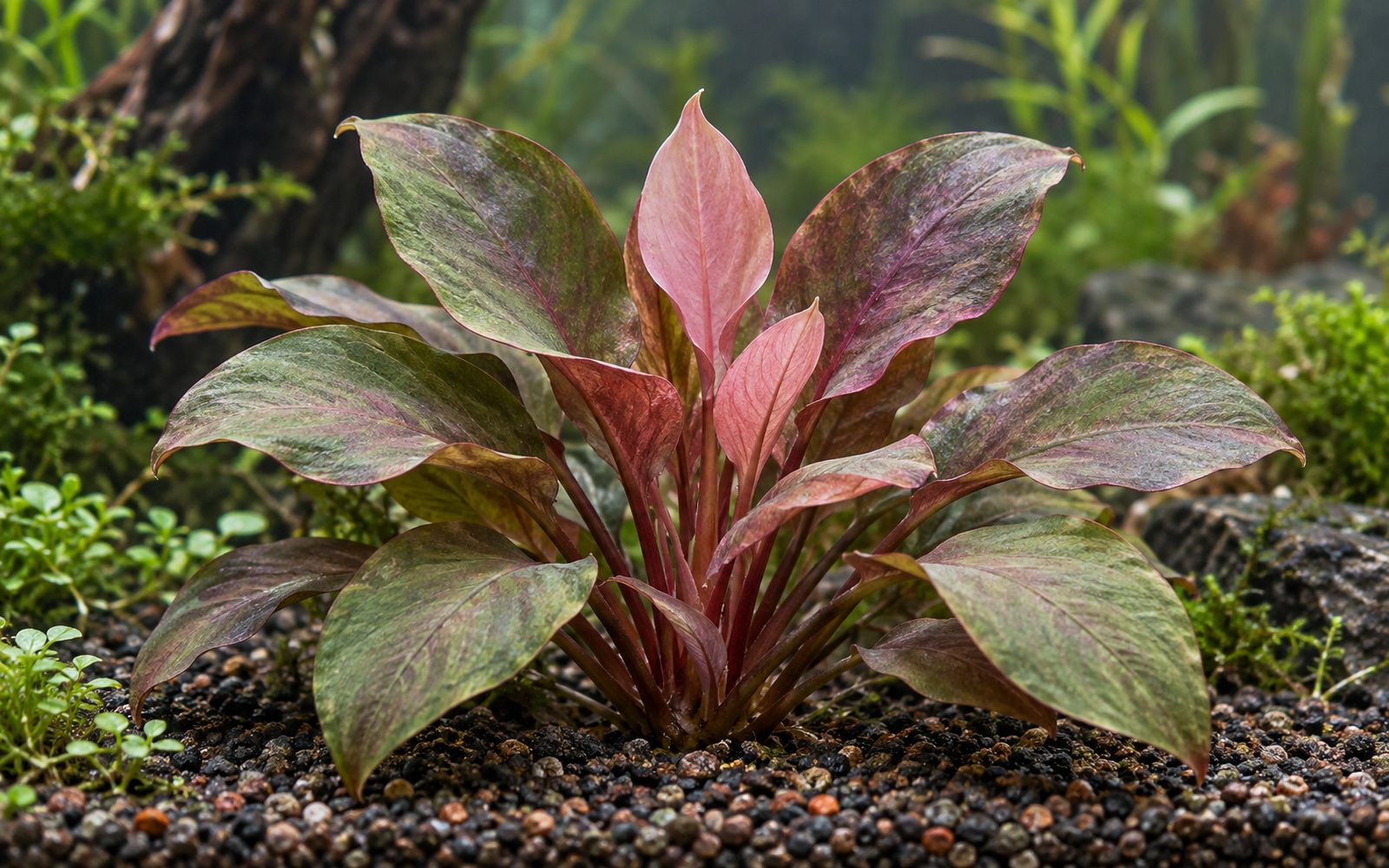
Lagenandra meeboldii is an aroid that grows along creek banks in southwestern India, on muddy ground, sometimes emersed and sometimes submersed. The 'Red' form comes from red-leaved plants collected in the Hassan region. It is a close relative of the cryptocorynes and resembles them; however, it does not spread by underground runners but grows from a thick rhizome.
Its broad, oval leaves reach 8 cm in width. The color is highly variable: dusty green, bright purple and red tones can be seen together on the same leaf; new leaves open light pink. The plant stays at 10–15 cm for a long time and over time can grow to 20 cm or more. It is used as a focal plant in small aquariums and as a color accent in the midground of large ones.
Planting and Placement
- It is planted like a crypt: the roots and rhizome are buried in the substrate, and the crown where the leaves emerge stays exposed.
- Because it feeds through its roots, a nutrient-rich substrate or a root tab buried next to the roots speeds up growth.
- Do not move it often after planting; it takes a few weeks to settle in.
Care and Fertilization
- Light: Medium. Under stronger light the red and purple tones increase; in low light the plant turns green and its growth almost stops.
- CO₂: Not required, but contributes to growth and color.
- Fertilizer: Root tabs every 2–3 months; liquid fertilizer is supportive.
- Location: Choose an open spot where it will not be shaded by other plants.
Propagation
Because it does not produce runners, propagation is slow. When the rhizome has grown long enough and formed several leaf clusters, it is divided with a sharp knife and each piece is planted separately. Plantlets also appear from the rhizome from time to time; they can be separated once their roots have developed.
Common Problems
- Leaf loss after planting: emersed-grown plants may melt some of their leaves when moved underwater, similar to crypts. If the rhizome is healthy, new leaves appear; do not pull up the plant.
- Color turning green: the light is insufficient or the plant is shaded.
- Very slow growth: nutrient-poor substrate; add root tabs.
Hobbyist notes
Things you won't find in books, learned by trial and error. The most helpful ones are on top.
Change history and contributors
- Page created · October 16, 2026