
Water parameters
Temperature22–28°C
pH5.5–6.8
General hardness (GH)1–6 dGH
Recommended range
Overview
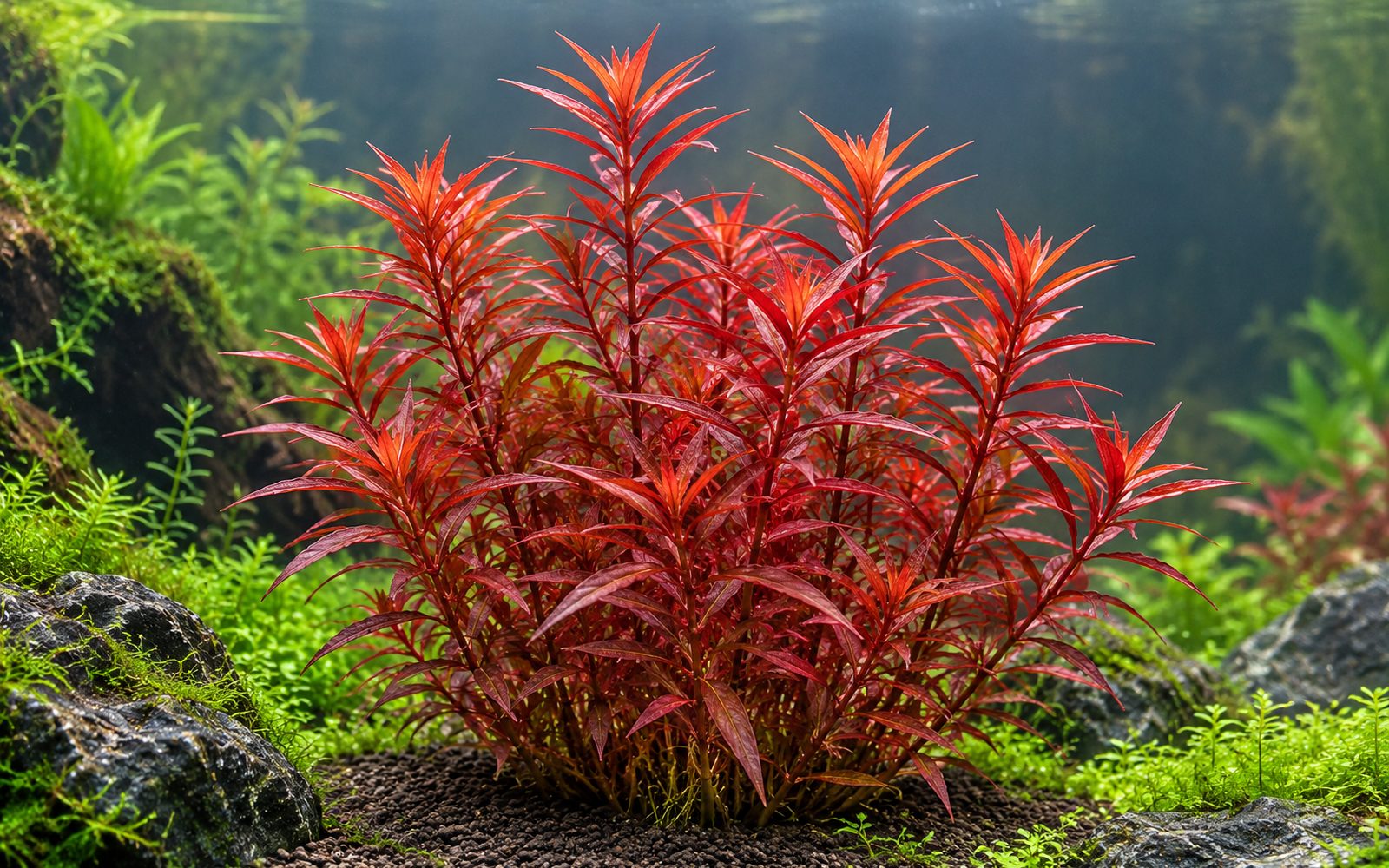
Ludwigia inclinata 'Cuba' is a rare ludwigia form whose leaves are arranged not in pairs but in whorls (verticils) along the stem. Under the right conditions the narrow, pointed leaves turn from orange to deep red, and from a distance the plant looks like a red bush. This look can only be achieved with careful care: soft, acidic water, strong light, constant CO₂ and regular iron supplementation are essential. When these conditions are not met, the leaves become smaller and the plant declines.
Planting and Placement
- Stems are planted singly or in groups of 2–3, 3–4 cm apart.
- It is placed in the background, in the area that gets the best light.
- A nutrient-rich active substrate that softens the water makes things much easier.
Care and Fertilization
- Light: High.
- CO₂: Required.
- Water: Very soft (GH 1–6), slightly acidic water.
- Fertilizer: Iron, potassium and micronutrients should be dosed regularly; if nitrate runs out completely, the leaves become stunted.
- Trimming: Cut from the top; healthy cut tops are replanted.
Propagation
This section has not been written yet. How is it propagated?
Be the first to write it
Common Problems
This section has not been written yet. Problems such as melting, yellowing and algae, and how to fix them.
Be the first to write it
Hobbyist notes
Things you won't find in books, learned by trial and error. The most helpful ones are on top.
No notes yet. If you have experience with this species, leave the first note.
Was this page helpful?
Change history and contributors
- Page created · October 16, 2026