
Water parameters
Temperature20–28°C
pH5.5–7.5
General hardness (GH)3–15 dGH
Recommended range
Overview
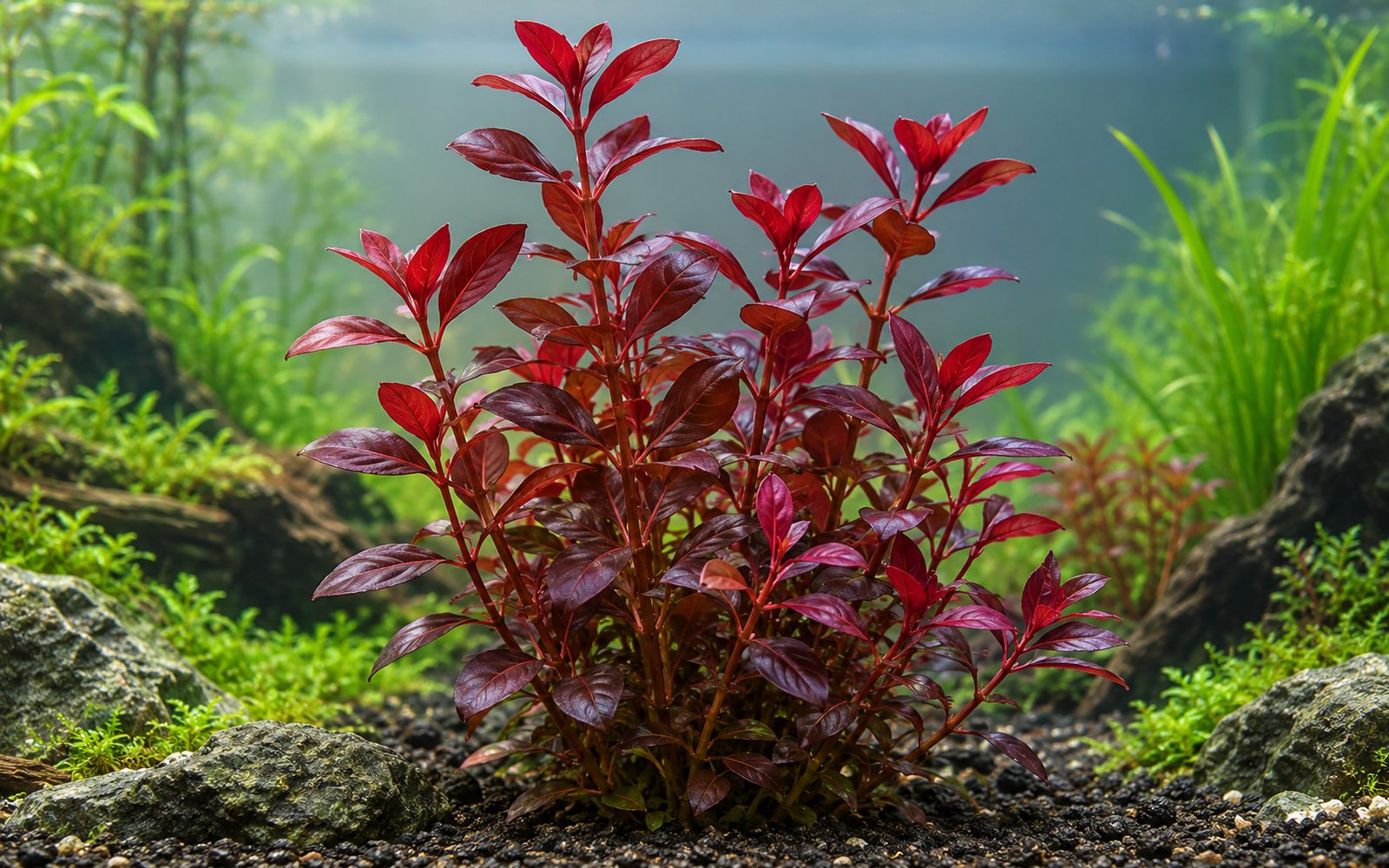
Ludwigia repens 'Rubin' is a deep red form of the well-known Ludwigia repens obtained through selection. While the upper side of the leaf stays green-copper in the wild species, in 'Rubin' both sides are a wine-red tone. It is as hardy as the parent species; it also grows in an aquarium without CO₂, only its color turns a little brownish. It creates a strong color contrast among green-leaved background plants.
Planting and Placement
- The stems are separated one by one, the lower leaf pairs are pinched off and they are buried 3–4 cm deep.
- Leave 2–3 cm between stems; plant in clusters of 5–7 stems.
- It is placed in the background or midground, in an area that gets good light.
Care and Fertilization
- Light: Medium; the darkest color is seen in strong light.
- CO₂: Not required, but beneficial for color and growth.
- Fertilizer: Iron-rich liquid fertilizer supports the red tone; root tabs are also beneficial.
- Trimming: Stems approaching the surface are cut from the top; the cut tops can be replanted.
Propagation
This section has not been written yet. How is it propagated?
Be the first to write it
Common Problems
This section has not been written yet. Problems such as melting, yellowing and algae, and how to fix them.
Be the first to write it
Hobbyist notes
Things you won't find in books, learned by trial and error. The most helpful ones are on top.
No notes yet. If you have experience with this species, leave the first note.
Was this page helpful?
Change history and contributors
- Page created · October 16, 2026