
Water parameters
Overview
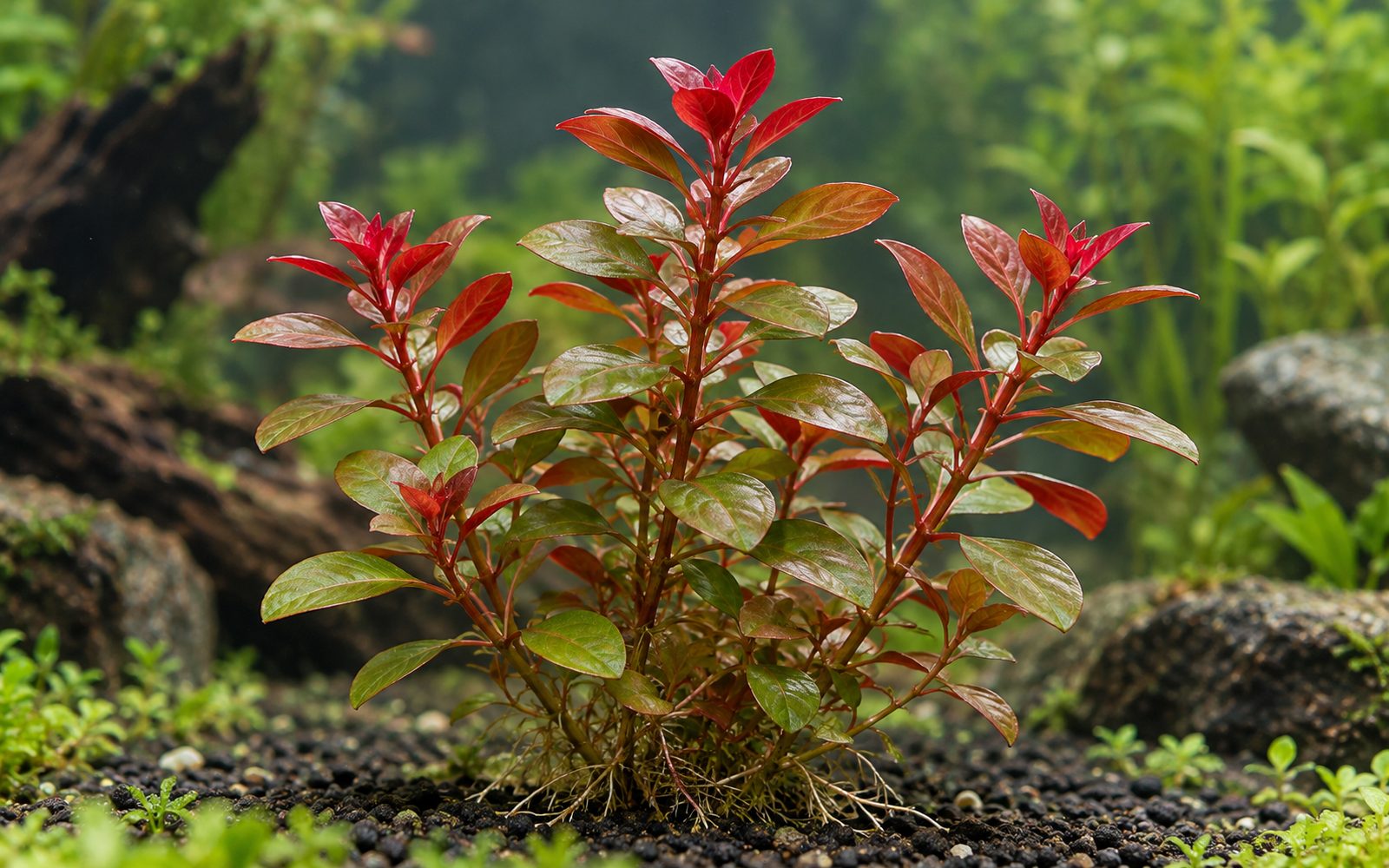
Ludwigia repens is one of the first choices for those who want to start with red stem plants. Its glossy, oval leaves are arranged in opposite pairs; the upper side of the leaf ranges from olive green to copper, and the underside from pink to red. As the light gets stronger, the whole plant turns deep red.
It lives across a wide range of temperature and hardness; it also grows without CO₂, only more slowly and staying greener. Thanks to this hardiness, it is used both in simple aquariums and in CO₂-injected setups. In the trade there are also darker forms such as 'Rubin' and hybrids with L. arcuata.
Planting and Placement
- The stems are separated one by one, the lower leaf pairs are pinched off and they are buried 3–4 cm deep.
- Leave 2–3 cm between stems; plant in clusters in the midground or background.
- It creates a strong color contrast in front of or among green-leaved plants.
Care and Fertilization
- Light: Medium; the red tones come out in strong light.
- CO₂: Not required, but it speeds up growth and deepens the color.
- Fertilizer: Iron-rich liquid fertilizer supports the red color; root tabs are also beneficial.
- Trimming: When the stems approach the surface, they are cut from the top; side shoots grow from the cut point.
Propagation
It is easily propagated from top cuttings. Stems lying on the substrate can root from their nodes and produce new plants; these can be separated and planted elsewhere.
Common Problems
- Lower leaves dropping: Shading or insufficient light; thin out the cluster and renew it with fresh tops.
- Pale green color: Light is weak or iron is lacking.
- Holes and yellowing in the leaves: Usually potassium deficiency; use a balanced liquid fertilizer.
- Spreading horizontally at the water surface: Stems that reach the surface shade the plants below; trim regularly.
Hobbyist notes
Things you won't find in books, learned by trial and error. The most helpful ones are on top.
Change history and contributors
- Page created · October 16, 2026