
Water parameters
Overview
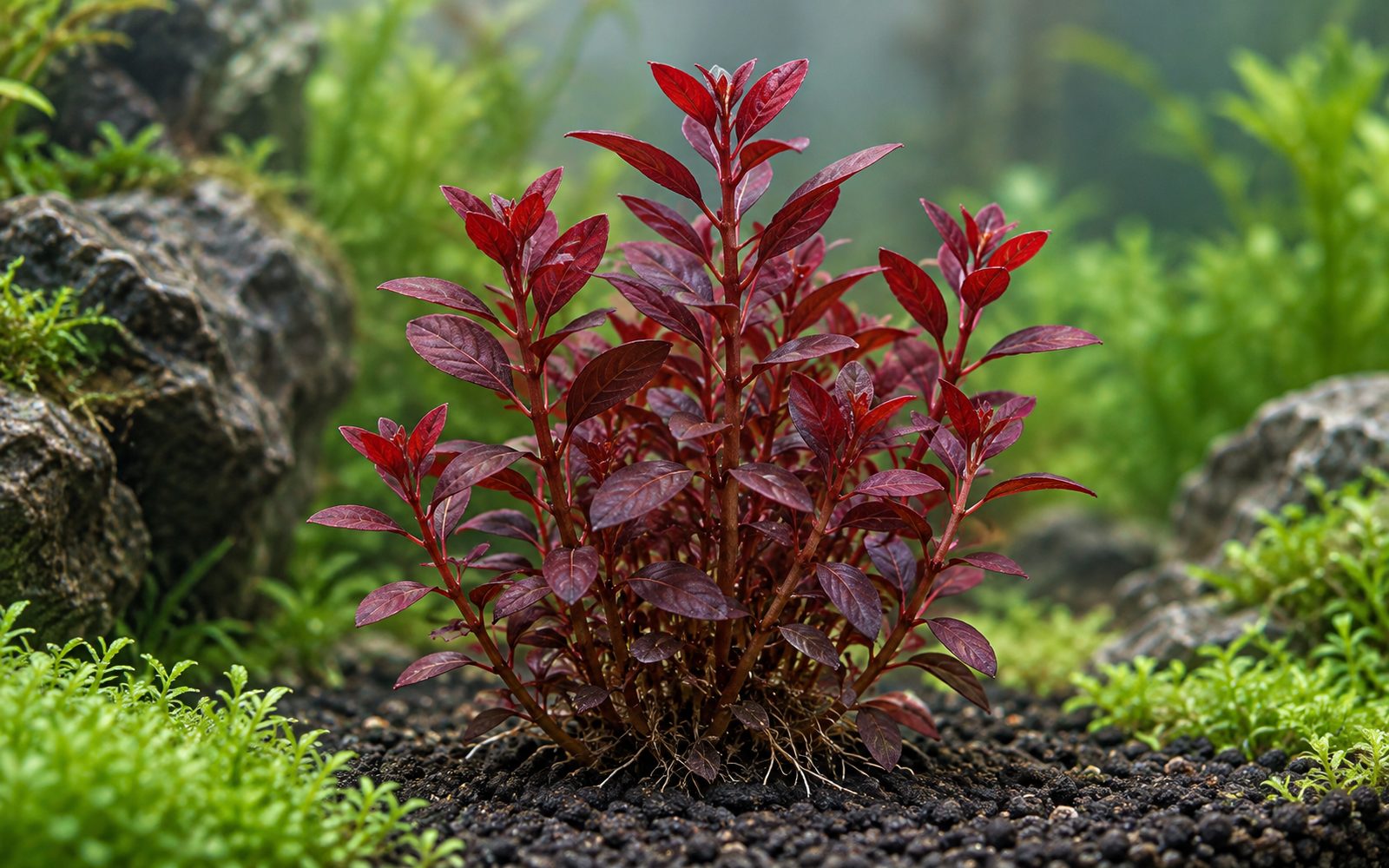
Ludwigia 'Super Red' is a cultivated form selected from marsh ludwigia (Ludwigia palustris). While the leaves of the wild species are mostly a mix of green and red, the leaves of this form are deep burgundy-red on both sides. Its main advantage is that it largely keeps its red color even in medium light, where many red plants turn green.
With its small, oval leaves and closely spaced nodes it stays tidy; because it is shorter than the large ludwigias, it can also be used in the midground. It lives in an aquarium without CO₂, and with CO₂ and strong light its color becomes even deeper.
Planting and Placement
- Stems are planted in bunches of 3–5, leaving 3 cm between bunches.
- The lower leaf pairs are pinched off and the stem is buried about 3 cm deep.
- It is used in the midground as a color focal point next to green stem plants or moss-covered wood.
Care and Fertilization
- Light: Medium light is enough; in strong light the color deepens and the stems become denser.
- CO₂: Not required, but beneficial.
- Fertilizer: Iron supplementation supports the red color; not keeping nitrate too high also helps preserve the color.
- Trimming: It becomes bushier when cut from the top; if trimmed very often, the leaves become smaller, which gives a neat look in the midground.
Propagation
It is propagated by replanting top cuttings. The cut lower stems produce new side shoots; after a few trims, the cluster becomes noticeably denser.
Common Problems
- Color turning brown: Light is weak or iron is low.
- Loss of lower leaves: The cluster was planted too densely; the lower parts are not getting light.
- Stunted new leaves: Nutrient imbalance or an unstable CO₂ level.
- Leaf drop in the first weeks: Emersed leaves from the nursery may drop as the plant transitions underwater; new shoots come in suited to life underwater.
Hobbyist notes
Things you won't find in books, learned by trial and error. The most helpful ones are on top.
Change history and contributors
- Page created · October 16, 2026