
Water parameters
Temperature20–28°C
pH6–7.5
General hardness (GH)2–12 dGH
Recommended range
Overview
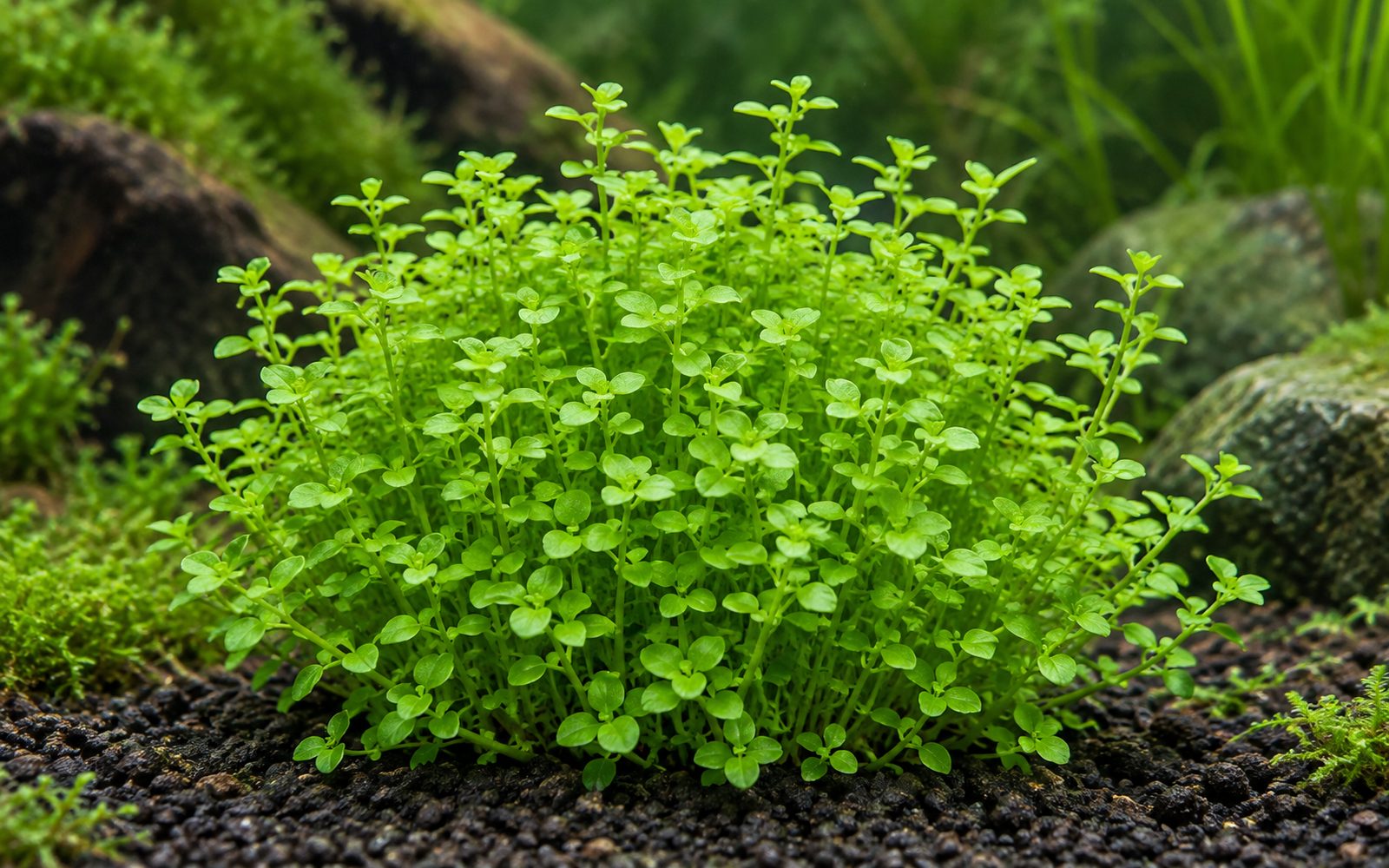
Micranthemum umbrosum is a plant with round, light green leaves from shallow waters in the warm regions of the Americas. Its leaves resemble Monte Carlo but are slightly larger, and instead of spreading across the substrate the plant mostly grows upward, branching densely. When trimmed regularly it forms soft, rounded clumps at the base of stones and driftwood. It is an easy plant; it grows under medium light in an aquarium without CO₂, and with CO₂ it becomes denser and faster.
Planting and Placement
- Plant the stems in small bunches of 3–5, 2 cm apart and 2–3 cm deep.
- It is used in the foreground and midground, at the base of stones, or as a transition plant between carpeting plants and the background.
Care and Fertilization
- Light: Medium; under strong light it stays lower and denser.
- CO₂: Not required, but beneficial.
- Fertilizer: Regular liquid fertilizer; when nutrients are low the leaves turn pale.
- Trimming: Trim it with scissors to shape the clump; thin it out from time to time, since the inside of a clump that gets too thick receives no light and can rot.
Propagation
This section has not been written yet. How is it propagated?
Be the first to write it
Common Problems
This section has not been written yet. Problems such as melting, yellowing and algae, and how to fix them.
Be the first to write it
Hobbyist notes
Things you won't find in books, learned by trial and error. The most helpful ones are on top.
No notes yet. If you have experience with this species, leave the first note.
Was this page helpful?
Change history and contributors
- Page created · October 16, 2026