
Water parameters
Overview
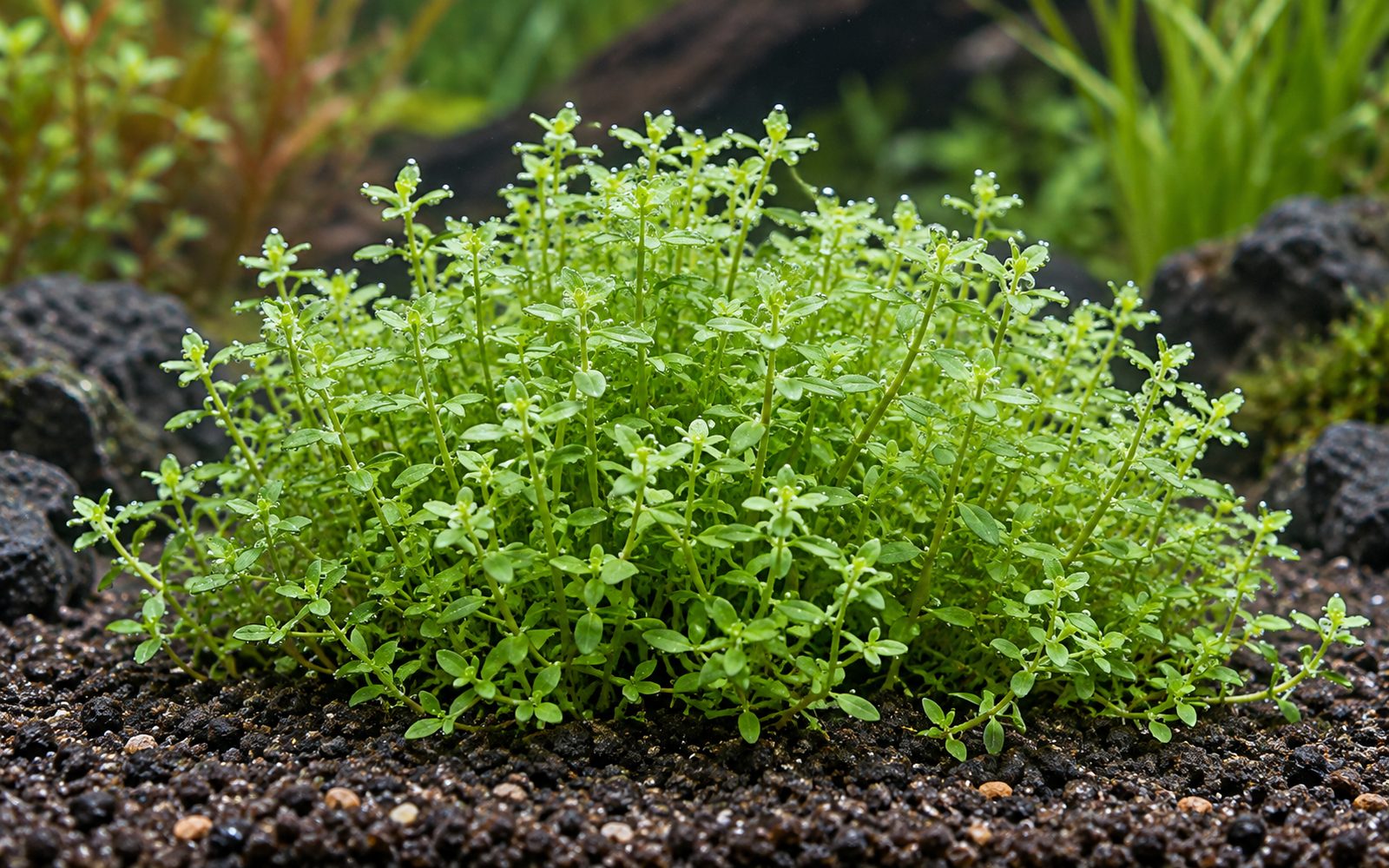
Pearlweed is endemic to Florida; its very small, elongated, light green leaves are arranged in whorls of three or four on thin stems. It gets its name because the oxygen bubbles that collect at the leaf tips when photosynthesis speeds up shine like pearls. In the hobby it was sold for many years as Hemianthus micranthemoides; however, it turned out that most of the plants in the trade are actually H. glomeratus.
It is a flexible plant: left untrimmed, it forms a soft bush 15–20 cm tall with upright stems; trimmed often and low, it becomes a near-carpet covering between the midground and the foreground. It is easier than HC Cuba and Monte Carlo; it grows under medium light in an aquarium without CO₂.
Planting and Placement
- Plant the stems in small bunches of 3–5, leaving 2 cm between bunches.
- Remove the lower leaves and push the thin stems 2–3 cm into the substrate with tweezers.
- It is used at the base of stones and driftwood, as a transition plant between the foreground and the background.
Care and Fertilization
- Light: Medium; under strong light it stays denser and lower.
- CO₂: Not required, but beneficial; the pearling effect is seen most in aquariums with CO₂.
- Fertilizer: Regular liquid fertilizer; when nutrients are low the leaf tips turn pale.
- Trimming: Shape it by trimming the top regularly with scissors. The more often it is trimmed, the bushier it gets.
Propagation
It is easily propagated by replanting the top cuttings. Stems lying on the substrate root from their nodes and spread on their own.
Common Problems
- Inner parts rotting: the inside of a bush kept too dense and thick gets no light; thin it out from time to time.
- Sparse, long stems: light is insufficient.
- Thread algae between the stems: the fine leaves catch algae; a balanced photoperiod and grazing shrimp help.
- Pale new leaves: iron deficiency.
Hobbyist notes
Things you won't find in books, learned by trial and error. The most helpful ones are on top.
Change history and contributors
- Page created · October 16, 2026