
Water parameters
Overview
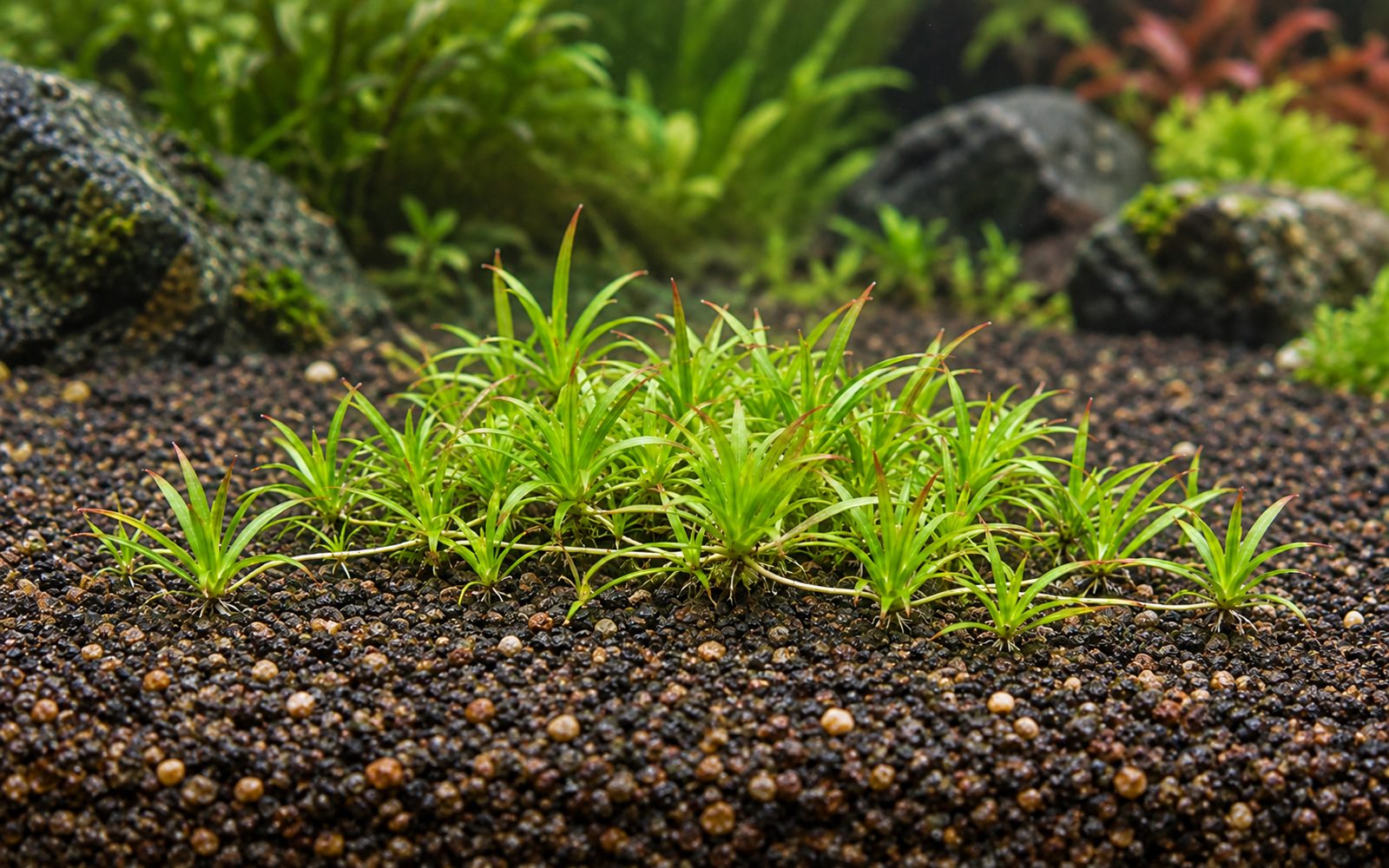
Helanthium tenellum, known for many years as Echinodorus tenellus, is a small relative of the Amazon sword. It forms small rosettes 5–10 cm tall, made of very thin, grass-like leaves. New plants keep appearing at the ends of thin runners stretching between the rosettes, and over time a soft lawn develops in the foreground.
It is an easy plant; it survives and spreads under medium light in an aquarium without CO₂. Under strong light the leaves get shorter and their tips can turn reddish brown. When light is weak, the leaves grow longer and sparser.
Planting and Placement
- Separate the rosettes one by one, trim the roots slightly and plant them 2–3 cm apart.
- The center of the rosette (the crown the leaves grow from) should stay just above the substrate; if buried, it can rot.
- Even sparse planting over a wide area of the foreground is enough; the runners fill the gaps over time.
Care and Fertilization
- Light: Medium; strong light is better for a short, dense lawn.
- CO₂: Not required, but speeds up spreading.
- Fertilizer: As a sword plant, it feeds through its roots; root tabs noticeably boost growth.
- Trimming: Usually not needed. Runners heading in unwanted directions are cut.
Propagation
It multiplies on its own by runners. Once the new plant at the end of a runner has formed a few leaves and roots, the connection to the mother plant can be cut and it can be planted where you want.
Common Problems
- Long, sparse leaves: light is insufficient.
- Yellowing: lack of root nutrients; add root tabs.
- Not spreading: runner formation slows in a very compacted, nutrient-poor substrate.
- Leaf loss in the first weeks: can occur in emersed-grown plants while the leaves are being replaced.
Hobbyist notes
Things you won't find in books, learned by trial and error. The most helpful ones are on top.
Change history and contributors
- Page created · October 16, 2026