
Water parameters
Overview
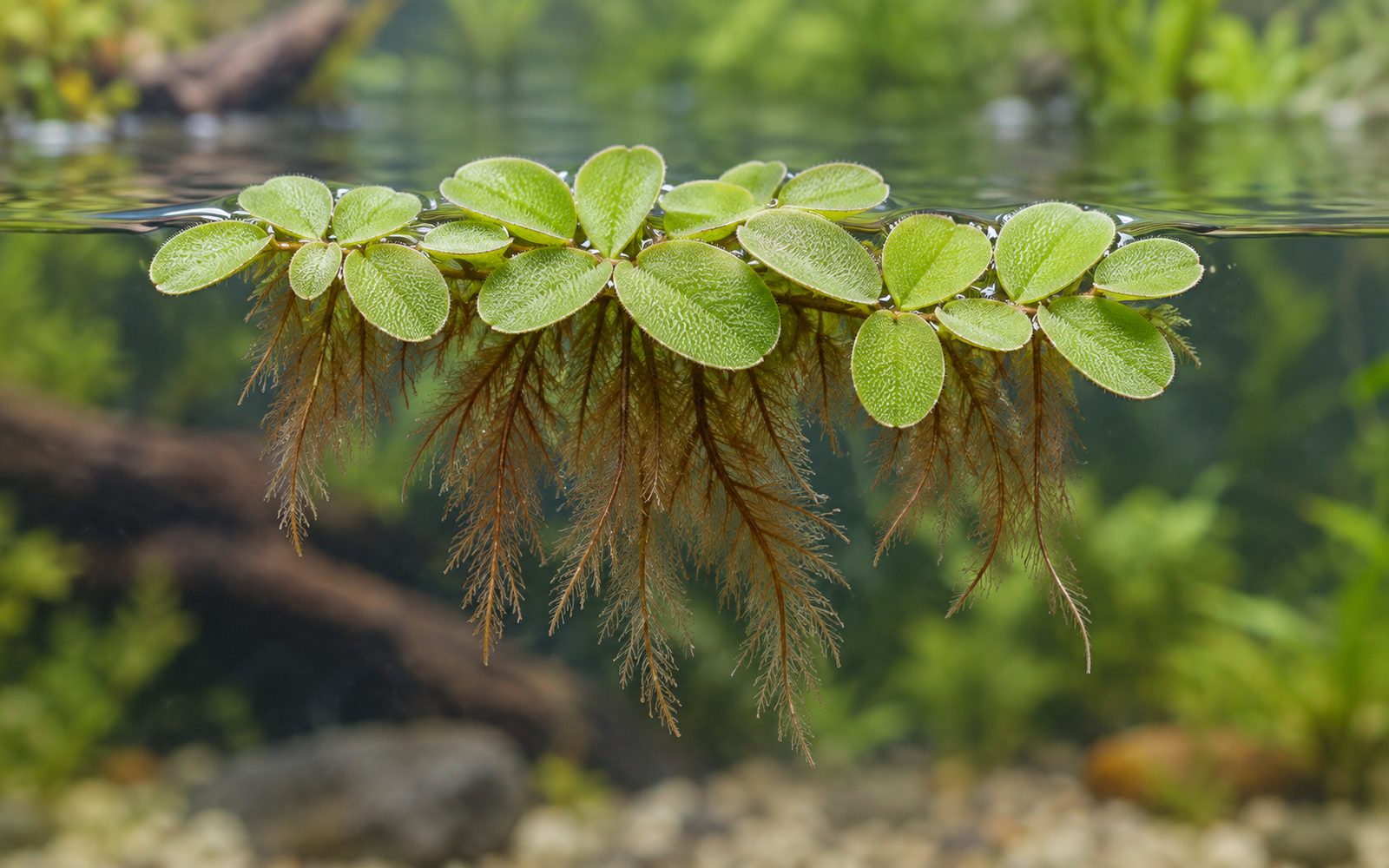
Salvinia is a small fern with no true roots that lives on the water surface. Oval, light green leaves 1–1.5 cm long are arranged in pairs on a floating stem. The upper surface of the leaves is covered with fine water-repellent hairs; thanks to these the leaf does not get wet and does not sink. The brown, hairy "roots" that hang down into the water are actually a third leaf adapted to the water.
It multiplies fast and competes with algae by using up excess nitrogen and phosphate in the water. It is useful for fish that want shade at the surface (bettas, gouramis, dwarf cichlids) and for fry aquariums.
Caution: Giant salvinia (Salvinia molesta), with which it is occasionally confused in the trade, is one of the world's most invasive aquatic plants and is on the EU's list of banned invasive species. No salvinia species should ever be thrown into natural waters.
Planting and Placement
It is not planted; it is placed on the water surface. To keep part of the surface free, it can be confined with an airline tube or a floating ring (a hoop made from plastic tubing or fishing line).
Care and Fertilization
- Light: Moderate. If it is too close to the light and condensation collects under the lid, the leaves can burn or rot.
- CO₂: Not required; it uses CO₂ from the air.
- Flow: It does not like strong surface movement; calm areas are ideal.
- Thinning: Remove the excess plants with a net once a week and do not let it cover more than half of the surface; a fully covered surface cuts off light to the plants below.
- Season: It is a temperate-climate species; it may weaken in very warm aquariums (above 26°C).
Propagation
It reproduces as the stem breaks apart on its own; each piece becomes a new plant. Under suitable conditions it can cover the surface within a few weeks, so thinning is needed far more than propagation.
Common Problems
- Yellowing or darkening leaves: condensation droplets under the lid, a light that is too hot, or nutrient deficiency (especially iron and potassium).
- Shrinking leaves: nutrients have run out; if many plants are competing, thin them out or add liquid fertilizer.
- Covering the surface completely: thin it regularly; throw the excess in the trash and never release it into the wild.
Hobbyist notes
Things you won't find in books, learned by trial and error. The most helpful ones are on top.
Change history and contributors
- Page created · October 16, 2026