
Water parameters
Overview
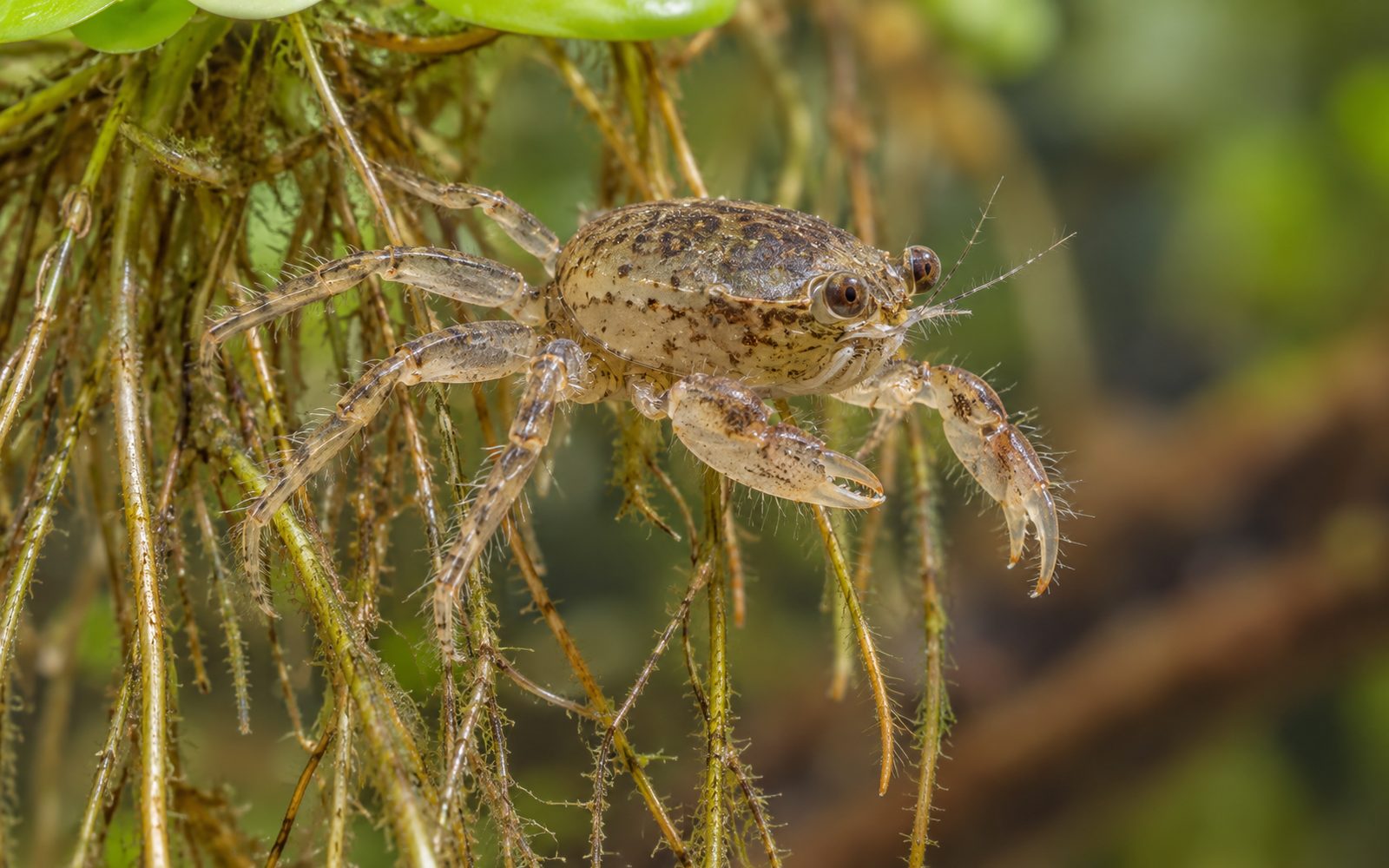
The Thai micro crab is one of the smallest crabs kept in aquariums: its shell is about 1 cm and its leg span around 2 cm. With its semi-transparent, gray-brown body and long legs covered in fine hairs, it resembles a spider.
Unlike most crabs, it lives entirely in water; it does not need to come out onto land, so it can be kept in a normal aquarium. It is not a predator but a peaceful filter feeder. However, because it is very small and likes to hide, it is usually not visible in the aquarium.
Natural Habitat
It lives in the rivers of central Thailand, especially among the hanging roots of floating plants such as water hyacinth. The roots serve both as a hiding place and as a sieve where food particles collect.
Tank Setup
- Volume: 20 liters or more for a small group; a mature aquarium with established biofilm.
- Floating plants: Floating plants with long roots (Limnobium, Pistia, Salvinia) are the most important element.
- Hiding places: Moss, roots and small piles of stones.
- Filter: A sponge filter; protect the intake of a powered filter with a sponge, or it may be sucked in.
- Water: 24–27°C, around neutral, soft to moderately hard. Products containing copper are deadly.
Diet
It collects particles and biofilm from the water with the fine hairs on its legs. In addition, shrimp powder, finely ground food and spirulina are sprinkled into the water; it also eats small sinking pieces of food. In aquariums with many fish it may not be able to reach the food; leaving part of the food near the roots where the crabs are helps.
Behavior and Compatibility
Completely peaceful; it does not harm fish, shrimp, snails or plants. It is shy and spends most of the day among the roots and moss.
Good companions: Neocaridina and Caridina shrimp, nerite snails, otocinclus, very small peaceful fish (Boraras, small rasboras).
Avoid: Any fish it fits into the mouth of (bettas, gouramis, cichlids), crayfish, large shrimp.
Group and Colony Structure
It is more relaxed and visible in small groups. At least 3, preferably 5–6 individuals are recommended. They are not aggressive toward each other and share the same bunch of roots without problems. Because it does not breed in the aquarium, the number does not increase on its own; losses are made up with new individuals.
Breeding
Females may occasionally carry eggs, but the free-swimming larvae do not survive in aquarium conditions, and no reliable breeding method is known. Most individuals for sale are collected from the wild.
Health and Common Problems
- Starvation: The most common cause of loss; provide enough biofilm and powdered food.
- Shipping stress: Acclimate slowly using the drip method.
- Poisoning: Copper and many antiparasitic medications are deadly.
Sexing
Sex is determined by looking at the abdominal flap: in females it is wide and rounded, in males narrow and roughly triangular. In this species it can only be seen up close because the crab is so small.
Tank mates
This list is calculated automatically from the species profile and grows as new species are added to the catalog. Try it in the planner for a definite answer.
Usually compatible









Hobbyist notes
Things you won't find in books, learned by trial and error. The most helpful ones are on top.
Change history and contributors
- Page created · October 16, 2026